The Radioddity Nodara is an upcoming, highly anticipated off-grid mesh communication device built for the LoRa network. Developed by Radioddity primarily as an official Meshtastic radio, its robust hardware has captured the attention of the MeshCore community. The device features an ultra-low-power Nordic nRF52840 MCU, an efficient SX1262 LoRa module, and an E-ink display, all housed in a military-grade, IP67 waterproof rugged enclosure.
While natively built for Meshtastic, the hardware is a prime target for MeshCore firmware. Unlike standard packet-flooding protocols, MeshCore utilizes intelligent, point-to-point path routing optimized for large mesh networks. Community developers have already successfully ported the alternative firmware to Nodara prototypes, confirming excellent hardware compatibility.
Official MeshCore support for the Radioddity Nodara is currently in active development. Once the public firmware build is officially released, this hardware will provide a durable, standalone alternative to existing MeshCore devices like the Lilygo T-Deck. It will offer users a reliable, tactical solution for decentralised text messaging without relying on cellular infrastructure.
Radioddity kindly sent me one of the devices to provide feedback on before it is released. I gave them my feedback and they allowed me to give you a sneak preview prior to it’s release.
Radioditty sent the new GS-10B Pro to me before it was released as they wanted you to see it first. When sending it, they never told me what to say, only to review it. So below is what I honestly experienced.
This handheld radio is not only dualband UHF, VHF radio, it also receives HF, single sideband, and CW. It has a waterfall display as well, plus a load of other goodies which I hadn’t seen in a handheld before. So, let’s have a look.
Some of the things this radio includes is a realtime spectrum display, which is the same as a waterfall. It’s got full HF, single sideband and CW reception. It’s an all band scanner receiver that covers most of UHF, VHF, HF, airband, and FM radio stations. It also connects to the weather station if you have them in your country.
It has two SMA connectors on the top. One that does for UHF and VHF and the other one is for the donut antennas that’s supplied which I will look at soon. You can program the radio either via computer or even by your mobile phone or direct input or each frequency. The direct option is a lot easier than has been before as the menu seems a lot better.
It has a 250 milliamp rechargeable battery that can be charged using USB-C cord and it has dual PTT and dual watch as well.
The 1.77 inch color screen is fantastic especially for the waterfall and I love the display how it shows not only the frequency the frequency name and the channel number when in memory mode it shows a whole lot more like signal strength and all sorts of things.
This upgraded PRO model has 999 channels, so you can store a lot more in there than you ever have before. It can transmit on the normal VHF and UHF bands, but it will also receive right down to 150 kHz.
Looking at the radio itself, the speaker is behind the keypad, which gives the radio a little bit more real estate.
They got quite a lot of menus in the radio making it a lot more functional. I have done a video below on this, which I receomend you watch it.
As an example, menu item 32 is autolock. So you can change that to how many seconds.
So one of the things you might like to do is to listen to HF. So how do you do that? If you go into the menu and I’m going to go to menu 2 4 (which takes me to menu 24). This menu item is where you program what the PF3 key is. I’m going to make sure that that is set to radio, then press confirm. So then if I press this PF3, it’ll go to radio. The next thing you should do is change the antenna to the donut antenna.
Take off the VHF/UHF antenna and next to it is a knob that screws off to reviel where you attach the donut antenna. You can plug in an external antenna if you like.
When listening to HF, if you press and hold down the home key, you get a waterfall right across the band.
The Radioddity GS-10B Pro is a high-power 8W handheld ham radio designed for long-range communication. At the time of this video, it had not been released yet. This new radio is built as an upgraded version of the popular tri-band radio, however, this portable transceiver features a real-time spectrum analyser (waterfall display) on a 1.77-inch color display, allowing you to instantly scan, view, and locate active frequencies in your area. Its precious model without all the extras is widely used by amateur radio operators for satellite communication, emergency readiness, and Parks on the Air (POTA) activations.
This handheld radio has advanced shortwave listening. The GS-10B Pro handheld transceiver includes wideband HF monitoring with SSB (Single Sideband) and CW modes. Unlike standard analog radios, it has a dual-antenna path system with two SMA ports to keep high-frequency and VHF/UHF signals clear and separate. It also comes with two donut antennas.
To make setup simple, the radio features built-in Bluetooth wireless programming, so you can easily configure channels, update your codeplug, and manage repeater offsets directly from an Android or iOS smartphone app without a computer programming cable.
The hardware is optimized for survival gear and off-grid use, with a 2500mAh USB-C rechargeable battery that supports 2A fast charging. It comes equipped with dual PTT (Push-to-Talk) switches for seamless dual-band monitoring and an extra physical channel knob for quick frequency tuning. If you are buying your first ham radio or looking for a budget-friendly backup radio, custom noise reduction, and standard Kenwood 2-pin accessories.
The Baofeng UV-29 Pro is a powerful dual-band handheld radio designed for amateur radio operators, outdoor activities, emergency communications and general VHF/UHF radio use. With up to 10 watts of transmit power, a large battery and a range of useful features, the UV-29 Pro offers more power and functionality than many basic handheld ham radios.…
In 2026, Baofeng celebrates 25 years as one of the world’s best-known manufacturers of affordable two-way radios. Founded in 2001 as Fujian Baofeng Electronics Co., Ltd., the company has grown from a small Chinese radio manufacturer into a global brand supplying handheld radios for amateur radio operators, emergency communications, outdoor activities, security, and commercial users.…
One day I was checking the bands and noticed the 17m band is open for a short period. I have noticed this over a long period that it often opens and provides reliable DX contacts at a similar time each day. I often could clearly hear operators who were midway through conversation, then suddenly the…
Radioditty sent the new GS-10B Pro to me before it was released as they wanted you to see it first. When sending it, they never told me what to say, only to review it. So below is what I honestly experienced. This handheld radio is not only dualband UHF, VHF radio, it also receives HF,…
CW Skimmer is a popular amateur radio software program used for decoding Morse code signals on the HF bands. The program is widely used by ham radio operators, DX chasers, and contest stations because it can monitor and decode many CW signals at the same time. Unlike traditional Morse code listening, CW Skimmer displays signals…
The 15 metre band is one of the most popular HF amateur radio bands for long-distance communication, offering an excellent balance between reliability and worldwide reach. Frequency Range The standard frequency range for the 15m band is 21.000 MHz to 21.450 MHz. Within this range, different segments are commonly used for specific modes: CW (Morse…
Maximum Usable Frequency (MUF) is an important concept in HF radio propagation and amateur radio communications. It refers to the highest frequency that can be used for reliable communication between two locations by reflecting off the ionosphere. If a radio signal is transmitted above the MUF, it will not return to Earth and will instead…
The Baofeng UV-5R Mini handheld radio is a popular and affordable dual-band amateur radio transceiver widely used by beginners and experienced ham radio operators. Designed as a compact version of the original UV-5R, this small and lightweight VHF/UHF walkie talkie offers solid performance for everyday communication, making it a common choice for those getting started…
HF radio and lightning storms are closely connected because lightning creates strong radio frequency interference that affects HF radio communication (3–30 MHz). High Frequency radio is commonly used for amateur radio (ham radio), marine radio, aviation HF communication, emergency communications, and long-distance shortwave listening. HF signals travel long distances by reflecting off the ionosphere, which…
OpenHamClock is an open-source amateur radio dashboard designed as a modern successor to the original HamClock used by radio amateurs worldwide. It provides a real-time visual display of essential ham radio propagation data, world clocks, DX activity, and space weather information in a single, easy-to-read interface. Built with modern web technology, OpenHamClock runs in any…
The Radtel P8 PoC radio is a Push-to-Talk over Cellular (PoC) device that looks like a traditional walkie-talkie but communicates using 4G/LTE mobile networks instead of UHF/VHF radio frequencies. This means its effective range is not limited to a few kilometres like standard two-way radios, but instead depends on cellular coverage, allowing communication across cities,…
An antenna coupler (also called an antenna tuner or matching network) is a device used in radio systems to ensure impedance matching between a transmitter and an antenna. Most transmitters are designed for a specific impedance, commonly 50 ohms, while antennas often vary depending on frequency and design. When the impedance is not matched, reflected…
Amateur radio operators use many different antenna types, each designed for specific bands, space limits, and operating goals. Here’s a clear overview of the most common ones and why hams choose them. Wire Antennas These are some of the simplest and most popular antennas that include: Dipole Antennas Two equal wire sections fed in the…
A dipole antenna is a basic radio antenna made of two conductive elements fed at the center. It is typically a half-wavelength long and is widely used as a reference antenna in antenna theory and practice. Dipole antennas work by converting alternating current into electromagnetic waves. Their radiation pattern is strongest perpendicular to the antenna…
Interference in Amateur Radio refers to unwanted signals that disrupt radio communication. This interference can reduce signal clarity, make contacts difficult, or completely block communication between amateur radio operators. Radio Frequency Interference (RFI) is one of the most common problems in amateur radio. It often comes from man-made electronic devices such as phone chargers, computers,…
I’ve been using the Parks and Peaks app on iphone and ipad for a little while now and quite enjoyed it. There don’t seem to be many iphone apps compared to android, so when there is one, I usually have a look. This one caught my eye as it was not only free, but useful.
After using it for a while, I contacted the author of the app, Sue Southcott, VK5AYL where she was thrilled that I would do a review on this free app, and provided me with a bit more information about her and the app.
The current version is for iphone only at this stage, but I think there are plans to expand this. It allows users to Spot, Alert and export in ADIF and or spreadsheet format.
The app also allows users to search for sites including parks, peaks and silos by site ID. Or you can search by partial site name or by using the inbuilt map.
Setting up the map and connecting site data by longitude/latitude co-ordinates has been Sue’s favourite part. Sue said “I already had the experience of connecting data to mapping systems during my career.
The following awards are handled – WWFF, SOTA, HEMA, IOTA, KRMNPA, SANPCPA, SIOTA, SHIRES, ZLOTA & POTA.
Parks & Peaks is an Australian website that collects data from Amateur Radio operators who get out of their shacks and operate their radios portable in parks or on peaks. It also collects data from those who Spot them.
AU/NZ sites can be downloaded to the device for use when there is no network available.
It will also produce multiple logs for one activation, so if you are on a Summit in a WWFF Park with a Pota reference, you will get 3 logs, one for SOTA, one for WWFF and one for POTA.
There is also a quick way to log activators as I show in the video below.
About Sue VK5AYL….
Sue has had her Advanced Amateur licence for a very long time and it led to her decision to study IT back in the 80s.
For over 30 years, she had a successful career as an IT Manager, Analyst/Programmer, TAFE Lecturer and even my own software business, contracting to many organisations.
Most of her work involved working on client/server applications for large businesses.
In 2014, Sue decided to learn how to write an iOS app and along came Parks & Peaks, which gave me something to work on. After purchasing a Mac Pro Sue had to learn how to use it very quickly, along with the new Apple language.
In 2015, Sue presented version 1 to the WIA AGM in SA. Since then, Sue has released versions 2 and 3 and compared to version 1, they had many more features. Sue told me she loved every minute of developing the app as it has been a massive challenge and allowed her to continue with my love of programming.
Why not have a look at my video on this app where you can see it in full operation:
If you enjoyed that read, please remember to like and subscribe so you get updates as they happen. Below are some more reads you may enjoy from this site:
Orion is an app that isn’t really known in my world, perhaps because it isn’t available on all platforms, or because it does transmit your exact location to everyone on the channel.…
There are several website that tell you what bands are open in your area. Most people paste them on their QRZ page, but there are some examples below that update every hour.…
I’ve been using EchoLink well before smartphones where the only way I knew how to connect to a different station was via the radio. The internet wasn’t as extensive as it is…
The Retevis RT73 and Kydera CDR300UV are identical radios. They are a DMR/FM duel band radio for Amateur radio use. This is great, as most of the early DMR radios available were…
I recently got my hands on a new Baofeng UV-17R Plus Series radio. It didn’t take long at all to arrive and was not expensive at all. People these days pay more…
As per the Yaesu FT-710 manual, the Digital Noise Reduction (DNR) system is designed to reduce the level of ambient noise found on the HF and 50 MHz bands. The (DNR) system…
I recently got the Radioddity M916 Heavy duty antenna magnetic mound with the Radioditty HF-008 all band portable antenna. I had always wanted to use HF more while camping or going on…
The first thing I noticed after receiving the radio was the size of the radio. It is small yet not to small that it is hard to use. It fits comfortably in…
CBL-561 Review The new CBL-561 antenna is strong and light that is fit for mobile work, camping or remote radio use. I plan to use this on our next outback trip! This…
I’ve been using EchoLink well before smartphones where the only way I knew how to connect to a different station was via the radio. The internet wasn’t as extensive as it is now and you had to dial the node you wanted via the radio. You can still do this today but I don’t think anywhere near as many do it.
I always felt EchoLink was well ahead of its time. Started well before any digital radio was thought of. Connecting the world via the internet.
It was great to be able to talk to the UK or States while mobile on the way to work just using a small whip antenna on the car.
Given I’m in Australia, it can be difficult to remember when overseas nets are on, or what part of the world is awake and up for a chat and which ones are not. But EchoLink has a CQ feature.
Calling CQ
EchoLink had a CQ feature where you can call CQ and it will automatically connect to someone who is calling CQ also.
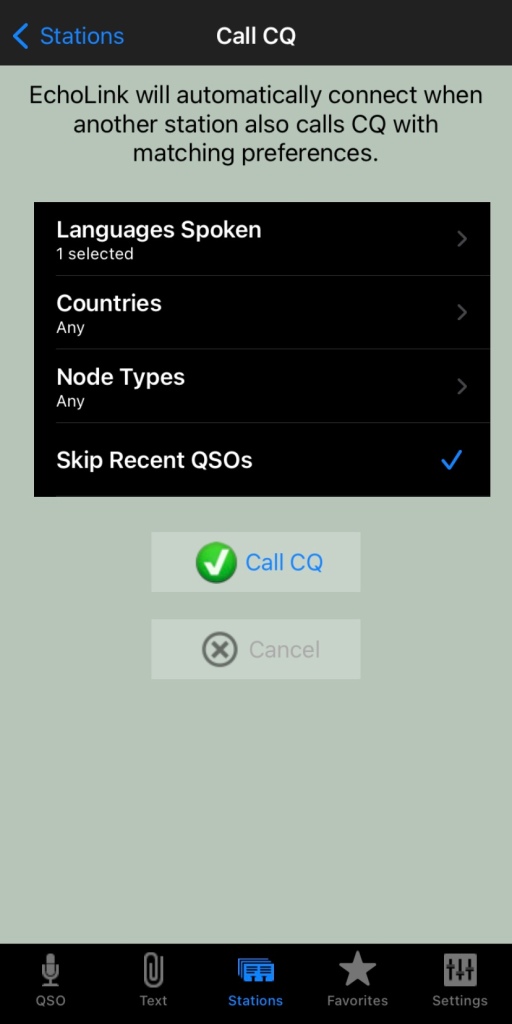
From the Stations screen select call CQ.
Then select your language.
Select the country, if you leave it as any, you will not limit your connection options
Select the node type, again, leave as any to start with
And you can skip recent if you want to.
Then press Call CQ
It will call CQ for a while searching for a connection that matches your settings. I find that sometimes it tries to connect to another node but can fail. This is perhaps because the connection drops out for whatever reason. Just try again.
The good thing about this option is you will get someone who is wanting to talk to someone just like you do!
What is your experience with EchoLink? What is your favourite nodes? Why don’t you put it in the comments below so we can all learn from your experiences.
The Radioddity Nodara is an upcoming, highly anticipated off-grid mesh communication device built for the LoRa network. Developed by Radioddity primarily as an official Meshtastic radio, its robust hardware has captured the attention of the…
The Baofeng UV-29 Pro is a powerful dual-band handheld radio designed for amateur radio operators, outdoor activities, emergency communications and general VHF/UHF radio use. With up to 10 watts of transmit power, a large battery…
In 2026, Baofeng celebrates 25 years as one of the world’s best-known manufacturers of affordable two-way radios. Founded in 2001 as Fujian Baofeng Electronics Co., Ltd., the company has grown from a small Chinese radio…
One day I was checking the bands and noticed the 17m band is open for a short period. I have noticed this over a long period that it often opens and provides reliable DX contacts…
Radioditty sent the new GS-10B Pro to me before it was released as they wanted you to see it first. When sending it, they never told me what to say, only to review it. So…
CW Skimmer is a popular amateur radio software program used for decoding Morse code signals on the HF bands. The program is widely used by ham radio operators, DX chasers, and contest stations because it…
ADIF Master is a popular amateur radio logging software tool used for editing and managing ADIF log files. ADIF stands for Amateur Data Interchange Format, which is the worldwide standard used by ham radio operators…
The 15 metre band is one of the most popular HF amateur radio bands for long-distance communication, offering an excellent balance between reliability and worldwide reach. Frequency Range The standard frequency range for the 15m…
The AOR AR1000XLT is a popular wideband scanner receiver that became well known among radio enthusiasts, amateur radio operators, aviation listeners, and shortwave hobbyists during the late 1980s and early 1990s. The scanner was designed…
Maximum Usable Frequency (MUF) is an important concept in HF radio propagation and amateur radio communications. It refers to the highest frequency that can be used for reliable communication between two locations by reflecting off…
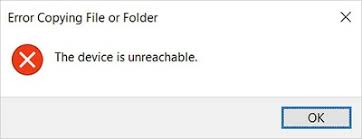
I get the “Device is unreachable” Error message when trying to import media from iPhone to Windows 10 PC. This was not extreemly fustrating as we had just completed an outback trip through Australia, but couldn’t get the photo’s saved when returning home.
Error Copying File or Folder – The device is unreachable
Error I got on my PC when copying files from an apple device
While trying to import photos and video from your iPhone onto your PC, I kept getting an error message.
I would go to the My-PC/AppleiPhone (or Ipad)/DCIM folder and locate the media I wanted to import. And get the “Device is unreachable” error.
Then I would attempt to copy and paste the media into a folder on the desktop. I got the error message “Device is unreachable” still.
However I was able to fix this problem by simply changing a setting on my apple device. If you have the same problem, go to Settings/Photos and scroll down to “Transfer to Mac or PC.” Change it to “Keep Originals”, not “Automatic.” This simple change in the setting solved my problem!
Further Read:
Thanks for visiting my post, I hope it helped you. Please give us a comment below if it did.
Below are some of our posts that are similar that may interest you also:
An unusual name, but a catchy name no less, just like Peanut that was written by the same person, David PA7LIM. If you like Peanut, then you will like this project also. This project, like Peanut, includes some amazing coding and thinking.…
I found it hard to find useful information on how to run the OpenGD-77 hotpot mode with Windows 10. At the time of writing this, there is a lot about this topic using a pistar and even android or ISO, but not much with Windows 10. This is my experence with BlueDV and Open GD-77 using a Windows 10 PC.…
I recently started using ProScan after years of using FreeScan. I have always enjoyed using FreeScan as it is easy to setup, I can download outputs from the software, and the main reason “it works”. However ProScan seems to be more graphical and has different features also.…
I recently started using ProScan after years of using FreeScan. I have always enjoyed using FreeScan as it is easy to setup, I can download outputs from the software, and the main reason “it works”. However ProScan seems to be more graphical and has different features also.…