DMR Explained

With digital radio changing so quickly, below is a bit of an update in regards to DMR radio networks.

DMR stands for Digital Mobile Radio and is an internation standard for digital radios since about 2005. It can contain voice and data. It was created as a standard so it remained low cost and could be used and made by any country.

DMR was designs with three tires where tire 3 is usually for trunked radio networks, however this didn’t start until about 2012. DMR is used between 30MHz and 1GHz

DMR uses 12.5 channel spacing but had two voice channels per frequency. This is done by having the two voice channels on two different time slots. In very basic terms, the radio will listen to 30ms of each time slot and only play the selected one. This means you will miss every second 30 millisecond, but as this is so short, you wouldn’t notice any of the voice missing unless the signal is weak.

Within each time slot, you can have talk groups. So, if you are not on the right frequency, time slot and talk group, you may not hear anything or be heard.

DMR Conventional

This can be either DMR Duplex (as in a base repeater) or DMR Simplex ( where uses talk direct to each other without a repeater). Radios can be lower in transmission power, and best suited to individuals or companies in outdoor recreation, small business, or other applications that do not require a lot of radio users and wide-area coverage. However a repeater can be used to widen the range of a DMR network.

DMR Capacity Plus

This is a single site network, is one with no central control channel. All radios on this system scan each frequency at that site continually. There is a maximum 6 frequencies / 12 channels (tier 1 and 2). This could be a Motorola Solutions Cap+ network, PA People Cap+ network and so on. There can be up to 1600 users per site.

Occasionally you will come across a 1 frequency Cap+ site with no second frequency. However single frequency DMR Capacity Plus systems are often preferred to standard conventional because of the following reasons:

  • Capacity. You can easily have 4-6 talk groups on a single repeater.
  • System wide All Call. You can easily contact every radio when doing a capacity plus all-call if their radio is on and in range.
  • System wide Private Call. You can easily connect to your private call recipient if their radio is on and in range.
  • System wide radio ping and disable. A radio ping can ping a users radio to see if it is on and in range.
  • With Conventional DMR you must be on the right slot and correct talk group in order to do any of the above.

DMR Connect Plus

This is a multi-site Trunked linked by IP and has a centralised control channel. An example of this is the Orion Network commenced in Australia in 2010 with Connect Plus. Also they started the Orion CapMax Tier 3 in 2019, the longer term aim is to move all Connect Plus users over to CapMax Tier 3 and eventually shut down the Connect Plus network. This has already happened in Queensland.
An example is the Orion Con+ on DSD (Site 1-XX).

DMR Capacity Max Tier 3

This is a multi-site Trunked with a centralised control channel with advanced radio features (integrated data applications such as GPS services, text messaging, data services and dispatch console capability). Examples include the Orion CapMax on DSD (Site H2-XXX).
Please let me know what your thoughts about this are. Did it help you? Is there something else you want to know?


If you enjoyed this, below are some other posts you may enjoy also:

  • Olivia Digital Mode MFSK
    Yes, this popular girl name is actually an Amateur Radio term. Christian, DK8EW, put me onto Olivia after we chatted on VARA HF. I had heard about Olivia before, but he encouraged me to give…
  • FreeDV
    I came across something different, FreeDV. The name FreeDV insinuates it is free, but is it? What is it? And what does it do? They say it will be the new SSB of radio. They…
  • HamClock
    HamClock has always fascinated me, as it seems such an amazing program specifically set up for Amateur Radio. I have seen countless videos on it but the draw back was always needing to have a…
  • NanoVNA H4 USB Control to PC
    If you haven’t seen my previous blog on the NanoVNA Analyser, then I suggest you look at that first before reading this blog. This one will talk about how to connect your NanoVNA to your…
  • Flrig
    Flrig is a transceiver control program designed to be used either stand alone or as an adjunct to fldigi (see my review on this). The supported transceivers all have some degree of CAT. The flrig…
  • VARA – VARAC
    Ever heard this sound on HF / VHF / UHF? I know I have more and more recently. After a bit of research, someone told me it was VARAC. https://www.varac-hamradio.com/ As I understand it, the…
  • DXHeat.com
    DXHeat.com is a great website that can update you the current conditions on each band. The website has filtering of incoming DX Spots which can be displayed instantly using great graphical tools. From the main…
  • EchoLink CQ
    I’ve been using EchoLink well before smartphones where the only way I knew how to connect to a different station was via the radio. The internet wasn’t as extensive as it is now and you…
  • NetTime
    When using digital over the radio, it is particularly important you have the correct time. Even a second out will stop you from making contacts. I relied on Windows to update the time and got…
  • GD-77 Won’t connect to PC
    I have been using my Radioddity now for some years and love it.  Though upgrading this to the OpenGD77 opened a whole new world and it gets better all the time. One issue I had…
  • DudeStar
    Here is a free windows program that will connect your PC to: DMR Yaesu Fusion DStar M17 P25 NXDN You can do all this without needing to purchase a radio. I prefer to use a…

RH1 Radio Cup Holder

Why does a radio need a cup holder? I agree it’s a bit odd. But this isn’t a product that involves a cup. Rather it uses a cup holder.

Almost every car now has a cup holder, but they are all different sizes and locations in the car. Some are large for bottles, others are small for a small coffee. Some are in the door, others are in the centre console of the car, while others are half under the dashboard. Unless it is the same model car, they all seem to be a bit different.

One thing I’ve noticed is a cup holder is never the same size as a hand held radio. What are they thinking! As a radio operator you would think they would build cars to house our radios! Seriously though, cars hardly have any space for much extra.

My current car has almost no space to mount a radio at all. I have a radio that has all the controls on the microphone because of this. I also have a hand held radio that sits on the center console between the two front seats. But this is far from ideal as if I have to brake suddenly, the radio goes flying. Not ideal!

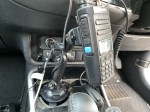
I saw this cup holder radio bracket that is adjustable and fits into a cup holder. It is very adjustable and fits sturdily into a cup or bottle holder.

At the top of the swivel, you can attach a fixture to attach any hand held radio via its belt clip or attach a small remote head radio via its bracket.

Once it is all secured, it works well. Now I have a hand held radio in my car, that doesn’t move around the car. It’s legal and sturdy plus I can see the screen when driving.

The other advantage of this device, apart from how easy it is to install and how versatile it is, was how easy it is to remove. So if I’m in the car for the day, or a year, I can take it out when I am done and return the car the way I found it.

Installing

Here are some quick steps how to install this device.

  • After unpacking the box, get the RH1 cup holder.
  • Attach the Angle-Adjusted Connector to the top.
  • Attach the Handheld radio holder to the Angle Adjustment Connector. Alternatively, you can attach your radio attachment plate to the Angle Adjustment Connector if using a remote head radio or light weight radio.
  • Place the RH1 in your cup holder and twist so it expands to a firm fit in the car.
  • Adjust all the available angles from the bottom up to your desired location, then tighten each angle once set. Make sure it does not obstruct you driving the car or your view.
  • Attach your radio
  • Start using your radio!

Yes it is that easy! See the video as I do it.

Purchasing Tips

If you go via this link, you will get a discount:
https://radioddity.refr.cc/bensangster then search for your product you want.

https://www.radioddity.com/products/radioddity-rh1-cup-holder-radio-mount

Other reads

  • Zastone D9000 Number Lock
    I purchased this radio from a friend, and it worked well. He hadn’t really used it, so I did a factory reset. This was a bit of a mistake, as it did a few things like turning everything…
  • Yaesu FT-620
    The Yaesu FT-620 (and its updated version, the FT-620B) is a vintage amateur radio transceiver designed specifically for the 6-meter band (50–54 MHz). Produced in the 1970s, it offers support for AM, CW, and SSB (USB/LSB) modes, making it a versatile rig for its time,…
  • Yaesu FT-225R
    The 2m band has always been an interesting one for me. It used to be swamped with pager interference, but it actually is a great band. Inversion allows your signal to travel long distances at times, especially on…
  • Yaesu 857D
    A great radio that does all bands up to 70cm. Using all modes also you can talk on SSB on VHF and UHF. If you haven’t done SSB on 2m and 70cm, then I’d encourage you to do…
  • WizNet DMR
    The WizNet DMR app is still in beta testing, and at the time of writing this, you have to not only have a currently have a licence as an Amateur Radio Operator, but approved to be part of…
  • What does this Antenna do?
    Have you ever had an antenna and forgotten what it is for? Maybe you have been given one and wasn’t told exactly what it was used for. I got given an antenna at at ham fest because it…
  • Welle.io
    Welle.io is a DAB and DAB+ software defined radio (SDR). It runs on Windows, Linux and embedded devices like the Raspberry Pi 2 and 3. You can find the program and where to download it from their website.…
  • Welcome to the site
    Hi there from Down Under, Melbourne Australia. Thank you for visiting my radio web site. Below is what items by category is available on this web site. Thanks again for visiting. This web site is still being built,…
  • VK3AHR Ron
    Today (20/06/25) I head Ron, VK3AHR, on the 7.100 40-meter net. I understand he ran this net for over 7 years, but hasn’t been able to for the last few weeks due to bad health. At 10am this…
  • VARA – VARAC
    Ever heard this sound on HF / VHF / UHF? I know I have more and more recently. After a bit of research, someone told me it was VARAC. https://www.varac-hamradio.com/ As I understand it, the project started with…
  • Using an Android TV Box for Ham Radio
    If you want to get onto Digital Radio for less (way less) than $100, then you may be interested in this. I have Apple equipment, and therefore miss out on a lot of the testing apps that are…
  • USB Device Error PL2303HXA
    I went into the device manager and found the error, my cable no longer worked. This same issue happened to a USB Card reader also.…
  • Upgrade to OpenGD77
    This page is just a help to friends I have spoke to who are interested in upgrading the Radioditty GD-77 to the OpenGD77 software. This is not my work, however I really do appreciate Roger and his team have done to put this together. I claim no responsibility if it breaks your radio, however I have not hear this happen now in some time. I am not an expert at all with OpenGD77, I have just put this together to help people who have asked me how to do it.…
  • Updating GD-77 Firmware
    Updating the firmware on the GD-77 can be daunting, as you can easily “brick” your radio. So be extremely careful. Make sure you understand why you are updating your firmware first. Since there is the option of “Bricking”…
  • Treehouse
    An unusual name, but a catchy name no less, just like Peanut that was written by the same person, David PA7LIM. If you like Peanut, then you will like this project also. This project, like Peanut, includes some amazing coding and thinking.…
  • The Radio Box
    How do you stop a hand held radio from falling and being damaged? Do you sometimes put the radio down on a bench or desk between overs or while you are waiting for someone to call you? Some…
  • The History Of Yaesu
    As licensed Amateur Radio operators, we have all heard about Yaesu. We have all seen a Yaesu radio and most of us have used and even own one. I’ve had and have several Yaesu radios. From extremely old…
  • The History of Ham Radio
    A good friend of mine, Mike VK5ZC, put the information below together and asked me to put it on my web site. He has spent a lot of time putting it together with pictures and videos, so I encourage you to have a good read.…

Radioddity RA-UV712 Magnet Mount Antenna

There are lots of duel band antennas available, but most required extra mounting brackets. These brackets often restrict you as to where you can mount the antenna on your car.

One of my first mobile antennas for the car was a magnet mount antenna. I used it on the family car before I even had a driver’s license. I could mount it right in the centre of the roof, giving me excellent reflection from the car.

It was also easy to remove when I wasn’t in the car, or if we had to park the car in a low garage.

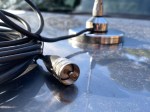
The dual band antenna is easy to put together on the magnetic base, and heavy-duty cable with PL-259 connector.

It comes with a very strong magnetic base that measures 91mm /3.6’’ across.  After using it on the car, I doubt any wind or speed will blow it off the car like my older smaller magnet base antennas.

See our video for more information:

Purchasing Tips

If you go via this link, and search for your item, you will get a discount:
https://radioddity.refr.cc/bensangster 

A direct link to this antenna is available here: https://www.radioddity.com/products/radioddity-ra-uv712-antenna-kithttps://www.radioddity.com/products/radioddity-ra-uv712-antenna-kit

Other option

While this antenna comes in silver with a PL259 plug, the other option is a black antenna with a SMA plug. That is the RA-UV713 available here https://www.radioddity.com/products/radioddity-ra-uv713-antenna-kithttps://www.radioddity.com/products/radioddity-ra-uv713-antenna-kit

Other Reads

  • 6m and TV Channel 0
    Prior to 1989, it was illegal to operate between 50 MHz and 52 MHz in Australia. It was a real pain as that was where all the action was when the…
  • Dipole Antennas Vs Long Wire Antennas
    I’ve heard a lot about dipole antennas, and I’ve heard a lot about long wire antennas also. I would say I’ve seen more dipoles than long wire antennas. So why is…
  • Repeater-START
    Repeater-START is a multi-platform app designed for ham radio and radio-operator enthusiasts who need fast access to repeater information. The app provides a detailed repeater map as well as a distance-sorted…
  • The 6-Meter Amateur Radio Band
    What Is the 6m Band? The 6-meter band, spanning roughly 50–54 MHz, is a section of the VHF spectrum assigned to amateur radio operators. Its wavelength is six meters, and its…
  • Anytone AT-778UV
    Overview The Anytone AT-778UV is a dual-band VHF/UHF mobile transceiver designed for amateur radio operators. It operates on the 136–174 MHz (VHF) and 400–490 MHz (UHF) bands, offering reliable two-way communication…
  • 160 Meters Band
    160 meters band is known as the “Gentlemen’s band”. It is right next to the AM commercial band, known as medium wave. The 160-meter band is the radio frequencies between 1.8…
  • What does this Antenna do?
    Have you ever had an antenna and forgotten what it is for? Maybe you have been given one and wasn’t told exactly what it was used for. I got given an…
  • Olivia Digital Mode MFSK
    Yes, this popular girl name is actually an Amateur Radio term. Christian, DK8EW, put me onto Olivia after we chatted on VARA HF. I had heard about Olivia before, but he…
  • Yaesu FT-620
    The Yaesu FT-620 (and its updated version, the FT-620B) is a vintage amateur radio transceiver designed specifically for the 6-meter band (50–54 MHz). Produced in the 1970s, it offers support for AM, CW, and SSB (USB/LSB) modes, making…
  • FreeDV
    I came across something different, FreeDV. The name FreeDV insinuates it is free, but is it? What is it? And what does it do? They say it will be the new…
  • Anytone 778UV Key Assignment
    Key Assignment For some reason, not all the key assignment options are in the manual and after a bit of searching, I found no complete list.  Hopefully this below helps you…
  • Kenwood – did you know this?
    Everyone that has been into radio for a while will know the brand Kenwood.  And most know Kenwood isn’t only into Amateur radio, they are bigger than that, and have been…
  • VK3AHR Ron
    Today (20/06/25) I head Ron, VK3AHR, on the 7.100 40-meter net. I understand he ran this net for over 7 years, but hasn’t been able to for the last few weeks…
  • The History Of Yaesu
    As licensed Amateur Radio operators, we have all heard about Yaesu. We have all seen a Yaesu radio and most of us have used and even own one. I’ve had and…
  • Parks & Peaks App
    I’ve been using the Parks and Peaks app on iphone and ipad for a little while now and quite enjoyed it.  There don’t seem to be many iphone apps compared to…
  • DMR Explained
    With digital radio changing so quickly, below is a bit of an update in regards to DMR radio networks. DMR stands for Digital Mobile Radio and is an internation standard for…

Radioddity GD77

After using this radio for years, this is my summary on how I find it.

While I want to replace it to a base station that puts out more power, I don’t want to lose the OpenGD77 firmware. Can you suggest a radio that would work for me where you can manually type in any talk group? It would be a base station radio that puts out 10 or more watts.

If you enjoyed this, here are some other things I have posted:

GD-77 Won’t connect to PC

I have been using my Radioddity now for some years and love it.  Though upgrading this to the OpenGD77 opened a whole new world and it gets better all the time.

One issue I had for a period was not being able to connect to it via my PC. For some time, it worked, then it stopped. It was most frustrating as I could not run the radio as a local repeater anymore. I almost never update the codeplug now and update the firmware every few weeks, but I could not do any of this without my PC connection.

After checking I had the latest community programming software, I was stumped.

Roger, who is behind all the programming of this radio and who lives nearby, kindly gave me some advice over email.  He suggested it was a Com-Port issue.  And he was correct.  So, I have put this together to help others who may have the same problem as I did.

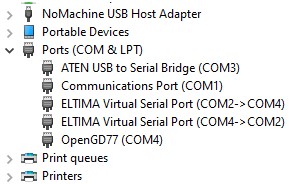
From windows 10, type in the search box Device Manager.  Then you will get a box like the following.

If you expand out the Ports section, you can see the issue I had straight away, I had the OpenGD77 on com port 4, and an Eltima Virtual Serial Port on com port 2-4 also.

I disabled the Eltima com ports listed by right clicking on them and nothing seemed to stop working, so then I uninstalled them both.  And straight away the com port worked through to the radio like it used to.

Great to have my GD77 back in action!  Hopefully this has helped you, if it has, please let me know.

There are some more interesting reads below that you may enjoy also.

  • HamClock
    HamClock has always fascinated me, as it seems such an amazing program specifically set up for Amateur Radio. I have seen countless videos on it but…
  • NanoVNA H4 USB Control to PC
    If you haven’t seen my previous blog on the NanoVNA Analyser, then I suggest you look at that first before reading this blog. This one will…
  • Flrig
    Flrig is a transceiver control program designed to be used either stand alone or as an adjunct to fldigi (see my review on this). The supported…
  • VARA – VARAC
    Ever heard this sound on HF / VHF / UHF? I know I have more and more recently. After a bit of research, someone told me…
  • EchoLink CQ
    I’ve been using EchoLink well before smartphones where the only way I knew how to connect to a different station was via the radio. The internet…
  • NetTime
    When using digital over the radio, it is particularly important you have the correct time. Even a second out will stop you from making contacts. I…
  • GD-77 Won’t connect to PC
    I have been using my Radioddity now for some years and love it.  Though upgrading this to the OpenGD77 opened a whole new world and it…
  • DudeStar
    Here is a free windows program that will connect your PC to: DMR Yaesu Fusion DStar M17 P25 NXDN You can do all this without needing…
  • Welle.io
    Welle.io is a DAB and DAB+ software defined radio (SDR). It runs on Windows, Linux and embedded devices like the Raspberry Pi 2 and 3. You…
  • Treehouse
    An unusual name, but a catchy name no less, just like Peanut that was written by the same person, David PA7LIM. If you like Peanut, then you will like this project also. This project, like Peanut, includes some amazing coding and thinking.…
  • Software Defined Radio (SDR)
    If you don’t have one of the latest and greatest expensive scanners, you will struggle to listen to a lot of transmissions. While there is still…
  • BlueDV Windows 10 GD-77
    I found it hard to find useful information on how to run the OpenGD-77 hotpot mode with Windows 10. At the time of writing this, there is a lot about this topic using a pistar and even android or ISO, but not much with Windows 10. This is my experence with BlueDV and Open GD-77 using a Windows 10 PC.…
  • Iphone won’t download photos
    I get the “Device is unreachable” Error message when trying to import media from iPhone to Windows 10 PC. …
  • ProScan and ProScan Client Update
    I recently started using ProScan after years of using FreeScan. I have always enjoyed using FreeScan as it is easy to setup, I can download outputs from the software, and the main reason “it works”. However ProScan seems to be more graphical and has different features also.…
  • ProScan and ProScan Client
    I recently started using ProScan after years of using FreeScan. I have always enjoyed using FreeScan as it is easy to setup, I can download outputs from the software, and the main reason “it works”. However ProScan seems to be more graphical and has different features also.…
  • USB Device Error PL2303HXA
    I went into the device manager and found the error, my cable no longer worked. This same issue happened to a USB Card reader also.…
  • DMR Explained
    With digital radio changing so quickly, below is a bit of an update in regards to DMR radio networks. DMR stands for Digital Mobile Radio and is…
  • RH1 Radio Cup Holder
    Why does a radio need a cup holder? I agree it’s a bit odd. But this isn’t a product that involves a cup. Rather it uses a…
  • Radioddity RA-UV712 Magnet Mount Antenna
    There are lots of duel band antennas available, but most required extra mounting brackets. These brackets often restrict you as to where you can mount the antenna…
  • Radioddity GD77
    After using this radio for years, this is my summary on how I find it. While I want to replace it to a base station that puts…
  • GD-77 Won’t connect to PC
    I have been using my Radioddity now for some years and love it.  Though upgrading this to the OpenGD77 opened a whole new world and it gets…
  • SMS via Radio or Hotspot
    One of the most underutilised by very cool feature that comes with some digital networks is the ability to send and receive SMS messages. You can send…
  • Portable Hot Stop with Battery Pack
    The new OpenSpot3 has come out with an internal battery. You might ask why? Well there is two common issues that is mostly raised with almost all…
  • BlueDV Windows 10 GD-77
    I found it hard to find useful information on how to run the OpenGD-77 hotpot mode with Windows 10. At the time of writing this, there is a lot about this topic using a pistar and even android or ISO, but not much with Windows 10. This is my experence with BlueDV and Open GD-77 using a Windows 10 PC.…
  • Upgrade to OpenGD77
    This page is just a help to friends I have spoke to who are interested in upgrading the Radioditty GD-77 to the OpenGD77 software. This is not my work, however I really do appreciate Roger and his team have done to put this together. I claim no responsibility if it breaks your radio, however I have not hear this happen now in some time. I am not an expert at all with OpenGD77, I have just put this together to help people who have asked me how to do it.…
  • The Radio Box
    How do you stop a hand held radio from falling and being damaged? Do you sometimes put the radio down on a bench or desk between overs…
  • Updating GD-77 Firmware
    Updating the firmware on the GD-77 can be daunting, as you can easily “brick” your radio. So be extremely careful. Make sure you understand why you are…
  • My Radio Diddity GD-77
    Starting in digital can be a little overwhelming to start with, no matter how many years you have had your licence.…

SMS via Radio or Hotspot

One of the most underutilised by very cool feature that comes with some digital networks is the ability to send and receive SMS messages. You can send it fairly easily to another radio, but did you know you can also receive a weather report, see where your last GPS transmitted location is, and send messages to your mobile phone. The best thing is there no cost either.

While not all networks and not all radio’s support sending SMS’s. Some hotspots do and some done also just to make it even more confusing. While I don’t plan to list all networks available, as they there are more all the time, and the settings change also. However, at the time of writing this (2020), the VK-DMR network does not support GPS or SMS (you must turn it off to use the system), but the BrandMeister one does. So, I will talk from here on about the BrandMeister network. If you use a different network, then check with that network first.

BrandMeister Setup

First you need to setup your BrandMeister account to send and receive SMS. From the BrandMeister page, login at the right of the screen. Then under Services on the left side, select selfcare. I usually set the radio brand to either ETSI or Motorola, however this will depend on the radio you have. While you are here, you might want to turn on or off your GPS location and check everything looks good.

Radio Setup

Would you believe most digital radios allow you to send and receive messages right from the screen easily. However not all. Unfortunately, at the time of writing this (2020), the OpenGD-77 does not support text messaging as yet. However, it is on the job list. I do understand that since text messaging isn’t the most used option in digital radio, probably leaving this setup until last is fair enough. However, I have done it on the original GD-77 firmware, and seen it done on other radio’s also.

If your fortunate enough, you may have a hotspot that can do it anyway.

Hotspot Sending

I am not going to talk about every hotspot available, mainly because I don’t own every hotspot available. But I will talk about the OpenSpot as I have a couple of them myself, and I know they work.

From a PC, the menu on the right side has DMR SMS chat that will bring up a box much like the picture below.

DMR SMS Chat in OpenSpot

262993 GPS and Weather

If you send the message help to destination ID 262993 you will get a prompt much like above. It may take a little while to reply. As I live in Melbourne, you can see above I then sent a private message to 262993 again and typed in the message wx Melbourne, AU. You can see above the message on the left I received. Remember, the reply’s do take a while to come back and usually arrive just as you have given up waiting!

You could also send the message gps help to the same number, 262993, to get an overview of all the GPS commands which includes setting your home position, and so on. If you have transmitted your GPS location with the same callsign you set up in the selfcare then it will reply with your last location sent. If you want to save that as your home location, send GPS SET and it will save your last location as your home location. Then you will get from now on your home location and your last transmitted location.

If you send RSSI to 262993 it will reply with the repeater and connected talk group you were last using. If you send a message INFO *callsign where *callsign is replaced with your call sign you will get a reply when you last spoke. If you have two digital ID numbers, then it will send both of them back to you.

262994 Repeater, POCSAG and dapnet

If you send RPT SMS to 262994 you will get a reply of what static talk groups you are currently connected to.

You can also send a message to a call sign using this 262994 number. For example, if you want to send a message to me, send VK3TBS followed by your message to number 262994. However, I couldn’t get this to work – maybe because I was messaging myself! If you get it to work, please let me know what I did wrong.

262995 SMSC – SMS-ing to a mobile phone

This is taking SMS-ing to the next level. I was even able to SMS my wife who doesn’t have a licence.

To do this, send the following message SMSGTE @[phone number] [message] to 262995. where [phone number] is your country number (e.g. 61 for Australia) followed by the mobile number. Remember to remove the first 0 if you’re in Australia.

There is more information on sending messages to and from your radio to mobile phones on the smsgte.org web site. There is heaps of information under the User Guide menu.

UPDATE – Before I finish, I discovered the hard way that when you send a message from a mobile phone to a radio, I got a bill. I am not sure if it was because I am in Australia, or my phone carrier saw the oppertunity, but I think with a few tests it was only $1 or so.

APRS Chat

APRS is almost a bit easier and can quickly send messages to and from a mobile phone. Once you have done the above setup, I selected APRS chat in my OpenSpot2 dashboard. Then I sent a message with the destination callsign of SMSGTE then the message was @[phone number] [message] there [phone number] is your country number (e.g. 61 for Australia) followed by the mobile number. Remember to remove the first 0 if you’re in Australia.

You can see in the picture below I sent a message Test from hotspot to my phone which appeared instantly. I then sent one back from my phone saying This is from my mobile phone which then appeared instantly. It worked really well.

Other Reads

Hope you enjoyed the above post. Below are some other reads I think you may also enjoy.

  • HamClock
    HamClock has always fascinated me, as it seems such an amazing program specifically set up for Amateur Radio. I have seen countless videos on it…
  • NanoVNA H4 USB Control to PC
    If you haven’t seen my previous blog on the NanoVNA Analyser, then I suggest you look at that first before reading this blog. This one…
  • Flrig
    Flrig is a transceiver control program designed to be used either stand alone or as an adjunct to fldigi (see my review on this). The…
  • VARA – VARAC
    Ever heard this sound on HF / VHF / UHF? I know I have more and more recently. After a bit of research, someone told…
  • EchoLink CQ
    I’ve been using EchoLink well before smartphones where the only way I knew how to connect to a different station was via the radio. The…

Portable Hot Stop with Battery Pack

The new OpenSpot3 has come out with an internal battery. You might ask why? Well there is two common issues that is mostly raised with almost all hot spots. One is the range – I have addressed this in my BlueDV post if you want to make your own long range hotspot. However the other issue is it isn’t very portable.

I have two OpenSpot2 hotspots and enjoy them very much. I can cross modes easily all by using the one radio. You used to have to get one radio per band which was a lot more expensive. Anyway I can take the OpenSpot2 in the car and plug it into the car battery and run it via my mobile phone which works well. However what if I want to go for a bike ride or walk without the car?

The main issue is not having the battery of the car when you walk or ride your bike. This is perhaps one reason why the OpenSpot3 has an internal battery. For the rest of us, you can still do it.

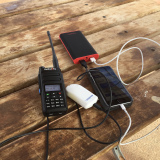
Below is a picture of my setup. I took this picture in outback South Australia. At the top of the picture is a small pocket size battery which actually has two USB plugs, so I could plug in my HotSpot and my mobile phone. It even has a torch on it and has a lot of charge (15,000 mAh 2.4 Amp) so it wasn’t the cheapest one available. I could have gone a lot cheaper however we also used this battery pack for other things while we were in remote Australia for several days.

To the left of the photo is my GD-77, my hotspot and my phone. With this setup, I was able to talk the world!

Some other reads you may enjoy

BlueDV Windows 10 GD-77

I found it hard to find useful information on how to run the OpenGD-77 hotpot mode with Windows 10. At the time of writing this, there is a lot about this topic using a pistar and even android or ISO, but not much with Windows 10. This is my experence with BlueDV and Open GD-77 using a Windows 10 PC.

Someone once asked me after reading this page, why would you want to do this? So I have added this paragraph to try and explain. One reason is to extend your hotspot range. For example, if you use a normal regular hotspot, it will only have a small range around or in the house. If you want to go for a walk or dig in the garden, you either have to take a battery pack to plug your hotspot in and your mobile plus your radio. This is something I have done many time, especially while camping and in outback Australia – I have added a photo of it below. However if you have a spare digital radio, then you can plug in your GD77 into an external antenna and via BlueDV as explained below, and then almost run your own 5W repeater into the talk group you want. I have done this and been able to walk several kms from home and still have full access yet only taking my GD77 radio with me. The other reason you can do this is because you can. To make your own repeater is a bit of fun.

Hotspot with battery pack and mobile phone on a park bench.

Before you read on, it should be noted that the Open GD-77 firmware and software is changing all the time, so some of the steps below may change. I will do my best to keep this page up to date, however please message me or leave a comment if you have any suggestions.

First install the Open GD-77 firmware and comm driver. There are instructions on my other post here.

Then once complete, make sure your GD77 is plugged into your USB on your PC. Then type in Device manager in the Windows 10 search box to open the Device Manager. Go to Ports and there you should see OpenGD77 followed by a COM number. If you do not, then you need to install the Comm Driver again. Take note of this Com number.

Now open the GD-77 CPS Community Edition and once loaded make sure it has an Extras menu between the View and Language menus. Click on the Extras menu and select OpenGD77 support. Click on Read codeplug and make sure that works. Obviously you need the radio plugged in and turned on to do this.

Now download the latest BlueDV install file from the following web site. Make sure you select the Windows version. There may be beta versions available if you want to try them.

Download and then install the msi file inside the zip file.

Keep the radio plugged into the USB port on your PC. Turn on the radio and press the green button to go into the OpenGD77 menu. Scroll down to options and then go up to Hotspot and when on hotspot press the right button until it changes to BlueDv. Press the green button to save.

Next open BlueDV and once opened, click on Menu then Setup. Put in your callsign, then change the serial port radio to the Com port noted earlier. Tick on RX/TX Colors, enter in the Frequency you wish to use, enter your DMR ID in both boxes, then select the Brandmeister DMR Master server you want to connect to and put in your password. Select Save to save these settings and close the setup box.

Now turn on Serial (top left under menu) by pressing the slide switch to the left, and DMR in the BlueDV interface. If you can not turn on DMR then you have the same problem I did, then you have not turned your radio on correctly or turned the hotspot mode on. If you have not turned on the hotspot, see two paragraphs above. Then, make sure the radio is in VFO mode by pressing the red button, you should see two lines of frequencies. Make sure they are both the frequency you are using in BlueDV. Turn your radio off, connect the cable and plug it into the PC, then hold down the small black button above the blue button and PTT button, and while holding the button, turn the radio on. The radio should say Hotspot along the top of the screen.

It should now work. Adjust your power level on this radio and plug into a nice antenna, then you can use another DMR radio on the same frequency and you now have your own hotspot that will cover an area that your GD77 will cover.

If you put in the DStar or Fusion settings, you can cross mode across to these networks also if you use the latest BlueDV version.

For more information, here is a video I found that got me going with this project. If you look at this video from 6:34 you can see how to do it without BlueDV and using MMDVMHost instead.

I hope you have found this useful. Please see below some other similar articles I have written that might be of interest. Please leave me some feedback if this has been of some help.

Upgrade to OpenGD77

This page has been updated April 2022.

This page is just some help to friends I have spoken to who are interested in upgrading the Radioditty GD-77 to the OpenGD77 software. This is not my work; however, I really do appreciate Roger and his team have done to put this together. I claim no responsibility if it breaks your radio, however I have not heard this happen now in some time. I am not an expert at all with OpenGD77, I have just put this together to help people who have asked me how to do it. The OpenGD77 project is changing and being advanced all the time. I will try and keep this page up to date with the latest and have put some links below. Regardless, even if the displays look slightly different, I hope this information will be an immense help.

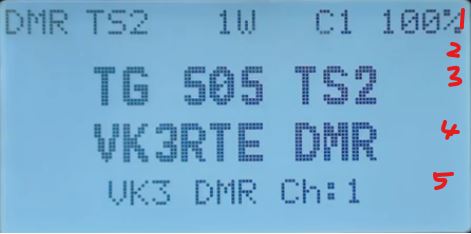
Here is just one of the improvements, and what the display looks like:

Top line has mode top left, power middle, and battery power to the right.
Line 2 has a signal meter when there is a signal.
Line 3 is the talk group line when in channel mode
Line 4 is the channel line
Line 5 is the zone and the channel number in that zone when in channel mode.

To update to the latest OpenGD77 firmware:

  1. You first need to download to the latest PC programming software. This is not the Radioddity Software, but what is called a “Community Edition” which has a few extra features, including an “extras” menu. Otherwise, it is the same as the old program. You need to download and install this software from the following link (you will need to look for the latest via this page: https://www.opengd77.com/downloads/CPS/) . When installing, select Normal installation, create desktop short cuts, then make sure both tick boxes are installed so you Install OpenGD77 Comm port driver. This comm port driver means when you attach you radio via the USB cable to your PC you will see it in the Com’s area in device manager. It will open a dos window, make sure it finishes before closing it – it should close by itself.
  2. Open the software you just installed, and make sure you have opened the new community edition by checking it has an “extras” menu at the top between the View and Language menus. After checking this, you should now make sure your OpenGD77 is up to the latest stable Radioditty firmware – you can skip the rest of this step if you have updated the firmware in the last year or so. To do this, first download the “GD-77_V3.1.8.sql” file from here (Make sure you get the GD77 one, either latest or stable). Then you can update your radio firmware. Turn your radio off, then connect it to your PC via the cable, then hold both buttons in below the PTT button, and then turn the radio on. The radio screen will be black with the green light on only, which means the radio is in firmware upgrade mode. Now go to the Extras Menu and select Firmware Loader. Select the file GD-77_V3.1.8.sgl you downloaded then select Upload firmware to GD-77. Once complete, turn your radio off, disconnect it and unplug it. Your radio is now upgraded to the latest stable Radioddity firmware. You may not see any, or little change, but if at least now it is now stable. If you are not aware, firmware is basically the software that controls your radio, but the codeplug stores the information such as channels etc.
  3. Now you know how to upgrade your radio firmware, you now want to install the latest OpenGD-77 firmware which comes with all the features and improvements. You will be amazed at the difference. First download the latest firmware version (you will need to look for the latest via this page: https://www.opengd77.com/downloads/releases/). As per step 2, turn your radio off, plug it in, and hold down the two buttons on the side and turn it on. Now via the extra menu, select the latest firmware software you just downloaded. It will upload slightly differently this time, but the same process will happen. Once complete, turn radio off, and on again.
  4. Now you should install a new codeplug. Have a look at my latest codeplug here (hover over the middle column for more information on each one), however this is currently considerably basic and made for Victoria Australia. It will get you started though. Please come back from time to time also, as I will upload more advanced codeplugs in time that will include other states and even other things to listen to outside of Amateur Radio. Once downloaded, open in the Community Software as per point 1 & 2 and you will need to put your own information in its first via the “General Settings” tab, such as your own Radio Name and Radio ID. Leave all other settings for now and customise later. If you want to change any frequencies for your hotspot or repeater, do this now, otherwise upload to your radio as per normal. My code plug has the following zones:
    • HotSpot – this codeplug now has three hotspot channels on it, one for a duplex hotspot 438.8 / 431.8 called Duplex HS, a simplex one on 439.125 called Simplex HS1 and one simplex on 439.150 called Simplex HS2 – if your hot spot is on a different frequency, either change the codeplug or hotspot. There is also a simplex direct frequency of 432.220 called Simplex_Direct.
    • CB – this is all 80 Australian UHF channels which will not apply overseas. If your radio does not transmitt in this zone, you will need to press the green button on your radio, select options, go to Band Limits and change to OFF.
    • VK3 DMR – current VK3 DMR Repeaters. If you live else ware, you will want to update this. At least this gives you an example of what they can look like. All my DMR repeaters have the call sign then an underscore followed by the frequency in the name.
    • VK3 2m Analogue repeaters. If you live else ware, you will want to update this. All my analogue repeaters have the call sign then a space followed by the frequency in the name.
    • VK3 70cm Analogue repeaters. If you live else ware, you will want to update this. All my analogue repeaters have the call sign then a space followed by the frequency in the name.
    • It now has VK2 and VK4 as per above VK3 zones. The rest will come soon.
      • Please note, I plan to upgrade this code plug to have all Australian DMR Repeaters and other things, so please come back to see if there is an update or let me know if you’re after one.

You’re done, just four simple steps. Now, have a good look through the OpenGD77 online manual that is updated as the firmware updates.

Here are some things I suggest changing in the radio’s settings:

  • Press the green button and go to options, General Options, turn HotSpot to BlueDV. Press green button to save.
  • Press the green button and go to options, radio options, then turn band Limits off. Press green button to confirm. This will allow CB etc to work. Press green button to save.
  • Press the green button and go to options, display options then go to brightness and I like it about 70% and change the timeout to 5s. This will help with your battery consumption. I also change info to both. You can also change the time zone and time while you are there. Press green button to save.
  • Press the green button and go to options, sound options and put time out beep to 5 or 10 so you get a 5 or 10 second warning before you time out. I also set Beep vol to -6db as I feel it is too loud at the standard 3db. You can also turn on DMR Beep to both so the radio will beep before it is transmitting on DMR, this way you know you are transmitting and connected while using DMR and don’t need to look at the green light. I also change FM mic to 14, this is the FM mic gain (non-digital use), as on previous firmware’s the radio mic was extremely soft so at my request Roger did this for me so. Press green button to save.

Remember, you can always reverse everything back to the way you had it by doing the above step 2, and then uploading your original codeplug.

I also recommend looking at the OpenGD77.com page and subscribing. Roger Clark is continually active on this page, so you will be kept up to date with any upgrades or issues. You can even suggest ideas here. Roger has done some great video’s also, look up VK3KKY on Youtube for some of them.

Button layout for Open GD77.  This picture was taken from OpenGD77.com and may update as the firmware updates.
Button layout for Open GD77. This picture was taken from OpenGD77.com and may update as the firmware updates.
Here is Roger’s youtube video on how to program using OpenGD77.

Any questions, please let me know.  Don’t forget to put your email address in the Follow Blog Via Email if you want to be notified of any updates. Enjoy, Ben VK3TBS.

Further Reading

So now you have done the upgrade, and have saved time changing talk groups etc, below is some more articles you may want to read about in your spare time.

First some other GD-77 articles:

The Radio Box

How do you stop a hand held radio from falling and being damaged? Do you sometimes put the radio down on a bench or desk between overs or while you are waiting for someone to call you? Some radio’s don’t stand very well on their own, or can fall over easily if the bench is bumped.

Have you ever tried my box method?

I use a stand-up desk most of the time and I found my hand held radio would sometimes topple over and hit the floor hard. The radio hit the floor hard and broke a clip on the battery. It could have been a lot worse, but also could have been avoided also. My box idea has stopped anymore falls.

Wooden box stops hand held radio's from being damaged
Wooden box stops hand held radio’s from being damaged

For my box, I simply just cut 4 small scrap pieces of wood at 45 degrees angles, screwed and glued them together, and there we have it. It doesn’t need a bottom it is so simple. It will look a heap better when I pain or stain it.

A simple wooden box stops my radio from falling over or off the desk

You could easily make a box like I did, or make several boxes joined together so you get a row. Make sure you build them so you can swap radio’s between boxes should you wish to change the order of them, or should you change or upgrade your radio in the future.

You could also use a speaker mic and keep the radio in the box, this way you can still see the screen, and will not knock you radio over or off the desk.

Here is a short video that shows a bit more detail.

Feel free to follow this web site by putting in your email address so you get notified of future posts. If you have any comments regarding this concept, please let me know – I always appreciate feedback.

Here are some other latest posts: