Dipole Antennas Vs Long Wire Antennas

I’ve heard a lot about dipole antennas, and I’ve heard a lot about long wire antennas also. I would say I’ve seen more dipoles than long wire antennas. So why is that? What is the difference between them? Which is better? If one is a clear winner, why does anyone build the other?

dipole antenna is one of the simplest and most widely used antenna types. It consists of two equal-length conductive elements, each about a quarter wavelength long, making the total length approximately half a wavelength. The antenna is center-fed, meaning the feedline connects at the midpoint, where the impedance is around 73 ohms, allowing for easy matching with standard coaxial cables.

The radiation pattern of a dipole is broadside to the antenna, producing a figure-eight pattern in the horizontal plane. This means it radiates most strongly in directions perpendicular to the wire. The dipole provides a predictable, efficient, and balanced pattern, making it ideal for both HF and VHF communication systems where simplicity and reliability are important.

long wire antenna, on the other hand, is a single conductive wire that is much longer than half a wavelength—often several wavelengths long. It is typically end-fed, with one end connected to the transmitter through an antenna tuner or matching network because the impedance is very high, often several hundred to several thousand ohms.

As the wire length increases, the radiation pattern of the long wire antenna becomes more directional and complex, forming multiple lobes with maximum radiation along the wire’s axis. This makes it useful for long-distance (DX)communication and applications where directional gain is advantageous.

In summary, the dipole antenna is a balanced, center-fed, half-wavelength antenna with a simple broadside pattern, while the long wire antenna is an unbalanced, end-fed, multi-wavelength antenna with a directional, multi-lobed pattern. Dipoles are preferred for efficient single-band operation, whereas long wire antennas are favored for multi-banduse and HF communications when space permits long installations.

So what is your experience with these antennas? Which one do you prefer and why? Have you made your own or have you bought it? Please leave your comments below.


If you enjoyed this read, see below for more interesting information:

  • 10 metres 28.490

    On the 10-metre band, 28.490 is the unofficial calling frequency for Australia and New Zealand. This is interesting as the Band plans state it is 28.390 as the recommended intra-VK calling frequency.

    That said, 28.490 is more recognised as the unofficial calling frequency down under.

    Most amateurs down under will listen to 28.490 on ten metres and put out a call there, but then QSY to another frequency 10 or 20 kHz away either after making contact, or before contacting another station by announcing where you plan to go.


  • 160 Meters Band

    160 meters band is known as the “Gentlemen’s band”. It is right next to the AM commercial band, known as medium wave.

    The 160-meter band is the radio frequencies between 1.8 and 2 MHz. For many decades it was the lowest radio frequency band allocated for use by amateur radio, before the 630 and 2200 meter bands were introduced.

    Amateur operators often refer to the 160 meters as the Top Band because it was for some time.

    The 160-meter band is the oldest amateur band. Antennas are usually huge in size due to the wavelength at this frequency, making the higher bands a lot easier to get into given they have shorter wavelengths, requiring smaller antennas. Small antennas lead to less space required and less cost.

    During the day propagation is limited to local contacts, but long distance contacts are possible at night, especially around sunrise and sunset.

    How it started for me

    The hobby started for me on Medium Wave, where I was shocked to receive long distance AM radio signals from interstate radio stations. The distances were huge, across countries if I was in Europe. As a kid I loved listening to interstate radio and sometimes phoned them to let them know. They were shocked I could hear them and often mentioned me by name soon after my phone call.

    My Antenna’s

    I’ve tried several antennas on this band. They include:

    • A horizontal dipole antenna. This worked really well though it was huge. The problem I had with this antenna was most people in my area use vertical antennas so they couldn’t hear me well.
    • A horizontal long wire antenna. This antenna was also huge, and also not vertical. So it worked well for close contacts, but not as good if I tried to contact a few suburbs away.
    • An inverted L antenna. This worked the best as my local contacts used vertical antennas. I tried to get the vertical part as high and as long as I could before doing that horizontal part. Given the length of the wire needed, most of the wire was still horizontal, but at least the first but was vertical. Though the secret to this antenna was the ground wires. I started with two of them and ran one around the house about 2 feet from the ground. The other was around the fence. I will put at least two more out which should also help improve things.

    Summary

    Getting on 160m was a bit of a challenge due to the wavelength. I could be heard on SSB, but AM was the biggest challenge. With AM, my radios would put out less watts so I had to rely more on my antenna.

    Below is a small video of my 160m antenna and how I made the inverted L. With amateur radio, there will always be improvements and I am sure this setup isn’t the best, but it is a start and I learned what I could from the other amateurs who had already mastered this band.

    Below is an extended video which goes into a bit more detail of how and why I did what I did. I adjusted all my HF antennas to make this 160m antenna work while not upsetting any of the other bands.

    As I mentioned in both videos, I am not a professional, but an amateur radio operator and as keen to learn as anyone else. If you have any thoughts on this, I would value them in the comments below. It will not only help me, but others reading this. So don’t forget to have a look at what others have to say.

    160m Coffee Break Net

    Each weekday in Melbourne, there is a 160m Coffee Break Net. This net is a bit of a challenge to get onto because you must:

    • Have a full licence
    • Have a vertical antenna (which is the biggest challenge for 160m)
    • Have a radio that does AM, and puts a few watts out

    As you can see above, I was able to make a 160m vertical antenna, so once I got this working, I was on the air! Many people try their dipole antenna, as did I at first, but on AM, it just doesn’t go far, and since everyone on the net is vertically polarised, they couldn’t hear me. I saw this as a challenge, and one worth trying.

    Don’t forget to subscribe to this page, as I am sure I will have a version 2 of these antennas out one day!


    If you enjoyed this, here are some other reads you may enjoy:

  • Amateur Radio Nets

    Below is a list of Radio nets we have gathered from web pages around the world, as well as friends etc.

    Clearly nets change all the time, so please let me know if there is anything you notice as potentially being wrong, needing to be updated, not clear of if you would like to add one you know.

    You can then sync this calendar to your device so you have all the nets available just by clicking on the Add to Google Calendar button down the bottom. It will update as we are notified of changes.

    I suggest you click on the weekly or daily view of the calendar below to see it correctly.

    If you found something missing, or incorrect, or just have some suggestions, please send us a message via the form below. It will be great to hear from you.

    While you are here, there is lots of other useful information on this site:

  • Anytone 778UV Key Assignment

    Key Assignment

    For some reason, not all the key assignment options are in the manual and after a bit of searching, I found no complete list.  Hopefully this below helps you in selecting your Key Assignments on the main unit P1-P6 keys, as well as on the microphone PA-PD keys. I have listed them in alphabetical order however under it I have how I have my radio set up.

    SelectionDescription
    A/BSwitch Main Display from A or B
    BNDBandwidth (adjust for low signals)
    CALCalibration (non-functional)
    CDTCTCSS / DCS options
    DIRDirection of display
    MONDisables squelch
    NULLWill make button do nothing.
    POWPower Level, Low Med Hi
    RDWDual Watch
    REVReverse transmit offset and frequency
    SCNScan, channels or frequencies
    SFTFrequency Offset
    SQLSquelch
    TALKTurns TX off for any particular channel
    TRFBusy channel lockout
    VOLVolume Level, press to change volume instead of channel
    VOXVox toggle on or off
    V/MSwitch from VFO to Memory Channel

    Please let me know if I got any wrong or have missed one.

    This is how I have set mine up, but as I use the radio, I will change this to suit my needs:

    P1A/B
    P2V/M
    P3MON
    P4SCN
    P5SQL
    P6VOL
    P1 mode 2DIR
    P2 mode 2SFT
    P3 mode 2RDW
    P4 mode 2POW
    P5 mode 2CDT
    P6 mode 2BND
    PASCN
    PBVOL
    PCPOW
    PDRDW

    So what are your thoughts on this? How do you setup your radio? Please let me know via the comments below.

    Here are some video’s you may enjoy also:


    If you enjoyed this, here are some more reads you may enjoy:

  • Anytone AT-778UV

    Overview

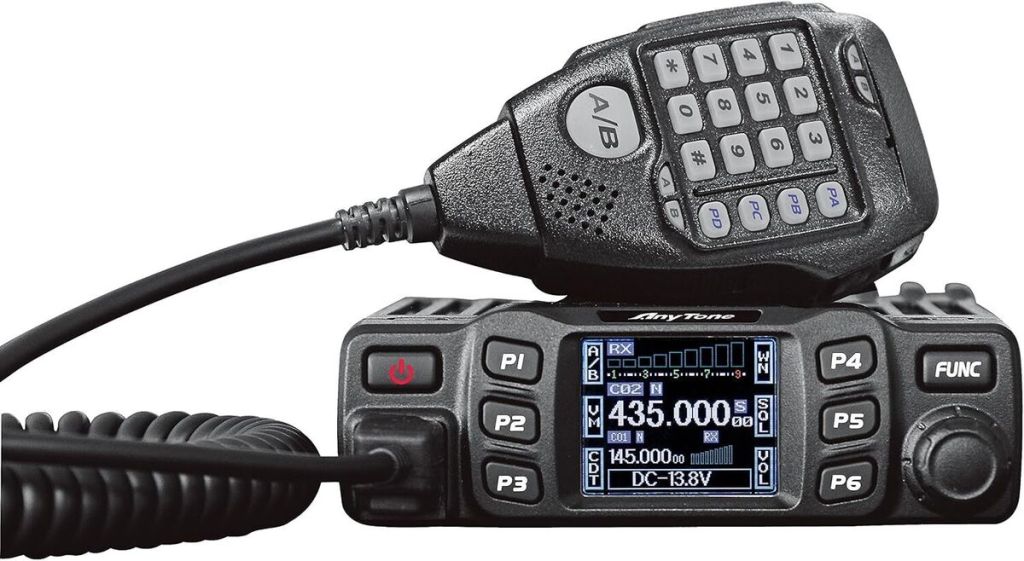
    The Anytone AT-778UV is a dual-band VHF/UHF mobile transceiver designed for amateur radio operators. It operates on the 136–174 MHz (VHF) and 400–490 MHz (UHF) bands, offering reliable two-way communication for both ham radio and commercial use (depending on firmware version).

    Power Output

    This transceiver provides selectable power levels — typically 25 W, 15 W, and 5 W. These adjustable settings allow users to manage power efficiency, heat, and battery draw when operating from a 12 V vehicle power system.

    Channel Capacity

    The AT-778UV supports 200–250 programmable memory channels, making it versatile for storing repeaters, simplex frequencies, and emergency channels. Channel naming and scanning functions simplify navigation during mobile operation.

    Display and Design

    It features a color TFT LCD display with 180-degree rotation, allowing flexible mounting in various vehicles. The metal chassis and integrated cooling system improve durability and heat dissipation, especially during extended transmission periods.

    Signaling and Features

    Key functions include CTCSS/DCS, DTMF encoding/decoding, 2-tone/5-tone signaling, and ANI/PTT ID. These options make it suitable for both amateur repeaters and commercial communication networks, enhancing identification and access control.

    Software and Programming

    Users often mention programming challenges, particularly with USB cable drivers and COM port errors on newer Windows systems. The Anytone programming software or CHIRP can be used, but compatibility varies depending on firmware version.

    Dual Watch

    Some people hate Dual Watch, but this is mainly because they do not understand it. I think this radio does dual watch better than most and the reason is:

    • There is a sperate signal meter per zone making it clear which one you are listening to. I wish all radio’s did this.
    • When Dual Watch is on, you can see both the A band and B band, but when it is off, you can only see one band on the screen. Again, I wish all radio’s did this.
    • It says clearly on the bottom of the screen if you are on A or B band. I really wish all radio’s did this.

    If you are not sure what Dual watch is, then have a look at this video. It is great when you are listening, but not talking to anyone and the repeaters are a bit quiet.

    Mic Gain

    I had a few mic gain issues my my radio. Some have drilled holes in the microphone to fix this, but before you do this, it might pay to watch the following video.

    Summary

    Most owners praise its value for money, build quality, and audio clarity. Common complaints include menu complexity, occasional freezing, and scan delays. Overall, it’s regarded as a solid budget mobile ham radio with a rich feature set.

    I do love how you can change the display on this radio and re-program the buttons. The following video with help you with this and show you what I mean.


    I hope you enjoyed that review, if you did, here are some more you may be interested in.

  • Australian DMR Repeaters

    There are several DMR networks around the world, and more and more start all the time. The Australian DMR network currently covers the entire country and is for Australian residents only.

    It can often be hard to find which DMR repeaters are online, offline and where they are, especially if you travel a bit like me.

    Here is a few links that may be of some use. Please let me know if these links no longer work.

    A map of all DMR repeaters around Australia is available here.

    If you want to check the status of these above repeaters, have a look at this page. It shows which ones are currently online, or offline.

    Online repeater map is a great page showing all repeaters around Australia. It is well worth the look at if you are traveling or are going to be in Australia. https://www.onlinerepeatermap.com/

    Another way is via the DMR database. If you put the start of the repeater call sign in the middle repeater section it will list the repeaters in your area. For example, all repeaters in my area start with VK3, so I put in VK3 in the middle callsign box and selected begins with and got a list of registered repeaters. This will work all over the world. https://www.radioid.net/database/search#!

    Further Reading

    Enjoyed what you read, here is some more interesting articles on this site you may enjoy.

  • Band Stacking

    Have you ever tried Band Stacking before? This is where you have three options per band every time you go to that band. For example, you may have one set up on SSB, one on CW and another on Data, all on the same band. You can easily switch between them all.

    For example, if you are on 20 metres, press band and 14 again, and if band stacking is on, it will keep you on 20 metres but to the different stack. This different stack could have a different mode. You usually have three per band.

    Have a look at the video for more on how to use it and turn it on:

    If you enjoyed that, below are some more interesting reads you may enjoy:

  • Baofeng GT-5R Pro

    The first thing I noticed after receiving the radio was the size of the radio. It is small yet not to small that it is hard to use. It fits comfortably in your hand.

    Not only is it physically small, the price is amazingly small also. How I would have loved to have this radio when I started in the hobby 35 years ago!

    Saying that, I see this as a great entry level budget radio. Or a small radio for camping or in the car rather than putting an expensive radio in.

    The GT-5R PRO is an enhanced version of the classic GT-5R, capable of receiving a wider range of frequency bands including UHF, VHF, FM, NOAA, Airband, 1.25M, and 1M.

    I was easily able to program the radio via the keypad putting in my local repeaters with the required offset and tone squelch.
    But it was even easier to program it via Chirp Next and I have a video on how to do that.

    It is a 5 watt radio complete with VOX if you want to go hands free.

    The GT-5R PRO is fully compatible with the UV-5R’s accessories. Such as the car charger, speaker mic, ear piece, antennas plus more.

    The GT-5R Pro comes in a standard single-unit version as well as a kit version that includes a long antenna and programming cable. I got the kit version, so be shore when purchasing you know if you want the kit or the single unit version.

    Contents
    • Radio
    • Fast desktop charger
    • Antenna
    • Long antenna
    • Li-lon battery pack
    • Wall adapter
    • Belt clip

    It supports UHF VHF dual band transmission and a wide range of reception frequency bands, including 136-174MHz, 400-520MHz, 76-108MHz, 108-136MHz, 200-260MHz, 350-390MHz, and NOAA weather channels.

    Receiver Frequency:
    FM 76-108 MHz;
    AM 108-136 MHz;
    VHF 136-174 MHz, 220-260 MHz;
    UHF 350-390 MHz, 400-520 MHz

    Transmission Frequency (US version): 144-148 & 420-450 MHz
    Transmission Frequency (EU version): 144-146 & 430-440 MHz

    It has 128 memory channels and I love how when you program them from the radio, you can see what has already been used.

    • 50 CTCSS tones and 210 DCS codes
    • SOS Emergency function
    • FM radio receiver (87.5-108MHz)
    • Channel or frequency mode selection
    • TOT (Time out timer)
    • Reverse function
    • CTCSS and DCS codes research
    • Busy Channel Lockout function (BCL)
    • Frequency step: 2.5/5/6.25/10/12.5/25KHZ
    • Repeater shift
    • VOICE: vocal indication of the function selected
    • Li-lon battery pack
    • VHF and UHF bands and channel name displayed
    • Squelch adjustable in 9 levels
    • 1750Hz tone for repeaters
    • LCD display with backlight adjustable in 3 colours
    • VOX, Scan, Dual Watch functions
    • Power Save
    • DTMF function
    • Alarm function
    • Setting and storing of channel names
    • High/low power selection
    • Frequency offset (adjustable): 0-69.990MHz
    • 2pin Kenwood accessory jack
    • Keypad lock
    • Battery allows direct charging from the DC port

    Testing

    I quickly made some contacts on both 2m and 70cm and both said my audio was great. I swapped antennas halfway though a conversation and found the small antenna better but that was just for one repeater. I plan on doing more tests in the coming weeks.

    Programming Tip

    Did you know you can program these radios via Chirp? Here is a great tip you may like with chirp.

    Summary

    When I received the radio, I was stunned at the price and thought I can’t really go wrong here. I didn’t check the hypnotics but everything else I checked worked well.

    If you go via this link, you will get a discount:
    https://radioddity.refr.cc/bensangster otherwise you can see it here: https://www.radioddity.com/products/baofeng-gt-5r-pro


    If you enjoyed this read, here are some other ones you may be interested in.

  • Baofeng K5 Plus Radio

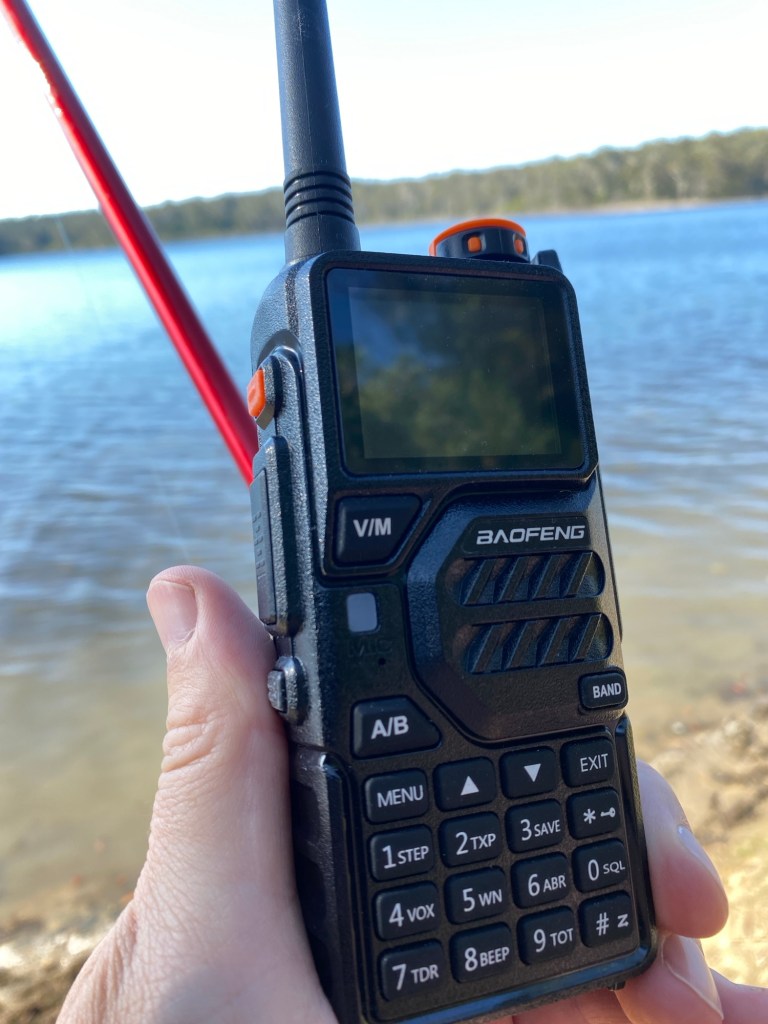
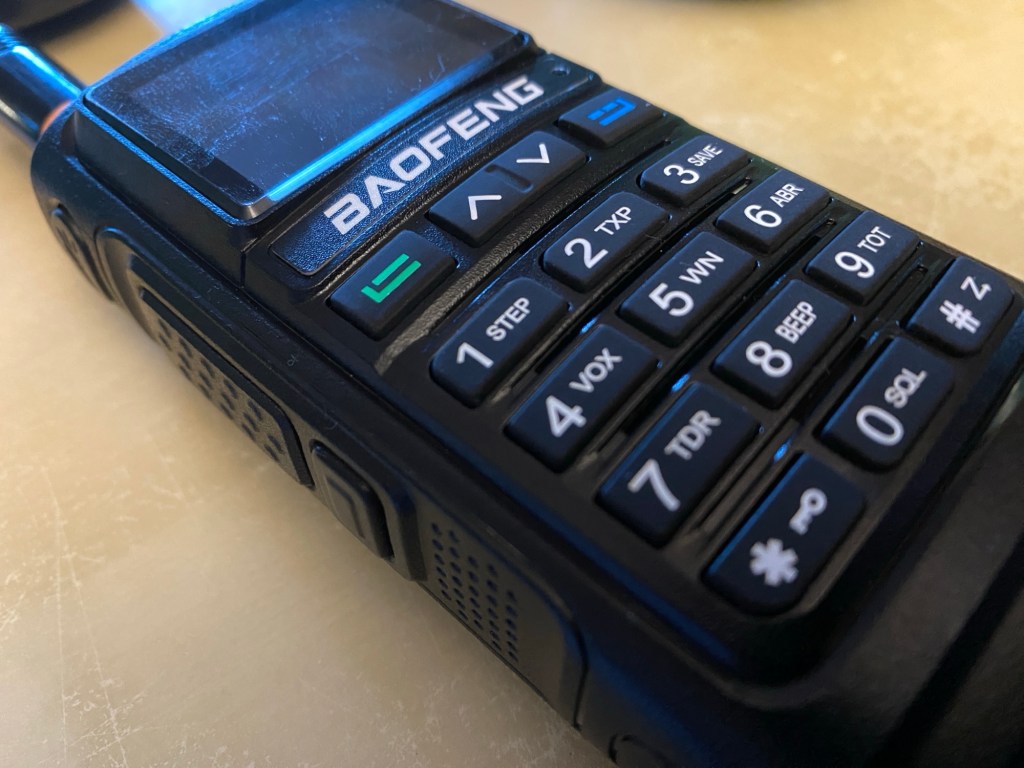
    I managed to get one of these radios and was rather impressed with it and what it came with.

    Have a look what my box had in it.

    Some of the things I liked included:

    It is a Tri-Band radio which includes UHF, VHF, 1.25M, and multi-band reception (VHF, UHF, FM, Airband, 1.25M, 1M, NOAA). 

    It does a huge 10W which isn’t bad for a hand held. But also does 10W, 7W, and 4W output.

    It has several ways to charge it. The 2500mAh rechargeable battery lasts a long time even on high power, and doesn’t take long to charge either. You can recharge via the new Type-C port cable, or recharge using the included desktop charger.

    While the radio does come with its own software, I love it is Chirp Programmable. It means you can continue to use software you are familiar with and import repeaters from repeaterbook for example.

    Using the radio while fishing

    The radio has a 1.77-inch LCD display and a robust 2500mAh rechargeable battery

    You can keep your conversations private using the scramble function, but just check first you can use this feature. I noticed it works well when signal levels are high.

    Some of the things I didn’t like

    The hand speaker mic felt a bit cheap as mine had a switch that made a lot of noise when you shook it. That said, it worked fine and no one said I sounded any different. It also has a nice adjustable clip that you can rotate.

    My Review

    Have a look at the video below for my review.

    Programming Tip

    Did you know you can program this radio via Chirp? Here is a great tip you may like with chirp.

    Purchasing Tips

    You can view the radio directly via this link.

    However you can get a discount if you go via this website and search for this product.


    If you enjoyed this, here are a few others you may enjoy. Don’t forget to subscribe to my site if you want to receive updates.

  • Baofeng Radios

    You could say every amateur radio operator knows about the Baofeng if they have been around long enough. Most have held one of their radios and lots have at least one. They have made a huge amount of radios.

    According to their website, they have been around fifty years now. However other information I found contradicts this.

    Owning a R&D team with 50 years experience in the field of wireless communication. Having launched the Baofeng series of wireless walkie-talkies and related ancillary products.

    But how big are they? Do they just build radios and then tweak them to launch another one or are they bigger than that?

    Again, according to their website:

    Total employees over 1500+. Our factory locates in Changfu Industrial Zone, XIamei of Nan’an, Quanzhou, Fujian province, China.

    So what does Baofeng mean in English?

    storm wind storm

    bào fēng. storm wind storm (force 11 wind)

    Baofeng Radio Information

    After a bit of research, this is what I found.

    Baofeng, a Chinese manufacturer, was founded in 2001 by Mr. Wang Jinding founded Baoan Electronics Co., Ltd. in Nan’an City, Fujian Province in Nan’an City, Fujian Province. In 2017, Fujian Nan’an Baofeng Electronics Co., Ltd. changed its name to Fujian Baofeng Electronics Co., Ltd.

    It gained prominence with its Baofeng UV-5R dual-band radio, which became popular for its affordability and features, but also faced regulatory scrutiny due to potential frequency interference.

    Fujian Baofeng Electronics Co., Ltd. was founded in 2001 as a high-tech enterprise focused on research, development, production, and sales of radios.

    The Baofeng UV-5R, a dual-band radio, became a global sensation in 2012 due to its affordability and features, particularly its ability to operate on both VHF and UHF bands.

    However, the UV-5R, and other similar radios, faced regulatory issues in countries like Switzerland, Germany, Poland, and South Africa, due to concerns about frequency interference and the lack of certification in some regions. In the United States, the FCC cited Baofeng for illegally marketing the UV-5R, which was “capable of operating outside the scope of its equipment authorization”. The UV-5R served as a basis for numerous other models, with vendors able to create private-labeled versions, according to CHIRP.

    The German Federal Network Agency banned the UV-5R because it dampens harmonics poorly, potentially disturbing other users, and the Independent Communications Authority of South Africa issued a ban after finding the UV-5R to be causing radio frequency interference and for having continuous tuning capabilities, a feature that would require an operator obtain a Frequency allocation license before purchasing or using the device.

    Baofeng Models

    This website I think only shows a fraction of the radios Baofeng have made and sold. For example a Pro version will be very similar to the original version but comes with so many more things, it is almost a new radio.

    https://en.m.wikipedia.org/wiki/List_of_amateur_radio_transceivers

    In my experience, you either love them starting at their cost, or hate them. It’s well known that some of cheap in price and quality, but this is perhaps the earlier models. If you love them, then they will bread like rabbits, if you hate them and own one, it will probably be sitting at the back of the draw or behind a box somewhere out of site.

    There are so many models available now. So if you are wanting a hand held radio and on a budget, do your homework well. Just because it may be the latest model, doesn’t mean it has everything all the other models have.

    Baofeng Radios Reviewed

    Below are the Baofeng radios I have reviewed on YouTube. Hope you enjoy them.

    Programming Tip

    Did you know you can program these radios via Chirp? Here is a great tip you may like with chirp.

    Purchacing

    If you go via this link, you will get a discount:
    https://radioddity.refr.cc/bensangsterhttps://radioddity.refr.cc/bensangster then search for your item.


    I hope you enjoyed this review, there are other posts below you may enjoy also:

  • Baofeng UV-17R Plus Series Review

    I recently got my hands on a new Baofeng UV-17R Plus Series radio. It didn’t take long at all to arrive and was not expensive at all. People these days pay more for a UHF CB radio than a radio that does all this can do.

    You can purchase it via this link: https://www.radioddity.com/products/baofeng-uv-17r-plus However, if you go via this link, you will get a discount: https://radioddity.refr.cc/bensangster

    My last Baofeng radio is a GT-3TP which you can still purchase new.  It also works well and have always received good reports from it.

    The UV-17R Plus is an upgraded version of the UV-17R handheld with the following: extras

    • an expanded receiving frequency band (encompassing aviation and police bands in the US),
    • an extended battery boost from 1800mAh to 2500mAh (that works out to about 40% more charge),
    • a quick USB-C charging plug and cord, and
    • it also has a new voice scrambler function.

    Some of the things I liked with the new UV-17R Plus Series includes:

    • The look and feel of the radio.  This includes the bright display, feel and position of the buttons, large LED lights, and easy antenna swapping as the area is wide. I also like the speaker behind the keypad, this saves room and is an area you never cover with your hand either. The text on the display is far easier to read than older models inside and in the sunshine.
    • The new USB-C charging is so much better.  You don’t have to bring a charging cradle anymore when you leave the house, and can even charge it in the car easily.
    • Customising DTMF is easy via the # key. It will also search for a used frequency then will display what CTCSS or DTMF is used. This can quickly be saved as a channel also.
    • Secure conversations – I couldn’t test this as I only have one radio, but agree this is a good feature. However, I did talk on it myself and my digital scanner couldn’t decode it.
    • The weather feature would be good if you are in a country that uses it.  Australia does not. I could see this being a great radio in an emergency with the LED lights.
    • The user manual is well put together and entirely in English.  A PDF version is available online also.
    • The radio can be programmed directly, or your PC via several different software options. I have done a video on this below if you want to see this.
    • It comes with an 18-month warranty.

    Here is a video where I unbox the radio and show what is included in the package. If it is helpful to you, please press the like button.

    The video below is an overview summary of this radio. I’d recommend watching it as it has more details than posted here.

    Below is another video showing some of the features that the radio has. While I don’t show you them all in action, it will at least give you an idea of how the radio works.

    If you want to get connected into the Baofeng community, have a look at this groups id where others comment and are there to help. https://groups.io/g/BaufangRadios

    This is a great radio for the price. It does far more than I thought it would and I am sure will get a lot of use out of it. I was initially concerned it may be hard to use because of the price, however, was pleasantly surprised how easy it was to program.

    Below is a video I did showing you how to program the radio via a PC using Chirp-Next.

    Programming Tip

    Did you know you can program this radio via chirp? Here is a tip you may like.

    Hope you have got something from this to help you in the hobby. If you go via this link, you will get a discount: for this radio and anything else on their website https://radioddity.refr.cc/bensangster

    There is also a new group io you can join if you want https://groups.io/g/BaofengRadios

    If this has been helpful, please let me know. Perhaps you have one of these radios and have thoughts of your own, I would value your commitments below.

    Other reads

    If you enjoyed this review, please see below some of my other articles.

  • Barefoot

    I’ve heard several amateur radio operators say they are running a Barefoot setup. But what does it mean?

    It has nothing to do with what is or is not on your feet. But simply means transmitting without an amplifier.

    While power helps, the best thing you can do to fix your signal is your antenna. It doesn’t matter how much power you put out if your antenna is facing the wrong way, or not tuned in correctly. If you are struggling to be heard and sure your radio is set up correctly, I would look at the antenna first.

    Some operators think there are two types of radio setups, thoughts with amplifiers, and thoughts without. Some see using an amplifier as cheating. I am not sure I would go that far, but if you are putting out a thousand watts, then yes people will hear you, but this doesn’t help you hear them when they put out 100 watts.

    So, are you a barefoot operator or not? Perhaps you are on some bands or radios, but not on others?

    Why not leave a comment below.

    Other things to see

  • Basic Antenna Fundamentals

    A good friend of mine, Mike VK5ZC, put the information below together and asked me to put it on my web site. He has spent a lot of time putting it together with pictures and videos, so I encourage you to have a good read.

    Topics include:

    • What is an antenna
    • Antennas types and general usage
    • Video of Antenna Propagation
    • The Antenna Mechanism
    • Antenna Resonance & Bandwidth
    • “Q” factor
    • Directional patterns of antennas
    • Video of Antenna Directivity
    • Gain of Antennas
    • Impedance matching
    • Vertical & Horizontal Polarization
    • Balun basics, Unun & Ugly Balun
    • SWR and Video
    • Coaxial cables and feed lines
    • The Velocity factor
    • Plugs and Connectors

    Open the PDF document here:

    So what did you think of this document? Please leave your comments below.

    Mike also wrote a document that has the full history of Amateur Radio. You can read that here.

    Want to read something similar:

    If you enjoyed that read, here is some more posts we have on this site.

    Antenna fun

The 6-Meter Amateur Radio Band

What Is the 6m Band?

The 6-meter band, spanning roughly 50–54 MHz, is a section of the VHF spectrum assigned to amateur radio operators.

Its wavelength is six meters, and its position between HF and VHF makes it behave like a mix of both services.

Why It’s Called the “Magic Band”

6 meters has an almost unpredictable personality.

Sometimes it acts like a local VHF band; other times it opens up suddenly and supports long-distance DX like HF.

Because of these rapid and surprising changes, operators refer to it as the Magic Band.

Contacts I had across to Europe

Propagation Characteristics

6 meters supports a wide range of radio propagation mechanisms:

Sporadic-E

Dense patches of ionization in the E-layer

Allows contacts hundreds to thousands of kilometers away

Most common from late spring through summer and again in winter

F-Layer / F2 Propagation

Appears during strong solar activity

Enables global, long-haul communication

Can keep the band open for long stretches

Tropospheric Enhancement

Weather-related bending in the lower atmosphere

Extends VHF-range signals over much longer distances

Meteor Scatter

Radio waves reflect off meteor trails

Excellent during meteor showers

Modern digital modes—especially MSK144—dominate this technique

Auroral Propagation

Signals scatter from auroral activity

Produces a very distinct, rough sound

Common at northern latitudes

Trans-Equatorial Propagation (TEP)

Occurs near the geomagnetic equator

Allows north–south DX paths across continents

Modes of Operation

6 meters accommodates virtually every common amateur mode

Weak-Signal & DX

SSB, CW

Digital

FT8 (primary mode for most openings)

FT4, JT65

MSK144 (meteor scatter)

FM

Simplex and repeater use in certain regions

AM

Niche but still used by some hobbyists

Equipment and Antennas

Radio

Many modern HF transceivers include the 6-meter band. Examples include:

Icom IC-7300

Yaesu FT-991A

Icom IC-705

Dedicated 6-meter rigs and transverters are also popular among weak-signal operators.

Antennas

6-meter antennas are small enough to install easily yet large enough to perform well.

Common options:

Dipoles

Verticals (good for FM)

Yagis (excellent for DX)

Moxons

Loops

End-fed half waves

Even a small Yagi can work impressive DX during an opening.

Seasonal and Solar Patterns

May–August: Prime Sporadic-E season

December–January: Smaller Es season

Active solar years: Best chances for worldwide F2 propagation

Meteor showers: Ideal for MSK144 activity

What Makes 6 Meters Appealing

Sudden, exciting band openings

Possibility of worldwide communication with small antennas

Plenty of room for experimentation

A wide variety of propagation modes

Generally less crowded than HF

The band blends scientific curiosity, operating skill, and pure luck — which is exactly why many operators love it.

Example

I love 6m when it is active. But I also love 6m when it isn’t open as a few of us use it to chat on it.

The Japanese love 6m. They seem to use it all year perhaps because they don’t need the band to be open to use it and talk across their country.

Below is a video where the band was open for a few minutes. Only a few contacts were made and I happen to be one of them.

After my contact, the bad suddenly closed, making this contact all the more special.


Other Reads

If you enjoyed this, here are some others you may enjoy also.

  • Dipole Antennas Vs Long Wire Antennas
    I’ve heard a lot about dipole antennas, and I’ve heard a lot about long wire antennas also. I would say I’ve seen more dipoles than long wire antennas. So…
  • Repeater-START
    Repeater-START is a multi-platform app designed for ham radio and radio-operator enthusiasts who need fast access to repeater information. The app provides a detailed repeater map as well as…
  • The 6-Meter Amateur Radio Band
    What Is the 6m Band? The 6-meter band, spanning roughly 50–54 MHz, is a section of the VHF spectrum assigned to amateur radio operators. Its wavelength is six meters,…
  • Anytone AT-778UV
    Overview The Anytone AT-778UV is a dual-band VHF/UHF mobile transceiver designed for amateur radio operators. It operates on the 136–174 MHz (VHF) and 400–490 MHz (UHF) bands, offering reliable…
  • 160 Meters Band
    160 meters band is known as the “Gentlemen’s band”. It is right next to the AM commercial band, known as medium wave. The 160-meter band is the radio frequencies…
  • What does this Antenna do?
    Have you ever had an antenna and forgotten what it is for? Maybe you have been given one and wasn’t told exactly what it was used for. I got…
  • Olivia Digital Mode MFSK
    Yes, this popular girl name is actually an Amateur Radio term. Christian, DK8EW, put me onto Olivia after we chatted on VARA HF. I had heard about Olivia before,…
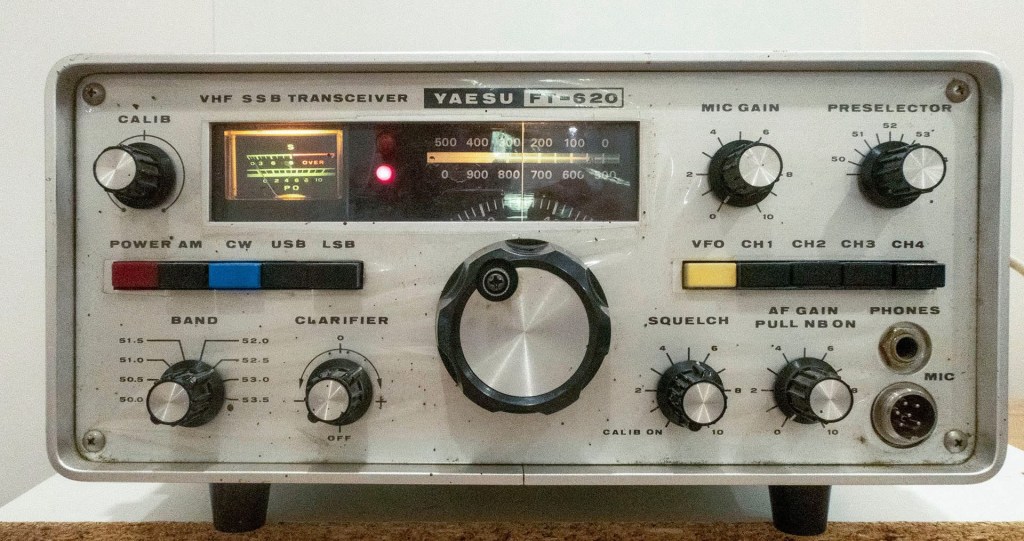
  • Yaesu FT-620
    The Yaesu FT-620 (and its updated version, the FT-620B) is a vintage amateur radio transceiver designed specifically for the 6-meter band (50–54 MHz). Produced in the 1970s, it offers support for AM, CW, and SSB…
  • FreeDV
    I came across something different, FreeDV. The name FreeDV insinuates it is free, but is it? What is it? And what does it do? They say it will be…
  • Anytone 778UV Key Assignment
    Key Assignment For some reason, not all the key assignment options are in the manual and after a bit of searching, I found no complete list.  Hopefully this below…
  • Kenwood – did you know this?
    Everyone that has been into radio for a while will know the brand Kenwood.  And most know Kenwood isn’t only into Amateur radio, they are bigger than that, and…
  • VK3AHR Ron
    Today (20/06/25) I head Ron, VK3AHR, on the 7.100 40-meter net. I understand he ran this net for over 7 years, but hasn’t been able to for the last…
  • The History Of Yaesu
    As licensed Amateur Radio operators, we have all heard about Yaesu. We have all seen a Yaesu radio and most of us have used and even own one. I’ve…
  • Parks & Peaks App
    I’ve been using the Parks and Peaks app on iphone and ipad for a little while now and quite enjoyed it.  There don’t seem to be many iphone apps…

160 Meters Band

160 meters band is known as the “Gentlemen’s band”. It is right next to the AM commercial band, known as medium wave.

The 160-meter band is the radio frequencies between 1.8 and 2 MHz. For many decades it was the lowest radio frequency band allocated for use by amateur radio, before the 630 and 2200 meter bands were introduced.

Amateur operators often refer to the 160 meters as the Top Band because it was for some time.

The 160-meter band is the oldest amateur band. Antennas are usually huge in size due to the wavelength at this frequency, making the higher bands a lot easier to get into given they have shorter wavelengths, requiring smaller antennas. Small antennas lead to less space required and less cost.

During the day propagation is limited to local contacts, but long distance contacts are possible at night, especially around sunrise and sunset.

How it started for me

The hobby started for me on Medium Wave, where I was shocked to receive long distance AM radio signals from interstate radio stations. The distances were huge, across countries if I was in Europe. As a kid I loved listening to interstate radio and sometimes phoned them to let them know. They were shocked I could hear them and often mentioned me by name soon after my phone call.

My Antenna’s

I’ve tried several antennas on this band. They include:

  • A horizontal dipole antenna. This worked really well though it was huge. The problem I had with this antenna was most people in my area use vertical antennas so they couldn’t hear me well.
  • A horizontal long wire antenna. This antenna was also huge, and also not vertical. So it worked well for close contacts, but not as good if I tried to contact a few suburbs away.
  • An inverted L antenna. This worked the best as my local contacts used vertical antennas. I tried to get the vertical part as high and as long as I could before doing that horizontal part. Given the length of the wire needed, most of the wire was still horizontal, but at least the first but was vertical. Though the secret to this antenna was the ground wires. I started with two of them and ran one around the house about 2 feet from the ground. The other was around the fence. I will put at least two more out which should also help improve things.

Summary

Getting on 160m was a bit of a challenge due to the wavelength. I could be heard on SSB, but AM was the biggest challenge. With AM, my radios would put out less watts so I had to rely more on my antenna.

Below is a small video of my 160m antenna and how I made the inverted L. With amateur radio, there will always be improvements and I am sure this setup isn’t the best, but it is a start and I learned what I could from the other amateurs who had already mastered this band.

Below is an extended video which goes into a bit more detail of how and why I did what I did. I adjusted all my HF antennas to make this 160m antenna work while not upsetting any of the other bands.

As I mentioned in both videos, I am not a professional, but an amateur radio operator and as keen to learn as anyone else. If you have any thoughts on this, I would value them in the comments below. It will not only help me, but others reading this. So don’t forget to have a look at what others have to say.

160m Coffee Break Net

Each weekday in Melbourne, there is a 160m Coffee Break Net. This net is a bit of a challenge to get onto because you must:

  • Have a full licence
  • Have a vertical antenna (which is the biggest challenge for 160m)
  • Have a radio that does AM, and puts a few watts out

As you can see above, I was able to make a 160m vertical antenna, so once I got this working, I was on the air! Many people try their dipole antenna, as did I at first, but on AM, it just doesn’t go far, and since everyone on the net is vertically polarised, they couldn’t hear me. I saw this as a challenge, and one worth trying.

Don’t forget to subscribe to this page, as I am sure I will have a version 2 of these antennas out one day!


If you enjoyed this, here are some other reads you may enjoy:

Olivia Digital Mode MFSK

Yes, this popular girl name is actually an Amateur Radio term.

Christian, DK8EW, put me onto Olivia after we chatted on VARA HF. I had heard about Olivia before, but he encouraged me to give it ago.

Soon I made contact with VK4XP and must say it is a great digital format, though I understand a lot feel voice to voice is better (as I do). That said, this digital mode doesn’t require as much bandwidth, so has the potential to go further. The typical Olivia signal can still be decoded when the amplitude of the noise is over ten times that of the Olivia signal which is amazing.

Olivia is part of the family of MFSK modes and has a high redundancy Forward Error Correction system similar to MT63. The MFSK family is very large with many modes, so it can make it very difficult to work out which is which when you hear it. Olivia works really well on poor HF paths.

Olivia digital modes are commonly referred to by the number of tones and the bandwidth, in Hertz, used. Therefore, it is common to express the Olivia digital mode as Olivia X/Y (or Olivia Y/X ), where X refers to the number of different audio tones transmitted and Y refers to the bandwidth in hertz over which these signals are spread. Examples of common Olivia modes are 8/250 (meaning, 8 tones/250-Hertz bandwidth), 16/500, and, 32/1000. There are three popular Olivia modes, which is 8-FSK, 16-FSK and 32-FSK, that have three, four or five bits per symbol.

Olivia QSO Formats

Format Bandwidth / TonesAudio Centre Marker (Hz)BaudDecode S/N Radio (dB)Speed WPM
500/16*75031.25-1319.5
1000/32*100031.25-1224.4
500/875062.5-1129.3
1000/16100062.5-1039.1
500/4750125-1039.1
250/862531.25-1414.6
* Is the most common Olivia format in use currently

Here is a video that will give you more information:

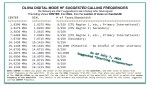
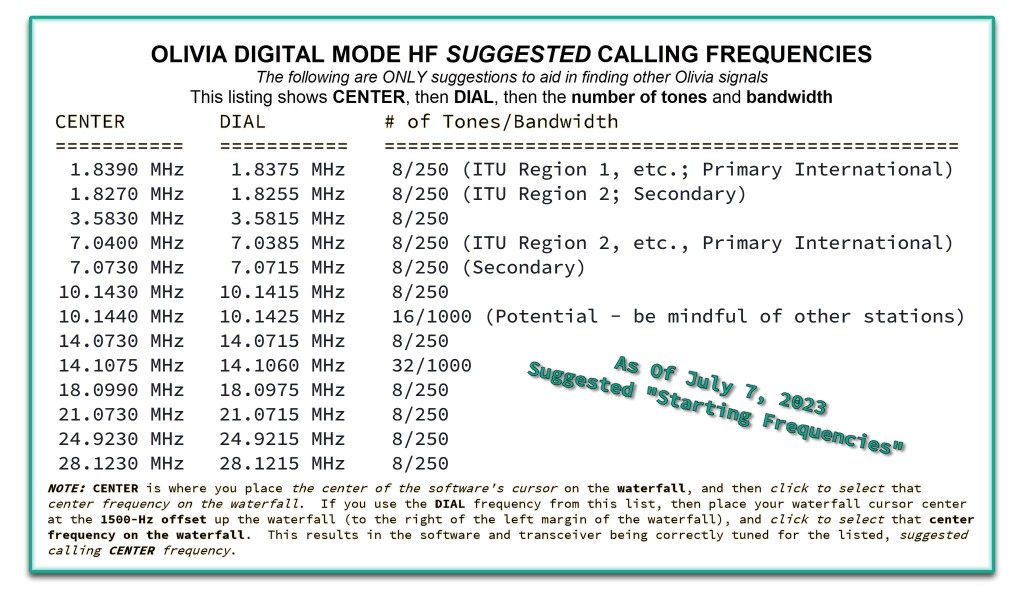
While Olivia could acutally be used anywhere in the data allocated area on HF, however you may not find anyone if you are not on the right frequency. Below is the suggested calling frequencies used around the world:

I’ve typed to many people around the world on this mode and surprised how well it works when conditions are not great. The software tells you if there is another conversation on the band also which is handy.

There are a few protocols, like using BTU (back to you) on your last line and some shortcut typing which isn’t the same as the youth of today use in text messages!

While I still prefer voice contacts with people, at least this option is a conversation and something different when conditions are not favourable.

What are your thoughts on this mode? Have you tried it? Have you had success? What radio and band did you try?


If you enjoyed that, here are some other interesting reads:

Yaesu FT-620

The Yaesu FT-620 (and its updated version, the FT-620B) is a vintage amateur radio transceiver designed specifically for the 6-meter band (50–54 MHz). Produced in the 1970s, it offers support for AM, CW, and SSB (USB/LSB) modes, making it a versatile rig for its time, especially during the era when 6 meters was gaining popularity for both local and DX communications. It was part of Yaesu’s early generation of VHF monoband rigs, built with a solid metal chassis and analog controls, reflecting the rugged, durable engineering of the period.

In terms of performance, the FT-620 delivers approximately 20 watts PEP on SSB and CW, and around 4–8 watts on AM. Receiver sensitivity is quite good for a rig of its era, typically around 0.5 µV for 10 dB S/N in SSB/CW modes. The transceiver divides the 6-meter band into multiple segments using a bandswitch, and offers decent selectivity for SSB and CW operation. It can be powered from AC mains or 12–14 VDC, providing some flexibility for mobile or backup use. However, it lacks FM capability, which limits its use with modern 6m FM repeaters or simplex FM operations.

While the FT-620 is highly regarded for its build quality and straightforward analog operation, it does show its age. There’s no digital display, DSP, or modern filtering, and some units may require refurbishment—such as replacing aging capacitors or realigning circuits for optimal performance. Its bulk and weight (~8 kg) also make it less convenient for portable use. Nonetheless, for those interested in classic radios or operating 6 meters on SSB/CW, it remains a capable and enjoyable rig, particularly when paired with a good antenna.

Overall, the FT-620 is best suited to enthusiasts who appreciate vintage gear and are willing to maintain it. It still holds practical value today in the right hands—especially for those focused on SSB or CW operation during band openings. While it won’t compete with modern rigs in terms of features or integration, its simplicity, durability, and vintage charm continue to appeal to collectors and seasoned hams alike.

See my video below where I fire it up and give it a test.

See me fire up this old girl

More interesting reads

If you enjoyed this read, here are some more I think you will like.

The History Of Yaesu

As licensed Amateur Radio operators, we have all heard about Yaesu. We have all seen a Yaesu radio and most of us have used and even own one.

I’ve had and have several Yaesu radios. From extremely old ones full of valves and extremely heavy. One can only assume they were transported to where we live by sea and not air given their weight.

But what do you know about the company Yaesu? We can assume it is or was a Japanese company, but I just felt there might be something interesting about the history of this company. Let me show you what I found after some research.

Let’s go to the beginning

Prior to 1959 Sako Hasegawa had been operating a company called General Television Co Ltd in Ota-ku, Tokyo since 1956. His first SSB Equipment had been manufactured under the General Television Co Ltd name in 1957. Sako Hasegawa’s ambition seems to have been to design and manufacture modern HF single sideband equipment for the amateur radio market.

Yaesu is a Japanese brand of amateur radio equipment, founded as Yaesu Musen Co. Ltd. in 1959 by a Japanese radio amateur Sako Hasegawa call sign JA1MP. He lived in Yaesu, Japan, a district of Tokyo.

Yaesu Musen Co’s first product was a crystal controlled monoband 40 metre transmitter, the FL-10/40. The second radio was released soon after the first which was a 5 band crystal controlled mechanical filter HF transmitter called the FL-20.

Yaesu had initially been formed with the intention to develop and manufacture commercial and amateur radio transceivers just for the Japanese market, but only five years after its formation, the company had signed foreign sales agreements for export to Australia and Germany.

Bail Radio & TV Service sold the FL-100B direct throughout Australia from their premises in the Melbourne, Victoria, suburb of Box Hill.

1963 and the Swiss

In Europe, the equipment was sold under the Yaesu brand and the Sommerkamp brand. In 1963, four years after the company started, the Swiss firm Sommerkamp imported Yaesu equipment and sold it using their own brand.

1965 and the Americans

In 1965, Yaesu’s equipment was first imported into America by Spectronics, Inc. located in Signal Hill, California. Today most companies try to import into America first, but that isn’t Yaesu’s story.

Yaesu became an important presence in the American amateur radio market with the introduction and improvement of its very popular FT-101 in the 1970s.

FT-101

The FL-100 was a crystal controlled 5 band HF transmitter but with an SSB power input of 100 watts PEP.

Sako Hasegawa death

Sako Hasegawa, who founded the company, died in 1993. Following his death, Jun Hasegawa took over as managing director.

1998 Vertex Standard

Yaesu Musen acquired the STANDARD radio equipment brand from Marantz Japan in 1998 and changed the company name to Vertex Standard Co. Ltd. 

2007 Motorola

Vertex Standard didn’t last long by itself. In 2007, Motorola announced its intention to purchase 80% of Vertex Standard and form a joint venture with Tokogiken (a privately held Japanese company controlled by Jun Hasegawa), which would hold the other 20%. This deal was completed in January 2008. The joint venture was dissolved effective January 1, 2012.

The Vertex Standard land mobile division operates as a wholly-owned subsidiary headquartered in Tokyo, Japan. The Amateur Radio, Airband and Marine Radio business was transferred to the new company “Yaesu Musen”.

Taken from Motorola’s website, Motorola Solutions combined the best of Vertex Standard’s portfolio with our industry-leading two-way radio lineup.

2000’s Minimal – Shift – Keying

In the early 2000s, minimum-shift keying (GMSK) technology emerged in amateur radio. It was the dominant digital mode.

2013 – Digital Mode “Fusion”

In 2013, YAESU launched its own digital mode of operation for amateur radio known as: “System Fusion”. Or known as Fusion.

Like most other digital modes, Fusion utilises a narrower radio bandwidth. However, with System Fusion, Yaesu gave it special attention to compatibility with analog FM radio. Their intended goal was to simplify migration of the existing amateur radio repeaters from analog to digital.

Yaesu is the only company with System Fusion-enabled devices. 

C4FM

C4FM, or Continuous Four-Level Frequency Modulation, is a digital communication mode used in amateur radio, particularly by Yaesu and System Fusion radios. It is a type of 4FSK (Four-Frequency Shift Keying) that, when combined with FDMA (Frequency Division Multiple Access), allows for digital voice and data transmission.

C4FM offers features like digital voice with clear audio, data transmission, and internet connectivity through WIRES-X nodes, enabling features like real-time navigation and text messaging.

The System Fusion communication protocol enables devices to analyze an incoming signal and automatically determine if it is using C4FM or conventional FM mode. System Fusion also enables data transfer at full rate with speeds reaching up to 9,600 bits per second.

Other Popular Digital Modes

ICOM developed devices using the D-STAR protocol. Other brands use DMR, among other modes. The list goes on and on.

My thoughts on Yaesu

For what it’s worth, I’ve always been happy with Yaesu products.  I have several radios with their name on it and have never had a problem with them.

Yaesu Musen, is still a Japanese company. It is a well-known manufacturer of amateur, marine, and commercial radio equipment.  Yaesu is well recognised for its amateur radio equipment.

So tell me, what are your thoughts on Yaesu? What products do you have of theirs? Do you like their products? Do you prefer something else? Perhaps you liked their earlier products compared to their current stock? Please share your thoughts in the comments below so others can see.

Yaesu did not play any part in this post. It is just information I found out about the company.


If you enjoyed that read, please subscribe and like. You may enjoy some of my other posts below.

  • Dipole Antennas Vs Long Wire Antennas
    I’ve heard a lot about dipole antennas, and I’ve heard a lot about long wire antennas also. I would say I’ve seen more dipoles than long wire antennas. So why…
  • Repeater-START
    Repeater-START is a multi-platform app designed for ham radio and radio-operator enthusiasts who need fast access to repeater information. The app provides a detailed repeater map as well as a…
  • The 6-Meter Amateur Radio Band
    What Is the 6m Band? The 6-meter band, spanning roughly 50–54 MHz, is a section of the VHF spectrum assigned to amateur radio operators. Its wavelength is six meters, and…
  • Anytone AT-778UV
    Overview The Anytone AT-778UV is a dual-band VHF/UHF mobile transceiver designed for amateur radio operators. It operates on the 136–174 MHz (VHF) and 400–490 MHz (UHF) bands, offering reliable two-way…
  • 160 Meters Band
    160 meters band is known as the “Gentlemen’s band”. It is right next to the AM commercial band, known as medium wave. The 160-meter band is the radio frequencies between…
  • What does this Antenna do?
    Have you ever had an antenna and forgotten what it is for? Maybe you have been given one and wasn’t told exactly what it was used for. I got given…
  • Olivia Digital Mode MFSK
    Yes, this popular girl name is actually an Amateur Radio term. Christian, DK8EW, put me onto Olivia after we chatted on VARA HF. I had heard about Olivia before, but…
  • Yaesu FT-620
    The Yaesu FT-620 (and its updated version, the FT-620B) is a vintage amateur radio transceiver designed specifically for the 6-meter band (50–54 MHz). Produced in the 1970s, it offers support for AM, CW, and SSB (USB/LSB) modes,…
  • FreeDV
    I came across something different, FreeDV. The name FreeDV insinuates it is free, but is it? What is it? And what does it do? They say it will be the…
  • Anytone 778UV Key Assignment
    Key Assignment For some reason, not all the key assignment options are in the manual and after a bit of searching, I found no complete list.  Hopefully this below helps…
  • Kenwood – did you know this?
    Everyone that has been into radio for a while will know the brand Kenwood.  And most know Kenwood isn’t only into Amateur radio, they are bigger than that, and have…
  • VK3AHR Ron
    Today (20/06/25) I head Ron, VK3AHR, on the 7.100 40-meter net. I understand he ran this net for over 7 years, but hasn’t been able to for the last few…
  • The History Of Yaesu
    As licensed Amateur Radio operators, we have all heard about Yaesu. We have all seen a Yaesu radio and most of us have used and even own one. I’ve had…

Yaesu 857D

A great radio that does all bands up to 70cm. Using all modes also you can talk on SSB on VHF and UHF.

If you haven’t done SSB on 2m and 70cm, then I’d encourage you to do so. it is a lot of fun.

This radio will do it and so will a lot of the old radios. There are very few new ones that do it now.

Some very old radios only do SSB on one band or another.

Please see my review of the 857D. It’s a great old radio but so small in size making it an ideal portable or mobile radio.


If you enjoyed this post, there are heaps of others you may enjoy here:

Flowerpot Antennas

Have you heard of a flowerpot antenna? I hadn’t until recently, and I enjoy gardening also. But this antenna has nothing to do with gardening apart from why it was named flowerpot and it will probably end up either on your roof or garden.

A good friend of mine put me onto it as I was having trouble on 6m. A small group of us think 6m is under-utilised so we all get on their and chat for a while either on AM or SSB.

My antenna worked reasonably well, but they suggested I build my own using the flowerpot method. Given I’m always up for learning something new, I couldn’t resist.

The best but about the antenna is it is extremely cheap to make, easy to put together and the antenna works really well.

Flowerpot Antenna by VK2ZOI https://vk2zoi.com/articles/half-wave-flower-pot/ is a great site and has all the measurements.

You can make a flowerpot antenna for either 6m, 2m or 70cm. You can hang it in a tree if you wish, in a pvc pipe like I did, or using a pole or something else.

There were only two parts I needed, everything else I already had. But if I had bought everything, it would have cost me I total about $15. Not bad for a great antenna and one you can say you built yourself.

All I needed to buy was the pvc pole, which is optional and a slightly wider pipe to make the coil on I already had the RG58 coax, and it even had a pl259 plug on it!

My flowerpot antenna

Items I purchased included:
PVC Pipe. Make sure you give it a shake in the store before buying. If it is too flexible then it may bend and snap in the wind. But you don’t want it to heavy either.

Coupling Plumber Part to make my 50mm coil on:
https://www.bunnings.com.au/holman-50mm-pvc-dwv-straight-coupling_p4756318

If you want more information on how to make it and how I put it together, have a look at my video.

Hope you enjoyed the read. If you have any questions please let me know.


Other reads

If you enjoyed this post, you may enjoy some of my other posts:

Remote testing Antennas

I’ve always wanted to take the radio with me while on holidays and I always do. However I’ve always been limited to 2m and 70cm including local repeaters and digital work.

Our family enjoy holidays all over Australia into some of the most remote places without water, power or any mobile signal. Sometimes this can last week’s at a time.

If your keen to learn more about our travels around Australia and learn more, please let me know.

Most of these remote locations means limited activity on 2m or 70cm as there are no repeaters for days!

Because of this remoteness, there are several outback radio networks we can join or listen to. They make quite interesting listening.

However, when on holidays, we amateurs don’t want to just listen, we want to be part of the action! And HF is the next best thing.

I’m currently on holiday in the Victorian high country, also known as “The Man from Snowy River” country. It is rugged, beautiful and high. So up here I can actually can receive several 2m and 70cm repeaters, but this is a good test for HF work.

High up on Mount Buffalo

With me, I brought a battery pack, that has a 12 volt lithium battery which we run our camping fridge off.  I now run my HF gear off it!

I also brought my new QT-80 radio, which is small in size yet puts out 80 watts.  I have placed a video below on this radio if you are not familiar with it.

I used a magnet mount antenna base as the car I was using is not mine. This mount sticks to the car like glue, but also comes off on demand so you can adjust the antenna as required.

I brought two antennas to test.  The first one was the HF-008 antenna that covers more bands than the QT80.  I have a video on both these below for you if you are not familiar with it.

I also brought the new CBL-561 HF antenna so I could compare the two antennas. This antenna can be used while mobile unlike the HF-008 antenna. I have another video for you to show you that antenna below:

Before leaving home, I went to the hardware store and bought two lengths of pipe with caps that could safely store each antenna. I could then almost throw them in the boot of the car and not be worried about them being damaged or caught on something as I pulled them out of the boot.

Hot Tip

The funny thing was, while on holidays, I forgot to bring a measuring tape to adjust the antenna. Fortunately one of my children had a ruler with them so I was able to mark measurements down the side of the tube with a sharpie.

I also wrote down next to the measurements the lengths Radioddity recommended and then as I tuned in the antenna myself with the lowest SWR, I marked the pipe to my best measurements which were very close to the same as Radioddity.

This Tip I am sure will be very useful going forward when I’m out in the Australian outback or somewhere that I have no ruler!

Results

Both antennas fitted the same magnetic base which made this setup work well.

On testing both antennas using the same frequency to the same long distance contact, I and they couldn’t tell the difference between us. I found both antennas easy to tune in and get the SWA right down before making any contacts.

I then tried again from the top of Mount Buffalo, one of our highest mountains and got the same results where both myself and the contacts I spoke to didn’t know I had even changed the antenna.

There are differences between the antennas though which may help you decide which antenna is right for you.

Compare Antennas

HF-008

This antenna covers a lot of HF bands, as covered in the video above. However it cannot be used while mobile, mainly due to the jumper cable. It is a great antenna and can be used with a radio that puts out a lot more watts than the small QT-80 radio I used.

CBL-561

The CBL-561R antenna does not cover as many HF bands as the HF-008 does, but if you are using the bands it does cover, then this antenna might be good for you. One big advantage to this antenna is that it can be used while mobile, not just stationary.

Both antennas will need adjusting if you switch bands or switch from one end of the band to another. So setting the antenna to a permanent mount on the car on the top of the roof where it ends up out of reach, then you may want to rethink this. I found the magnet mount ideal, as you can still have it on the highest point of the car and access it easily.

Another option I also use is a bull bar mount that I use on my 4×4.

I’d encourage you to watch my video below as it explains what I discovered.

Remember the old saying Hight is Might and going portable gives you an opportunity to test this theory.


Hope you enjoyed this read. Below are some other interesting articles I have also written that you may enjoy.

Fishing Line Antenna DIY

With so many different HF antennas available, I often wondered what people in high rise buildings did.  If they can not put an antenna on the roof, what options are left for them?  I talk to so many people from Asian cities who would have this problem, and occasionally I see what they do.

The easiest option is to stay on digital like DMR.  These only require internet, and a hand held radio, but this always asks the question, is this real amateur radio?  My opinion is if it connects people that are licenced and only licenced people can uses it, then I guess it is, while understanding it may not be everyone’s cuppa.  I do understand there are many even in Australia in retirement villages who only have the option of digital radio due to restrictions on antennas.

Today, I made contact with Lok Shui Fan VR2VAZ in Hong Kong, and on his QRZ page, he came up with an amazing idea that clearly works for him.  While it is not going to be the best antenna ever seen, it is perhaps the best antenna he is able to use.  Given we are about 7450 km (4627 miles) apart, and still made contact on this antenna, you can’t say it doesn’t work.

On his QRZ page, Lok says “This is my DIY HF Fish Pole Antenna. Can be used under 80M,40M,30M, 20M, 17M, 15M, 12M, 10M band.”

He also says “If I am not playing radio, all the antenna will be hidden in flower bed”.

There are more photo’s on his QRZ page. He even has a youtube video on it.

I guess it would feel like catching contacts everytime you made a contact. If you enjoyed fishing and radio, this might be a bit of fun for you?

I think it is a fantastic idea.  What do you think? Have you built your own antenna that camouflage’s when not in use?

If you enjoyed this read, here are some other reads you may enjoy also:

  • Using an Android TV Box for Ham Radio
    If you want to get onto Digital Radio for less (way less) than $100, then you may be interested in this. I have Apple equipment, and therefore miss out on a lot of the testing apps that are only available…
  • Orion Push to Talk
    Orion is an app that isn’t really known in my world, perhaps because it isn’t available on all platforms, or because it does transmit your exact location to everyone on the channel. However there are some benefits to this mode…
  • WizNet DMR
    The WizNet DMR app is still in beta testing, and at the time of writing this, you have to not only have a currently have a licence as an Amateur Radio Operator, but approved to be part of the beta…
  • The Radio Box
    How do you stop a hand held radio from falling and being damaged? Do you sometimes put the radio down on a bench or desk between overs or while you are waiting for someone to call you? Some radio’s don’t…
  • Amateur Radio Nets
    A list of Radio nets we have gathered from web pages around the world, as well as friends etc.…
  • USB Device Error PL2303HXA
    I went into the device manager and found the error, my cable no longer worked. This same issue happened to a USB Card reader also.…
  • The History of Ham Radio
    A good friend of mine, Mike VK5ZC, put the information below together and asked me to put it on my web site. He has spent a lot of time putting it together with pictures and videos, so I encourage you to have a good read.…
  • Basic Antenna Fundamentals
    A good friend of mine, Mike VK5ZC, put the information below together and asked me to put it on my web site. He has spent a lot of time putting it together with pictures and videos, so I encourage you to have a good read.…
  • Australian DMR Repeaters
    There are several DMR networks around the world, and more and more start all the time. The Australian DMR network currently covers the entire country and is for Australian residents only. It can often be hard to find which DMR…
  • BlueDV Windows 10 GD-77
    I found it hard to find useful information on how to run the OpenGD-77 hotpot mode with Windows 10. At the time of writing this, there is a lot about this topic using a pistar and even android or ISO, but not much with Windows 10. This is my experence with BlueDV and Open GD-77 using a Windows 10 PC.…