Baofeng Celebrates 25 Years of Two-Way Radio Innovation

In 2026, Baofeng celebrates 25 years as one of the world’s best-known manufacturers of affordable two-way radios. Founded in 2001 as Fujian Baofeng Electronics Co., Ltd., the company has grown from a small Chinese radio manufacturer into a global brand supplying handheld radios for amateur radio operators, emergency communications, outdoor activities, security, and commercial users.

Baofeng became especially popular in the amateur radio community thanks to the release of the Baofeng UV-5R. This low-cost dual-band handheld radio made it possible for thousands of new amateur radio operators to get on the air without spending a lot of money. The UV-5R supports VHF and UHF frequencies, is compatible with CHIRP programming software, and has become one of the best-selling amateur radio handheld transceivers ever produced.

Over the past 25 years, Baofeng has expanded its product range well beyond the original UV-5R. The company now manufactures a wide variety of analogue and digital two-way radios, waterproof models, commercial radios, and accessories for users around the world. Baofeng radios are used by amateur radio enthusiasts, emergency volunteers, event organisers, businesses, hikers, campers, and off-road travellers in more than 100 countries.

Baofeng’s success has been driven by its ability to offer reliable communication equipment at affordable prices. While the company continues to improve its radio designs and introduce new features, its products remain known for providing excellent value for beginners and experienced operators alike.

Reaching its 25th anniversary is an important milestone for Baofeng. During the past quarter-century, the company has helped make amateur radio and two-way radio communications more accessible than ever before, encouraging countless people to discover the hobby and stay connected through reliable radio communication.

Baofeng UV-5R 25th Anniversary Edition

The Baofeng UV-5R 25th Anniversary Edition by Radioddity is a limited-edition dual-band handheld amateur radio released to celebrate 25 years of Baofeng. Based on the popular Baofeng UV-5R, this special edition combines the proven performance of one of the world’s best-selling handheld ham radios with modern upgrades, collector’s styling, and USB-C charging. It is designed for amateur radio operators, emergency communication, camping, hiking, off-road touring, and anyone looking for an affordable VHF/UHF handheld transceiver.

Transparent Design and Special Edition Features

One of the standout features of the Baofeng UV-5R 25th Anniversary Edition is its transparent housing, available in Glacier Ice and Solar Flare colours. The clear case showcases the internal electronics, giving the radio a unique appearance that sets it apart from standard UV-5R models. Exclusive anniversary branding includes a commemorative startup screen, a custom 25th Anniversary keypad button, a collector’s badge, and premium packaging, making it appealing to both new operators and long-time Baofeng fans.

See my review below:

Baofeng UV-5R 25th Anniversary Specifications

The Baofeng UV-5R 25th Anniversary Edition operates on the 136–174 MHz VHF and 400–520 MHz UHF frequency ranges. It delivers up to 5 watts of transmit power, stores 128 programmable memory channels, and includes dual watch, dual standby, VOX hands-free operation, CTCSS and DCS signalling, an FM broadcast receiver, LED flashlight, and emergency alarm. Like the standard UV-5R, it is fully compatible with CHIRP programming software, making it easy to program repeaters and memory channels from a computer.

USB-C Charging and Everyday Convenience

A major upgrade over many earlier UV-5R models is the included 1800 mAh USB-C rechargeable battery. Users can charge the radio with a standard USB-C cable, reducing the need to carry a dedicated desktop charger while travelling or operating in the field. The package also includes a durable hard-shell carry case that helps protect the radio during transport, making it well suited for portable amateur radio, four-wheel driving, hiking, camping, and emergency preparedness.

Performance and Compatibility

The Baofeng UV-5R 25th Anniversary Edition offers the same reliable performance that has made the UV-5R one of the most popular handheld ham radios in the world. It performs well for local repeaters, simplex communication, public service events, emergency communication, and general amateur radio use. Existing UV-5R accessories, including antennas, speaker microphones, batteries, programming cables, and headsets, remain compatible, allowing current Baofeng owners to continue using their existing equipment.

Is the Baofeng UV-5R 25th Anniversary Edition Worth Buying?

If you are looking for an affordable handheld ham radio with modern features, the Baofeng UV-5R 25th Anniversary Edition is an excellent option. While the radio performs similarly to the standard UV-5R, the addition of USB-C charging, the transparent collector’s design, premium accessories, and anniversary branding make it an attractive upgrade. Whether you are a beginner studying for your amateur radio licence or an experienced operator wanting a unique addition to your radio collection, the Baofeng UV-5R 25th Anniversary Edition offers excellent value for money.

Popular search terms: Baofeng UV-5R 25th Anniversary Edition, Radioddity Baofeng UV-5R, Baofeng UV-5R review, Baofeng handheld radio, dual-band amateur radio, USB-C ham radio, VHF UHF handheld transceiver, Baofeng UV-5R specifications, CHIRP programming, beginner ham radio, portable amateur radio, emergency communication radio.

The 6-Meter Amateur Radio Band

What Is the 6m Band?

The 6-meter band, spanning roughly 50–54 MHz, is a section of the VHF spectrum assigned to amateur radio operators.

Its wavelength is six meters, and its position between HF and VHF makes it behave like a mix of both services.

Why It’s Called the “Magic Band”

6 meters has an almost unpredictable personality.

Sometimes it acts like a local VHF band; other times it opens up suddenly and supports long-distance DX like HF.

Because of these rapid and surprising changes, operators refer to it as the Magic Band.

Contacts I had across to Europe

Propagation Characteristics

6 meters supports a wide range of radio propagation mechanisms:

Sporadic-E

Dense patches of ionization in the E-layer

Allows contacts hundreds to thousands of kilometers away

Most common from late spring through summer and again in winter

F-Layer / F2 Propagation

Appears during strong solar activity

Enables global, long-haul communication

Can keep the band open for long stretches

Tropospheric Enhancement

Weather-related bending in the lower atmosphere

Extends VHF-range signals over much longer distances

Meteor Scatter

Radio waves reflect off meteor trails

Excellent during meteor showers

Modern digital modes—especially MSK144—dominate this technique

Auroral Propagation

Signals scatter from auroral activity

Produces a very distinct, rough sound

Common at northern latitudes

Trans-Equatorial Propagation (TEP)

Occurs near the geomagnetic equator

Allows north–south DX paths across continents

Modes of Operation

6 meters accommodates virtually every common amateur mode

Weak-Signal & DX

SSB, CW

Digital

FT8 (primary mode for most openings)

FT4, JT65

MSK144 (meteor scatter)

FM

Simplex and repeater use in certain regions

AM

Niche but still used by some hobbyists

Equipment and Antennas

Radio

Many modern HF transceivers include the 6-meter band. Examples include:

Icom IC-7300

Yaesu FT-991A

Icom IC-705

Dedicated 6-meter rigs and transverters are also popular among weak-signal operators.

Antennas

6-meter antennas are small enough to install easily yet large enough to perform well.

Common options:

Dipoles

Verticals (good for FM)

Yagis (excellent for DX)

Moxons

Loops

End-fed half waves

Even a small Yagi can work impressive DX during an opening.

Seasonal and Solar Patterns

May–August: Prime Sporadic-E season

December–January: Smaller Es season

Active solar years: Best chances for worldwide F2 propagation

Meteor showers: Ideal for MSK144 activity

What Makes 6 Meters Appealing

Sudden, exciting band openings

Possibility of worldwide communication with small antennas

Plenty of room for experimentation

A wide variety of propagation modes

Generally less crowded than HF

The band blends scientific curiosity, operating skill, and pure luck — which is exactly why many operators love it.

Example

I love 6m when it is active. But I also love 6m when it isn’t open as a few of us use it to chat on it.

The Japanese love 6m. They seem to use it all year perhaps because they don’t need the band to be open to use it and talk across their country.

Below is a video where the band was open for a few minutes. Only a few contacts were made and I happen to be one of them.

After my contact, the bad suddenly closed, making this contact all the more special.


Other Reads

If you enjoyed this, here are some others you may enjoy also.

  • Baofeng Celebrates 25 Years of Two-Way Radio Innovation
    In 2026, Baofeng celebrates 25 years as one of the world’s best-known manufacturers of affordable two-way radios. Founded in 2001 as Fujian Baofeng Electronics Co., Ltd., the company has…
  • 20m vs 17m
    One day I was checking the bands and noticed the 17m band is open for a short period. I have noticed this over a long period that it often…
  • HF on a Hand Held?
    Radioditty sent the new GS-10B Pro to me before it was released as they wanted you to see it first. When sending it, they never told me what to…
  • CW Skimmer
    CW Skimmer is a popular amateur radio software program used for decoding Morse code signals on the HF bands. The program is widely used by ham radio operators, DX…
  • ADIF Master
    ADIF Master is a popular amateur radio logging software tool used for editing and managing ADIF log files. ADIF stands for Amateur Data Interchange Format, which is the worldwide…
  • 15 Metre band
    The 15 metre band is one of the most popular HF amateur radio bands for long-distance communication, offering an excellent balance between reliability and worldwide reach. Frequency Range The…
  • AOR AR1000XLT Fix
    The AOR AR1000XLT is a popular wideband scanner receiver that became well known among radio enthusiasts, amateur radio operators, aviation listeners, and shortwave hobbyists during the late 1980s and…
  • Maximum Usable Frequency (MUF) in HF Radio Propagation
    Maximum Usable Frequency (MUF) is an important concept in HF radio propagation and amateur radio communications. It refers to the highest frequency that can be used for reliable communication…
  • World Amateur Radio Day
    World Amateur Radio Day is celebrated every year on April 18, marking the founding of the International Amateur Radio Union (IARU) in 1925. The organisation was established in Paris…
  • Amateur TV
    Amateur Radio Television (ATV), often called “ham TV,” is a niche part of amateur television where licensed radio operators transmit live video and audio over radio frequencies instead of…
  • Baofeng UV-5R Mini
    The Baofeng UV-5R Mini handheld radio is a popular and affordable dual-band amateur radio transceiver widely used by beginners and experienced ham radio operators. Designed as a compact version…
  • Lightning Storm & HF Radio
    HF radio and lightning storms are closely connected because lightning creates strong radio frequency interference that affects HF radio communication (3–30 MHz). High Frequency radio is commonly used for…
  • OpenHamClock
    OpenHamClock is an open-source amateur radio dashboard designed as a modern successor to the original HamClock used by radio amateurs worldwide. It provides a real-time visual display of essential…
  • Radtel P8 PoC radio
    The Radtel P8 PoC radio is a Push-to-Talk over Cellular (PoC) device that looks like a traditional walkie-talkie but communicates using 4G/LTE mobile networks instead of UHF/VHF radio frequencies.…

DXHeat.com

DXHeat.com is a great website that can update you the current conditions on each band. The website has filtering of incoming DX Spots which can be displayed instantly using great graphical tools.

From the main landing page dxheat.com you can do a search by call sign or open DX Cluster. You can also scroll down to see more information.

Callsign Search

By typing in a call sign, you will see a lot of information instantly about that person. Some of the graphs are interesting as it shows how often the selected user does DX Spots by date, by band and what Continent they have been heard in.

It then shows what DX spots this user as submitted by time, band, and Continent.

DX Cluster

This is the best part of the website.

In the middle you can see live data. You can apply filters as required on the left side. On the right is the current UTC time and a lot of other interesting things.

On the right is a Propagation box which is helpful.

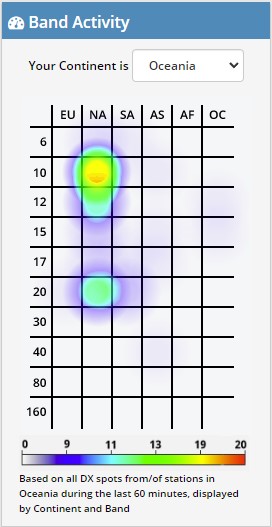
Also on the right is a Band Activity box which is great and perhaps the best part of the website.

This graph is powerful and shows you instantly where the bands are open.

Select your area via the drop-down box. I have selected Oceania in the example shown. You can see the band is open on 10 metres to NA, which is North America, and slightly open to NA on 20 metres also.

10 minutes before I took this screen dump, 10 metres was in the red to North America, so it changes live. 10 minutes after this screen dump, 20 metres was in the purple meaning conditions were getting harder, however 10 metres became a solid red.

20 minute later after the above screen dump, I took the following one on the right.

Now you can see 10 metres to North America is strong, and 20 metres is not even showing anymore. 15 metres is also on the graph now potentially growing in strength.

Asia is also starting to show signs of colour on 17 metres which it wasn’t before.

While these graphs are powerful, they are limited to the amount of activity on the band. For example, if no one picks up a microphone, then there is still no one to listen to.

It is a great starting point though and displayed very well. I would love to embed this on my QRZ page if anyone knows how.

The main text in the screen, you can hover over the green boxes and filter according to that box. Up towards the top, there is a mode section on the left side with green boxes, you can filter by them also. You can filter via region and band also.

Login

At the top of the screen is a login/sign up option. I would encourage you to create an account. Simply put in your email and password, then confirm it and you will be able to update your profile. You will then have an opportunity to adjust your display DX-Cluster settings as you like.

Other websites

There are other websites that show similar information in a different format that include:

Other interesting reads:

Did you enjoy this read, below are some other interesting topics you may enjoy also:

  • Baofeng Celebrates 25 Years of Two-Way Radio Innovation
    In 2026, Baofeng celebrates 25 years as one of the world’s best-known manufacturers of affordable two-way radios. Founded in 2001 as Fujian Baofeng Electronics Co., Ltd., the company has grown…
  • 20m vs 17m
    One day I was checking the bands and noticed the 17m band is open for a short period. I have noticed this over a long period that it often opens…
  • HF on a Hand Held?
    Radioditty sent the new GS-10B Pro to me before it was released as they wanted you to see it first. When sending it, they never told me what to say,…
  • CW Skimmer
    CW Skimmer is a popular amateur radio software program used for decoding Morse code signals on the HF bands. The program is widely used by ham radio operators, DX chasers,…
  • ADIF Master
    ADIF Master is a popular amateur radio logging software tool used for editing and managing ADIF log files. ADIF stands for Amateur Data Interchange Format, which is the worldwide standard…
  • 15 Metre band
    The 15 metre band is one of the most popular HF amateur radio bands for long-distance communication, offering an excellent balance between reliability and worldwide reach. Frequency Range The standard…
  • AOR AR1000XLT Fix
    The AOR AR1000XLT is a popular wideband scanner receiver that became well known among radio enthusiasts, amateur radio operators, aviation listeners, and shortwave hobbyists during the late 1980s and early…
  • Maximum Usable Frequency (MUF) in HF Radio Propagation
    Maximum Usable Frequency (MUF) is an important concept in HF radio propagation and amateur radio communications. It refers to the highest frequency that can be used for reliable communication between…
  • World Amateur Radio Day
    World Amateur Radio Day is celebrated every year on April 18, marking the founding of the International Amateur Radio Union (IARU) in 1925. The organisation was established in Paris when…
  • Amateur TV
    Amateur Radio Television (ATV), often called “ham TV,” is a niche part of amateur television where licensed radio operators transmit live video and audio over radio frequencies instead of traditional…