Yes, this popular girl name is actually an Amateur Radio term.
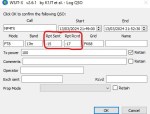
Christian, DK8EW, put me onto Olivia after we chatted on VARA HF. I had heard about Olivia before, but he encouraged me to give it ago.
Soon I made contact with VK4XP and must say it is a great digital format, though I understand a lot feel voice to voice is better (as I do). That said, this digital mode doesn’t require as much bandwidth, so has the potential to go further. The typical Olivia signal can still be decoded when the amplitude of the noise is over ten times that of the Olivia signal which is amazing.
Olivia is part of the family of MFSK modes and has a high redundancy Forward Error Correction system similar to MT63. The MFSK family is very large with many modes, so it can make it very difficult to work out which is which when you hear it. Olivia works really well on poor HF paths.
Olivia digital modes are commonly referred to by the number of tones and the bandwidth, in Hertz, used. Therefore, it is common to express the Olivia digital mode as Olivia X/Y (or Olivia Y/X ), where X refers to the number of different audio tones transmitted and Y refers to the bandwidth in hertz over which these signals are spread. Examples of common Olivia modes are 8/250 (meaning, 8 tones/250-Hertz bandwidth), 16/500, and, 32/1000. There are three popular Olivia modes, which is 8-FSK, 16-FSK and 32-FSK, that have three, four or five bits per symbol.
Olivia QSO Formats
Format Bandwidth / Tones
Audio Centre Marker (Hz)
Baud
Decode S/N Radio (dB)
Speed WPM
500/16*
750
31.25
-13
19.5
1000/32*
1000
31.25
-12
24.4
500/8
750
62.5
-11
29.3
1000/16
1000
62.5
-10
39.1
500/4
750
125
-10
39.1
250/8
625
31.25
-14
14.6
* Is the most common Olivia format in use currently
Here is a video that will give you more information:
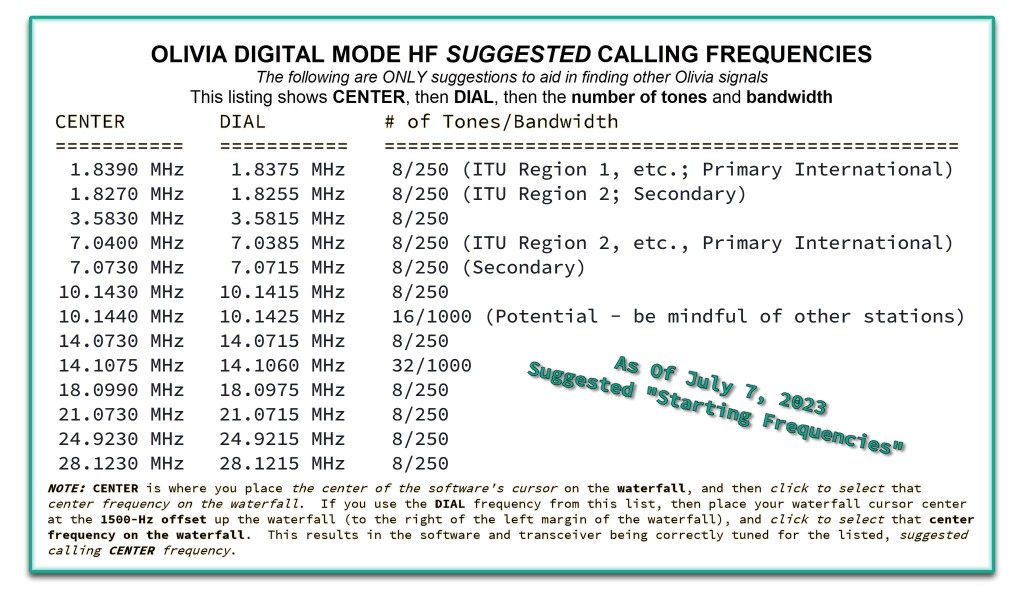
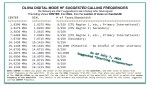
While Olivia could acutally be used anywhere in the data allocated area on HF, however you may not find anyone if you are not on the right frequency. Below is the suggested calling frequencies used around the world:
I’ve typed to many people around the world on this mode and surprised how well it works when conditions are not great. The software tells you if there is another conversation on the band also which is handy.
There are a few protocols, like using BTU (back to you) on your last line and some shortcut typing which isn’t the same as the youth of today use in text messages!
While I still prefer voice contacts with people, at least this option is a conversation and something different when conditions are not favourable.
What are your thoughts on this mode? Have you tried it? Have you had success? What radio and band did you try?
If you enjoyed that, here are some other interesting reads:
When using digital over the radio, it is particularly important you have the correct time. Even a second out will stop you from making contacts. I relied on…
I purchased the Diamond W series W8010 antenna and quickly put it together. The instructions were a bit hard to read as it was exceedingly small. However, I…
The Nano VNA-H 4 is my new toy that has just arrived after purchasing via Banggood. This Antenna Analyser is a complicated device, but doesn’t have to be,…
DXHeat.com is a great website that can update you the current conditions on each band. The website has filtering of incoming DX Spots which can be displayed instantly…
The S-meter is an instrument on most radio receivers that measures the strength of the signal being received. It uses a unit: the S-point. HF radios usually have…
I recently got the Radioddity M916 Heavy duty antenna magnetic mound with the Radioditty HF-008 all band portable antenna. I had always wanted to use HF more while…
I came across something different, FreeDV. The name FreeDV insinuates it is free, but is it? What is it? And what does it do?
They say it will be the new SSB of radio. They say it is clear and goes further when conditions are not great.
Here is what else I found:
FreeDV is an open-source digital voice mode designed for amateur radio operators, enabling digital communicationover HF (high-frequency) bands. It uses the Codec2 audio codec for low bit-rate voice compression, allowing clear voice transmission in narrow bandwidths (typically 1.1–1.6 kHz), which is more efficient than traditional SSB (Single Sideband).
The system requires:
A computer with the FreeDV software,
An HF transceiver, and
An audio interface or sound card for connection.
As a free and open-source project, FreeDV supports experimentation, digital innovation, and promotes efficient spectrum use within the ham radio community.
Rade
RADE V1 (Radio Autoencoder) is the latest digital voice mode introduced in FreeDV 2.0.0 (released June 2025). It combines Machine Learning (ML) and Digital Signal Processing (DSP) to provide a neural voice codec optimized for HF (high-frequency) amateur radio.
Key Features:
ML-based autoencoder architecture integrates voice compression, modulation, and error correction.
Operates within 1.5 kHz bandwidth, suitable for narrowband HF channels.
Achieves intelligible voice transmission down to –2 dB SNR, outperforming analog SSB and earlier FreeDV modes like 700D or 1600.
Uses the Codec2 framework as part of its signal chain.
Performance & Enhancements:
Enhanced voice quality, robustness under weak-signal, fading, and QRM conditions.
Integrated with FreeDV Reporter and PSK Reporter for real-time signal tracking.
Latest builds (e.g., 2.0.0‑20250130) include:
Live SNR monitoring
Improved sync algorithms
Optimized C-based signal processing backend
Signed macOS binaries, and better Python startup performance
Some FreeDV videos
Below are some videos I’ve done on this project.
I’d encourage you to give FreeDV a go. It seems to work well and so clear. But I am keen to hear what your thoughts are on this? Have you used it? Have you tried? Please let me know in the comments.
If you enjoyed this read, here are some more things you may have missed
Yes, this popular girl name is actually an Amateur Radio term. Christian, DK8EW, put me onto Olivia after we chatted on VARA HF. I had heard about Olivia before, but he encouraged me to give it ago. Soon I made contact with VK4XP and must say…
I came across something different, FreeDV. The name FreeDV insinuates it is free, but is it? What is it? And what does it do? They say it will be the new SSB of radio. They say it is clear and goes further when conditions are not…
Ever heard this sound on HF / VHF / UHF? I know I have more and more recently. After a bit of research, someone told me it was VARAC. https://www.varac-hamradio.com/ As I understand it, the project started with Irad Deutsch 4Z1AC. It is free of charge…
DXHeat.com is a great website that can update you the current conditions on each band. The website has filtering of incoming DX Spots which can be displayed instantly using great graphical tools. From the main landing page dxheat.com you can do a search by call sign…
When using digital over the radio, it is particularly important you have the correct time. Even a second out will stop you from making contacts. I relied on Windows to update the time and got an email from a helpful amateur telling me my time was…
I’ve heard a lot about dipole antennas, and I’ve heard a lot about long wire antennas also. I would say I’ve seen more dipoles than long wire antennas. So why is that? What is the difference between them? Which is better? If one is a clear winner,…
Repeater-START is a multi-platform app designed for ham radio and radio-operator enthusiasts who need fast access to repeater information. The app provides a detailed repeater map as well as a distance-sorted list, allowing users to easily locate nearby communication points wherever they travel. Because it uses open…
What Is the 6m Band? The 6-meter band, spanning roughly 50–54 MHz, is a section of the VHF spectrum assigned to amateur radio operators. Its wavelength is six meters, and its position between HF and VHF makes it behave like a mix of both services. Why It’s…
Overview The Anytone AT-778UV is a dual-band VHF/UHF mobile transceiver designed for amateur radio operators. It operates on the 136–174 MHz (VHF) and 400–490 MHz (UHF) bands, offering reliable two-way communication for both ham radio and commercial use (depending on firmware version). Power Output This transceiver provides…
160 meters band is known as the “Gentlemen’s band”. It is right next to the AM commercial band, known as medium wave. The 160-meter band is the radio frequencies between 1.8 and 2 MHz. For many decades it was the lowest radio frequency band allocated for use…
Have you ever had an antenna and forgotten what it is for? Maybe you have been given one and wasn’t told exactly what it was used for. I got given an antenna at at ham fest because it didn’t sell. Funny enough after I got it, many…
Yes, this popular girl name is actually an Amateur Radio term. Christian, DK8EW, put me onto Olivia after we chatted on VARA HF. I had heard about Olivia before, but he encouraged me to give it ago. Soon I made contact with VK4XP and must say it…
The Yaesu FT-620 (and its updated version, the FT-620B) is a vintage amateur radio transceiver designed specifically for the 6-meter band (50–54 MHz). Produced in the 1970s, it offers support for AM, CW, and SSB (USB/LSB) modes, making it a versatile rig for its time, especially during the era when 6 meters was gaining…
I came across something different, FreeDV. The name FreeDV insinuates it is free, but is it? What is it? And what does it do? They say it will be the new SSB of radio. They say it is clear and goes further when conditions are not great.…
Key Assignment For some reason, not all the key assignment options are in the manual and after a bit of searching, I found no complete list. Hopefully this below helps you in selecting your Key Assignments on the main unit P1-P6 keys, as well as on the…
Everyone that has been into radio for a while will know the brand Kenwood. And most know Kenwood isn’t only into Amateur radio, they are bigger than that, and have been also. But are you sure it started in Japan? What else do they make? How big…
Today (20/06/25) I head Ron, VK3AHR, on the 7.100 40-meter net. I understand he ran this net for over 7 years, but hasn’t been able to for the last few weeks due to bad health. At 10am this morning he gave the group an announcement stating “I…
As licensed Amateur Radio operators, we have all heard about Yaesu. We have all seen a Yaesu radio and most of us have used and even own one. I’ve had and have several Yaesu radios. From extremely old ones full of valves and extremely heavy. One can…
I’ve been using the Parks and Peaks app on iphone and ipad for a little while now and quite enjoyed it. There don’t seem to be many iphone apps compared to android, so when there is one, I usually have a look. This one caught my eye…
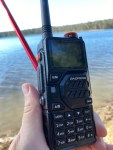
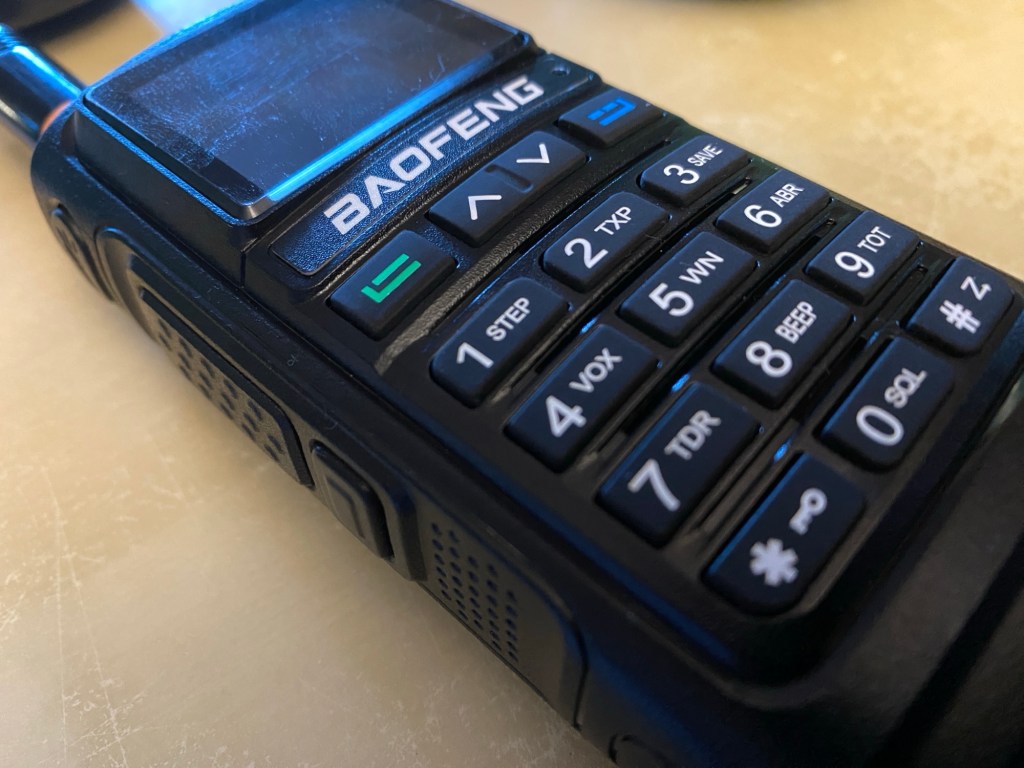
You could say every amateur radio operator knows about the Baofeng if they have been around long enough. Most have held one of their radios and lots have at least one. They have made a huge amount of radios.
According to their website, they have been around fifty years now. However other information I found contradicts this.
Owning a R&D team with 50 years experience in the field of wireless communication. Having launched the Baofeng series of wireless walkie-talkies and related ancillary products.
But how big are they? Do they just build radios and then tweak them to launch another one or are they bigger than that?
Again, according to their website:
Total employees over 1500+. Our factory locates in Changfu Industrial Zone, XIamei of Nan’an, Quanzhou, Fujian province, China.
So what does Baofeng mean in English?
storm wind storm
bào fēng. storm wind storm (force 11 wind)
Baofeng Radio Information
After a bit of research, this is what I found.
Baofeng, a Chinese manufacturer, was founded in 2001 by Mr. Wang Jinding founded Baoan Electronics Co., Ltd. in Nan’an City, Fujian Province in Nan’an City, Fujian Province. In 2017, Fujian Nan’an Baofeng Electronics Co., Ltd. changed its name to Fujian Baofeng Electronics Co., Ltd.
It gained prominence with its Baofeng UV-5R dual-band radio, which became popular for its affordability and features, but also faced regulatory scrutiny due to potential frequency interference.
Fujian Baofeng Electronics Co., Ltd. was founded in 2001 as a high-tech enterprise focused on research, development, production, and sales of radios.
The Baofeng UV-5R, a dual-band radio, became a global sensation in 2012 due to its affordability and features, particularly its ability to operate on both VHF and UHF bands.
However, the UV-5R, and other similar radios, faced regulatory issues in countries like Switzerland, Germany, Poland, and South Africa, due to concerns about frequency interference and the lack of certification in some regions. In the United States, the FCC cited Baofeng for illegally marketing the UV-5R, which was “capable of operating outside the scope of its equipment authorization”. The UV-5R served as a basis for numerous other models, with vendors able to create private-labeled versions, according to CHIRP.
The German Federal Network Agency banned the UV-5R because it dampens harmonics poorly, potentially disturbing other users, and the Independent Communications Authority of South Africa issued a ban after finding the UV-5R to be causing radio frequency interference and for having continuous tuning capabilities, a feature that would require an operator obtain a Frequency allocation license before purchasing or using the device.
Baofeng Models
This website I think only shows a fraction of the radios Baofeng have made and sold. For example a Pro version will be very similar to the original version but comes with so many more things, it is almost a new radio.
In my experience, you either love them starting at their cost, or hate them. It’s well known that some of cheap in price and quality, but this is perhaps the earlier models. If you love them, then they will bread like rabbits, if you hate them and own one, it will probably be sitting at the back of the draw or behind a box somewhere out of site.
There are so many models available now. So if you are wanting a hand held radio and on a budget, do your homework well. Just because it may be the latest model, doesn’t mean it has everything all the other models have.
Baofeng Radios Reviewed
Below are the Baofeng radios I have reviewed on YouTube. Hope you enjoy them.
Programming Tip
Did you know you can program these radios via Chirp? Here is a great tip you may like with chirp.
I’ve heard a lot about dipole antennas, and I’ve heard a lot about long wire antennas also. I would say I’ve seen more dipoles than long wire antennas. So why is that? What is the difference between them? Which is…
Repeater-START is a multi-platform app designed for ham radio and radio-operator enthusiasts who need fast access to repeater information. The app provides a detailed repeater map as well as a distance-sorted list, allowing users to easily locate nearby communication points…
What Is the 6m Band? The 6-meter band, spanning roughly 50–54 MHz, is a section of the VHF spectrum assigned to amateur radio operators. Its wavelength is six meters, and its position between HF and VHF makes it behave like…
Overview The Anytone AT-778UV is a dual-band VHF/UHF mobile transceiver designed for amateur radio operators. It operates on the 136–174 MHz (VHF) and 400–490 MHz (UHF) bands, offering reliable two-way communication for both ham radio and commercial use (depending on…
160 meters band is known as the “Gentlemen’s band”. It is right next to the AM commercial band, known as medium wave. The 160-meter band is the radio frequencies between 1.8 and 2 MHz. For many decades it was the…
Have you ever had an antenna and forgotten what it is for? Maybe you have been given one and wasn’t told exactly what it was used for. I got given an antenna at at ham fest because it didn’t sell.…
Yes, this popular girl name is actually an Amateur Radio term. Christian, DK8EW, put me onto Olivia after we chatted on VARA HF. I had heard about Olivia before, but he encouraged me to give it ago. Soon I made…
The Yaesu FT-620 (and its updated version, the FT-620B) is a vintage amateur radio transceiver designed specifically for the 6-meter band (50–54 MHz). Produced in the 1970s, it offers support for AM, CW, and SSB (USB/LSB) modes, making it a versatile rig for its time, especially during…
I came across something different, FreeDV. The name FreeDV insinuates it is free, but is it? What is it? And what does it do? They say it will be the new SSB of radio. They say it is clear and…
Key Assignment For some reason, not all the key assignment options are in the manual and after a bit of searching, I found no complete list. Hopefully this below helps you in selecting your Key Assignments on the main unit…
Everyone that has been into radio for a while will know the brand Kenwood. And most know Kenwood isn’t only into Amateur radio, they are bigger than that, and have been also. But are you sure it started in Japan?…
Today (20/06/25) I head Ron, VK3AHR, on the 7.100 40-meter net. I understand he ran this net for over 7 years, but hasn’t been able to for the last few weeks due to bad health. At 10am this morning he…
As licensed Amateur Radio operators, we have all heard about Yaesu. We have all seen a Yaesu radio and most of us have used and even own one. I’ve had and have several Yaesu radios. From extremely old ones full…
I’ve been using the Parks and Peaks app on iphone and ipad for a little while now and quite enjoyed it. There don’t seem to be many iphone apps compared to android, so when there is one, I usually have…
With digital radio changing so quickly, below is a bit of an update in regards to DMR radio networks. DMR stands for Digital Mobile Radio and is an internation standard for digital radios since about 2005. It can contain voice…
I managed to get one of these radios and was rather impressed with it and what it came with. Have a look what my box had in it. Some of the things I liked included: It is a Tri-Band radio…
I purchased this radio from a friend, and it worked well. He hadn’t really used it, so I did a factory reset. This was a bit of a mistake, as it did a few things like turning everything to Chinese.…
HamClock has always fascinated me, as it seems such an amazing program specifically set up for Amateur Radio. I have seen countless videos on it but the draw back was always needing to have a Raspberry Pi. While I am…
You could say every amateur radio operator knows about the Baofeng if they have been around long enough. Most have held one of their radios and lots have at least one. They have made a huge amount of radios. According…
A great radio that does all bands up to 70cm. Using all modes also you can talk on SSB on VHF and UHF. If you haven’t done SSB on 2m and 70cm, then I’d encourage you to do so. it…
I recently got my hands on the Hiroyasu IC-980 Pro dual band base radio. This is pronounced as “Hiro-Yasu”. When I say, got my hands on it, the unit is so small, you only need one hand really! This analogue…
Have you heard of a flowerpot antenna? I hadn’t until recently, and I enjoy gardening also. But this antenna has nothing to do with gardening apart from why it was named flowerpot and it will probably end up either on…
The Daiwa CN-460M is a small cross-needle meter displays both forward and reflected power for 2m and 70cm. It measures in ranges of 15/150 watts forward and 5/50 watts reflected. SO-239 jacks. It includes a mobile mounting bracket and meter illumination option…
The 2m band has always been an interesting one for me. It used to be swamped with pager interference, but it actually is a great band. Inversion allows your signal to travel long distances at times, especially on SSB. This…
Why does a radio need a cup holder? I agree it’s a bit odd. But this isn’t a product that involves a cup. Rather it uses a cup holder. Almost every car now has a cup holder, but they are…
There are lots of duel band antennas available, but most required extra mounting brackets. These brackets often restrict you as to where you can mount the antenna on your car. One of my first mobile antennas for the car was…
I’ve always wanted to take the radio with me while on holidays and I always do. However I’ve always been limited to 2m and 70cm including local repeaters and digital work. Our family enjoy holidays all over Australia into some…
Why does a radio need a cup holder? I agree it’s a bit odd. But this isn’t a product that involves a cup. Rather it uses a cup holder.
Almost every car now has a cup holder, but they are all different sizes and locations in the car. Some are large for bottles, others are small for a small coffee. Some are in the door, others are in the centre console of the car, while others are half under the dashboard. Unless it is the same model car, they all seem to be a bit different.
One thing I’ve noticed is a cup holder is never the same size as a hand held radio. What are they thinking! As a radio operator you would think they would build cars to house our radios! Seriously though, cars hardly have any space for much extra.
My current car has almost no space to mount a radio at all. I have a radio that has all the controls on the microphone because of this. I also have a hand held radio that sits on the center console between the two front seats. But this is far from ideal as if I have to brake suddenly, the radio goes flying. Not ideal!
I saw this cup holder radio bracket that is adjustable and fits into a cup holder. It is very adjustable and fits sturdily into a cup or bottle holder.
At the top of the swivel, you can attach a fixture to attach any hand held radio via its belt clip or attach a small remote head radio via its bracket.
Once it is all secured, it works well. Now I have a hand held radio in my car, that doesn’t move around the car. It’s legal and sturdy plus I can see the screen when driving.
The other advantage of this device, apart from how easy it is to install and how versatile it is, was how easy it is to remove. So if I’m in the car for the day, or a year, I can take it out when I am done and return the car the way I found it.
Installing
Here are some quick steps how to install this device.
After unpacking the box, get the RH1 cup holder.
Attach the Angle-Adjusted Connector to the top.
Attach the Handheld radio holder to the Angle Adjustment Connector. Alternatively, you can attach your radio attachment plate to the Angle Adjustment Connector if using a remote head radio or light weight radio.
Place the RH1 in your cup holder and twist so it expands to a firm fit in the car.
Adjust all the available angles from the bottom up to your desired location, then tighten each angle once set. Make sure it does not obstruct you driving the car or your view.
I purchased this radio from a friend, and it worked well. He hadn’t really used it, so I did a factory reset. This was a bit of a mistake, as it did a few things like turning everything…
The Yaesu FT-620 (and its updated version, the FT-620B) is a vintage amateur radio transceiver designed specifically for the 6-meter band (50–54 MHz). Produced in the 1970s, it offers support for AM, CW, and SSB (USB/LSB) modes, making it a versatile rig for its time,…
The 2m band has always been an interesting one for me. It used to be swamped with pager interference, but it actually is a great band. Inversion allows your signal to travel long distances at times, especially on…
A great radio that does all bands up to 70cm. Using all modes also you can talk on SSB on VHF and UHF. If you haven’t done SSB on 2m and 70cm, then I’d encourage you to do…
The WizNet DMR app is still in beta testing, and at the time of writing this, you have to not only have a currently have a licence as an Amateur Radio Operator, but approved to be part of…
Have you ever had an antenna and forgotten what it is for? Maybe you have been given one and wasn’t told exactly what it was used for. I got given an antenna at at ham fest because it…
Welle.io is a DAB and DAB+ software defined radio (SDR). It runs on Windows, Linux and embedded devices like the Raspberry Pi 2 and 3. You can find the program and where to download it from their website.…
Hi there from Down Under, Melbourne Australia. Thank you for visiting my radio web site. Below is what items by category is available on this web site. Thanks again for visiting. This web site is still being built,…
Today (20/06/25) I head Ron, VK3AHR, on the 7.100 40-meter net. I understand he ran this net for over 7 years, but hasn’t been able to for the last few weeks due to bad health. At 10am this…
Ever heard this sound on HF / VHF / UHF? I know I have more and more recently. After a bit of research, someone told me it was VARAC. https://www.varac-hamradio.com/ As I understand it, the project started with…
If you want to get onto Digital Radio for less (way less) than $100, then you may be interested in this. I have Apple equipment, and therefore miss out on a lot of the testing apps that are…
This page is just a help to friends I have spoke to who are interested in upgrading the Radioditty GD-77 to the OpenGD77 software. This is not my work, however I really do appreciate Roger and his team have done to put this together. I claim no responsibility if it breaks your radio, however I have not hear this happen now in some time. I am not an expert at all with OpenGD77, I have just put this together to help people who have asked me how to do it.…
Updating the firmware on the GD-77 can be daunting, as you can easily “brick” your radio. So be extremely careful. Make sure you understand why you are updating your firmware first. Since there is the option of “Bricking”…
An unusual name, but a catchy name no less, just like Peanut that was written by the same person, David PA7LIM. If you like Peanut, then you will like this project also. This project, like Peanut, includes some amazing coding and thinking.…
How do you stop a hand held radio from falling and being damaged? Do you sometimes put the radio down on a bench or desk between overs or while you are waiting for someone to call you? Some…
As licensed Amateur Radio operators, we have all heard about Yaesu. We have all seen a Yaesu radio and most of us have used and even own one. I’ve had and have several Yaesu radios. From extremely old…
A good friend of mine, Mike VK5ZC, put the information below together and asked me to put it on my web site. He has spent a lot of time putting it together with pictures and videos, so I encourage you to have a good read.…
If you haven’t seen my previous blog on the NanoVNA Analyser, then I suggest you look at that first before reading this blog. This one will talk about how to connect your NanoVNA to your PC via the USB cable, so I am assuming you know the basics on how to operate it.
There is a google drive (link here) that has a lot of things on it, including manuals and software. There is lot of other things that I haven’t looked at yet also available in several languages.
If you go into the Software and Drivers folder via the link above, you will see the file NanoVNASharp.zip. Download this file onto your PC, then unzip it into a folder.
Once unzipped, you can run the NanoVNA.exe file after connecting your NanoVNA device with the USB cable. You may need to install the driver. I used the nanovna-cdc.acm.zip file you can see on the above google drive.
You may have to go to your windows device manager to check which COM Port the NanoVNA has been allocated. Below is what the program looks like (without the graph showing).
You can see above where to select the com port and connect. You can adjust the start and stop frequencies as mentioned in the last post. You can either press the Get Data button or tick the Auto Refresh box. Then you can save and open the file. I did screen shots before I adjusted my antenna, so you can open the current and old side by side and compare what your adjustments did.
Down the bottom of the chart is where you can change the chart format from Logmag to Smith Chart or SWA etc. You can also change the scale as needed.
Below is an output from my dipole antenna. You can see the SWA is very high at 3.5Mhz still but a lot better on other bands.
The other bands may not be perfect, I can now zoom in to each band one at a time and see how the antenna works across the selected band more accurately.
I would value your thoughts on this and if you found it interesting. Please send me an email or post a comment below.
The Daiwa CN-460M is a small cross-needle meter displays both forward and reflected power for 2m and 70cm. It measures in ranges of 15/150 watts forward and 5/50 watts reflected. SO-239 jacks. It…
When measuring SWR, I always forget if I should lengthen or shorten the antenna. So rather than jump around the bush, I will get to the answer straight away. The graph…
If you haven’t seen my previous blog on the NanoVNA Analyser, then I suggest you look at that first before reading this blog. This one will talk about how to connect…
The Nano VNA-H 4 is my new toy that has just arrived after purchasing via Banggood. This Antenna Analyser is a complicated device, but doesn’t have to be, and can be…
If you want to get onto Digital Radio for less (way less) than $100, then you may be interested in this. I have Apple equipment, and therefore miss out on a…
Orion is an app that isn’t really known in my world, perhaps because it isn’t available on all platforms, or because it does transmit your exact location to everyone on the…
The WizNet DMR app is still in beta testing, and at the time of writing this, you have to not only have a currently have a licence as an Amateur Radio…
How do you stop a hand held radio from falling and being damaged? Do you sometimes put the radio down on a bench or desk between overs or while you are…
A good friend of mine, Mike VK5ZC, put the information below together and asked me to put it on my web site. He has spent a lot of time putting it together with pictures and videos, so I encourage you to have a good read.…
There are several DMR networks around the world, and more and more start all the time. The Australian DMR network currently covers the entire country and is for Australian residents only.…
I found it hard to find useful information on how to run the OpenGD-77 hotpot mode with Windows 10. At the time of writing this, there is a lot about this topic using a pistar and even android or ISO, but not much with Windows 10. This is my experence with BlueDV and Open GD-77 using a Windows 10 PC.…
The new OpenSpot3 has come out with an internal battery. You might ask why? Well there is two common issues that is mostly raised with almost all hot spots. One is…
One of the most underutilised by very cool feature that comes with some digital networks is the ability to send and receive SMS messages. You can send it fairly easily to…
After talking to a friend just to the north of me, he told me about the app DROID-Star for Android. As I only have apple devices, this wasn’t initially an option…
An unusual name, but a catchy name no less, just like Peanut that was written by the same person, David PA7LIM. If you like Peanut, then you will like this project also. This project, like Peanut, includes some amazing coding and thinking.…
I have spoken to a few people who have felt a bit overwhelmed setting up their OpenSpot from the start. In saying that, I have always been surprised how many people…
The thing with digital communications, it can be extremely complicated. It only takes one tick box to be ticked incorrectly to take your station off the air. Just as easily one…
Sometimes we try and build things and a lot of time abs money on our radio racks but have you thought outside the square? A simple shoe shelf makes a fantastic…
Here is a free windows program that will connect your PC to: DMR Yaesu Fusion DStar M17 P25 NXDN You can do all this without needing to purchase a radio. I…
As per the Yaesu FT-710 manual, the Digital Noise Reduction (DNR) system is designed to reduce the level of ambient noise found on the HF and 50 MHz bands. The (DNR) system is especially effective during SSB operation. Any of 15 different noise-reduction algorithms can be selected; each of these algorithms was created to deal with a different noise profile. You will want to experiment with the DNR system to find the best setting corresponding to the noise currently being experienced.
The DNR function can be operated individually for VFO-A band and VFO-B.
But have you ever tried this trick with the RF-Gain. Have a look at this video to see more:
Press the [DNR] key to enable the DNR operation. To disable DNR operation, press the [DNR] key once more. If you turn your RF gain back to 12 o’clock, it will sound super.
I would love to hear your views on this, and how you have used it. Please like or comment below.
If you enjoyed this read, here are some others you may like:
As licensed Amateur Radio operators, we have all heard about Yaesu. We have all seen a Yaesu radio and most of us have used and even own one. I’ve had and have several Yaesu radios. From extremely…
Have you ever tried Band Stacking before? This is where you have three options per band every time you go to that band. For example, you may have one set up on SSB, one on CW and…
As per the Yaesu FT-710 manual, the Digital Noise Reduction (DNR) system is designed to reduce the level of ambient noise found on the HF and 50 MHz bands. The (DNR) system is especially effective during SSB…
I’ve heard a lot about dipole antennas, and I’ve heard a lot about long wire antennas also. I would say I’ve seen more dipoles than long wire antennas. So why is that? What is the difference between…
What Is the 6m Band? The 6-meter band, spanning roughly 50–54 MHz, is a section of the VHF spectrum assigned to amateur radio operators. Its wavelength is six meters, and its position between HF and VHF makes…
160 meters band is known as the “Gentlemen’s band”. It is right next to the AM commercial band, known as medium wave. The 160-meter band is the radio frequencies between 1.8 and 2 MHz. For many decades…
Yes, this popular girl name is actually an Amateur Radio term. Christian, DK8EW, put me onto Olivia after we chatted on VARA HF. I had heard about Olivia before, but he encouraged me to give it ago.…
The Yaesu FT-620 (and its updated version, the FT-620B) is a vintage amateur radio transceiver designed specifically for the 6-meter band (50–54 MHz). Produced in the 1970s, it offers support for AM, CW, and SSB (USB/LSB) modes, making it a versatile rig for its…
I came across something different, FreeDV. The name FreeDV insinuates it is free, but is it? What is it? And what does it do? They say it will be the new SSB of radio. They say it…
A great radio that does all bands up to 70cm. Using all modes also you can talk on SSB on VHF and UHF. If you haven’t done SSB on 2m and 70cm, then I’d encourage you to…
Have you heard of a flowerpot antenna? I hadn’t until recently, and I enjoy gardening also. But this antenna has nothing to do with gardening apart from why it was named flowerpot and it will probably end…
I’ve always wanted to take the radio with me while on holidays and I always do. However I’ve always been limited to 2m and 70cm including local repeaters and digital work. Our family enjoy holidays all over…
CBL-561 Review The new CBL-561 antenna is strong and light that is fit for mobile work, camping or remote radio use. I plan to use this on our next outback trip! This antenna supports a frequency range…
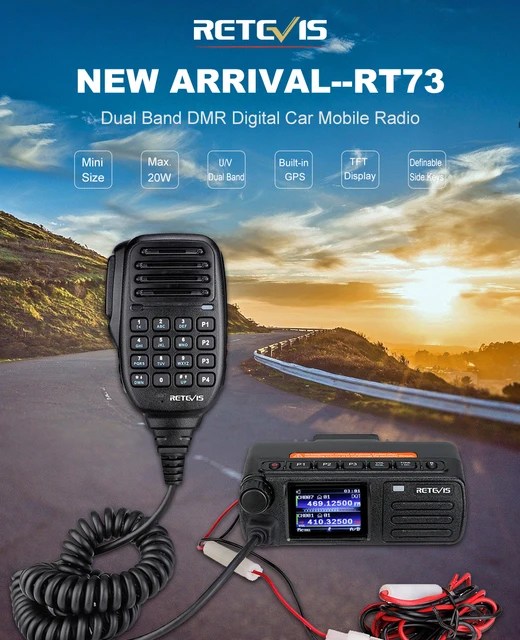
The Retevis RT73 and Kydera CDR300UV are identical radios. They are a DMR/FM duel band radio for Amateur radio use. This is great, as most of the early DMR radios available were commercial radios that were used for Amateur operations.
At time of writing this, the radio is one of the smallest dual band DMR mobile I’ve seen, about the size of a handheld.
Some of the features include:
DMR / Analog
Dual Timeslot (MotoTRBO compatible)
VHF / UHF Dual Band
Size: 121 x 76 x 43mm, 4.75 x 3.0 x 1.7″
Weight: 329g, 11.6oz
136-174 400-480 MHz
5W-20W transmit
FM radio receive
300,000 DMR DB IDs (w/ Latest FW/SW)
20,000 call groups
4000 channels
Analog APRS
16 zones (250 Chan / zone)
Built in GPS
DMR roaming
Included with the radio in the box are:
Microphone (DTMF currently doesn’t work but may be fixed with a future update)
Mounting bracket and screws
2m 12V power cord
60-page user guide – 6 languages
GPS antenna
Programming cable (optional – but you may already have one)
There are three programable keys along the top along with other buttons. These buttons respond differently to long and short presses. The speaker is on the front making it easy to mount, however the speaker microphone can also be a speaker if you want it to be. There are two power levels, 5W and 20W.
The display is small, but it is a small radio. However, the 2″ screen is bright and colourful. It is easy to navigate also with icons on the main menu.
Programming can be a bit tricky if you use the normal software, however there are a few alternatives. The good news is the software is free. Some do not allow you to export or import, and when you want to add a channel, it has to be added to the end, not between.
I would recomend Codeplug Editor by David MM7DBT as it has an easy tabulated menu system that guides you through each step of programming this radio.
Some other things you should know:
Listen in single channel or dual channel mode
Has promiscuous mode for DMR, however it is only on the one timeslot even in dual mode which is a pain.
You will need to make sure you are on the latest firmware for everything to work correctly (eg APRS).
You can adjust the TX audio for DMR and analog. This may need adjusting when you first get it.
Colour display that is easy to use, but can be hard to see from a distance or in a car.
You can program in zones, which is great. So you can turn them on or off.
Small design so easy to mount in the car
It is clear from other reviews that this radio had and has some bugs. But as more firmware updates gets pushed out, the better the radio becomes. This is mainly about GPS and APRS making the radio slow or even take over. However, most reviews admit with the latest firmware, the problem has been fixed.
If you enjoyed this read, please subscribe so you do not miss out on any other posts we put here. There are some other articles you may find of interest below:
I’ve heard a lot about dipole antennas, and I’ve heard a lot about long wire antennas also. I would say I’ve seen more dipoles than long wire antennas. So…
Repeater-START is a multi-platform app designed for ham radio and radio-operator enthusiasts who need fast access to repeater information. The app provides a detailed repeater map as well as…
What Is the 6m Band? The 6-meter band, spanning roughly 50–54 MHz, is a section of the VHF spectrum assigned to amateur radio operators. Its wavelength is six meters,…
Overview The Anytone AT-778UV is a dual-band VHF/UHF mobile transceiver designed for amateur radio operators. It operates on the 136–174 MHz (VHF) and 400–490 MHz (UHF) bands, offering reliable…
160 meters band is known as the “Gentlemen’s band”. It is right next to the AM commercial band, known as medium wave. The 160-meter band is the radio frequencies…
Yes, this popular girl name is actually an Amateur Radio term. Christian, DK8EW, put me onto Olivia after we chatted on VARA HF. I had heard about Olivia before,…
The Yaesu FT-620 (and its updated version, the FT-620B) is a vintage amateur radio transceiver designed specifically for the 6-meter band (50–54 MHz). Produced in the 1970s, it offers support for AM, CW, and SSB…
Key Assignment For some reason, not all the key assignment options are in the manual and after a bit of searching, I found no complete list. Hopefully this below…
The S-meter is an instrument on most radio receivers that measures the strength of the signal being received. It uses a unit: the S-point. HF radios usually have a needle scale, whereas other bands often have LEDs displaying the S-Points.
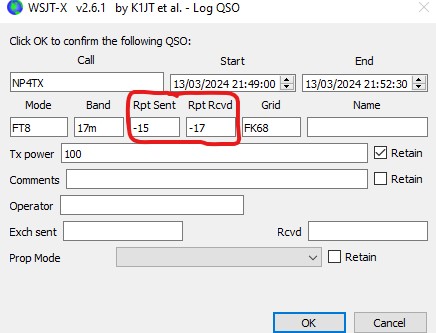
S-Points is the common method of measuring signal strength between operators, however many programs like WSJTX use dB. So how do you convert between dB and S?
S-points go from S1 to S9, and each S-point is defined as a 6 dB change in signal strength. Therefore, each time the voltage is halved (–6 dB) the signal strength decreases by one point. S9 is already a very strong signal, but to describe larger signals, steps of 10 dB are used instead of 6 dB, noted “S9+20” meaning 20 dB above S9.
S-points for frequencies below 30 MHz
Signal strength
Relative intensity
S1
–48 dB
S2
–42 dB
S3
–36 dB
S4
–30 dB
S5
–24 dB
S6
–18 dB
S7
–12 dB
S8
–6 dB
S9
0 dB
S9+10
10 dB
S9+20
20 dB
S9+30
30 dB
S9+40
40 dB
S9+50
50 dB
S9+60
60 dB
S-points for frequencies above 30 MHz:
Signal strength
Relative intensity
S1
–48 dB
S2
–42 dB
S3
–36 dB
S4
–30 dB
S5
–24 dB
S6
–18 dB
S7
–12 dB
S8
–6 dB
S9
0 dB
S9+10
10 dB
S9+20
20 dB
S9+30
30 dB
S9+40
40 dB
S9+50
50 dB
S9+60
60 dB
Hopefully, this helps answer the question how to convert a dB signal strength to a S1 to S9 signal strength.
If you enjoyed this read, there are some others below you may enjoy. Please put your email address in the subscribe area if you want to keep updated with all the updates.
I’ve heard a lot about dipole antennas, and I’ve heard a lot about long wire antennas also. I would say I’ve seen more dipoles than long wire antennas. So why…
Repeater-START is a multi-platform app designed for ham radio and radio-operator enthusiasts who need fast access to repeater information. The app provides a detailed repeater map as well as a…
What Is the 6m Band? The 6-meter band, spanning roughly 50–54 MHz, is a section of the VHF spectrum assigned to amateur radio operators. Its wavelength is six meters, and…
Overview The Anytone AT-778UV is a dual-band VHF/UHF mobile transceiver designed for amateur radio operators. It operates on the 136–174 MHz (VHF) and 400–490 MHz (UHF) bands, offering reliable two-way…
160 meters band is known as the “Gentlemen’s band”. It is right next to the AM commercial band, known as medium wave. The 160-meter band is the radio frequencies between…
Yes, this popular girl name is actually an Amateur Radio term. Christian, DK8EW, put me onto Olivia after we chatted on VARA HF. I had heard about Olivia before, but…
The Yaesu FT-620 (and its updated version, the FT-620B) is a vintage amateur radio transceiver designed specifically for the 6-meter band (50–54 MHz). Produced in the 1970s, it offers support for AM, CW, and SSB (USB/LSB) modes,…
Ever heard this sound on HF / VHF / UHF? I know I have more and more recently.
Listen to the strange data sounds you can hear
After a bit of research, someone told me it was VARAC. https://www.varac-hamradio.com/ As I understand it, the project started with Irad Deutsch 4Z1AC. It is free of charge for amateur radio operators.
This software provides text base communications over HF / VHF / UHF bands (and a few more also!). It is a bit different to FT8 FT4 JT8 etc as this not only gives you a signal report, but you can do a lot of cool things and really make some good friends in the process. I know I have in just the first 2 days. You can type in real time via your radio, and even see when the other person is typing. You can send files, and emails also and send out a beacon every 15 minutes to let people know you are there or see who can hear you on PSK. The software will also let people know when you hear them automatically.
You need the software VARA HF to decode it. VARA HF is essentially a software modem. Whereas VARAC is the chat-based software.
Downloading
Simply go to the address https://www.varac-hamradio.com/download and download the appropriate version. You can download HF or FM depending on what mode you will be using. Down the bottom of this page you can put in your email address and they will send you instructions.
Setting Up VARA HF
VARA FM is also available to be used with UHF and VHF. There is also VARA SAT for geostationary Sat.
VARA HF (as well as VARA FM and VARA SAT) is essentially a software modem that connects your radio to the VARA AC software. VARA HF is for HF only and this is the one I am using and talking about here. Though I understand the others are the same concept, just different radios.
Once installed, select settings, then sound card and update to the settings you use. If you are not sure what device to add, then have a look at windows device manager. Then put in your call sign and registration Key. If you don’t have one, you can just use your call sign for a period. This part of the software you will have to buy at some point, but you get a while to try it before you have to and it really isn’t expensive. There are updates all the time by the look of what is posted on Facebook.
Setting Up VARAC
Go to settings then Rig Control and VARA configurations. Here we need to set the PTT configuration up the top left of this screen. This will be how the software connects to your radio. You also need to setup the frequency control section. Once setup, press the save and exit button.
Using VARAC
Each band has a calling frequency, which you can select up the top left of the default screen via the drop-down box. On the calling frequency, you can receive calls which will be shown on the top blue box. While on the calling frequency, other users can get an automatic signal report from you, or even ping you to see if you are there.
The above picture is the main screen in advanced mode (you can see I have it ticked up the top right). The lower blue box shows that I have sent a beacon, and about to send another one. Prior to that I had a 15min conversation with VK3FFB.
The box up the top right shows anyone currently calling CQ (currently none in the above example, but the band was a bit dead), and the box next to that is the two beacons I can pick up with their signal strength. You can see on the top left I am on the calling frequency of 28.105 Mhz.
If you click on someone calling CQ, VARAC will attempt to connect with that station via the same slot that they are on. The slots are just a different frequency to the main calling frequency.
When calling CQ yourself, you press the purple CALL CQ button then check which slots are available. Select a slot then press the sniffer button and listen to your radio to check no one is there. Remember to turn the volume up for this! If there is traffic on that selected slot, select another slot and sniff that one. Once you have found one, you can press CALL CQ on that box.
VARA AC will now call CQ on the calling frequency then receive on the chosen slot. Should someone join you, you will see it on the bottom blue screen. You can type whatever you want in the bottom new message box and press send, and you can do it for as long as you want, it is not like FT8 with just a signal report. You can also see when the other person is typing a message (if enabled).
You can also send files to each other should you want to. I like to send a QSL card. On the right you can see Send VMail, or you can set yourself to away.
Just above the new message box to the far right, are some canned messages. You can edit these via the settings menu. These will send pre-populated information about yourself to the other person, like your name, QTH, Location and your power. This information will then auto populate on their screen in the boxes just above the New Message box. If they send you one back, it will auto populate on yours so you can either auto log or press log to log the contact with all the information received. This logged information can then be used for a variety of logging programs.
If you are logging on QRZ, you will find VARAC under Dynamic mode.
PSK
One extra feature is you can go to https://pskreporter.info/pskmap.html and put in your call sign and then select VARA. Every 15 minutes VARAC will send out a ping and on PSK you can see who heard you around the world on the map. This 15-minute time can be adjusted in the settings window down the bottom right.
VarAC Do’s and Don’ts
Here is a copy of the code of conduct that should get emailed to you if you put in your email address. Make sure you have a good read as you don’t want to be the one everyone talks about for the wrong reason!
The Don’t: Don’t jam the Calling Frequency (CF). Don’t hold it for more then a few minutes or more then necessary.
The Do: Started a QSO on the CF? It’s OK, but QSY as soon as possible. You have QSY UP/Down buttons or a free-form QSY button where you can select your desired QSY frequency.
The Don’t: Don’t use the PING feature for DXCC/Grid hunting. Pings are not registered as QSOs as only one side sends an SNR report.
The Do: Use PING only as tool to check the link quality with your desired destination.
The Don’t: Don’t use 2300Hz BW on the VarAC CF or on any of the slots.
The Do: Use Only 500Hz on VarAC CF and slots to avoid QRM-ing nearby VarAC QSOs. Use 2300Hz only outside of the slot frequencies.
The Don’t: Don’t QSY to a frequency without checking if it is free.
The Do: VarAC provides you with Sniffers. Right-click on the QSY Up/Down buttons will temporarily QSY to the destination frequency (without keying your PTT) so you can listen before QSY-ing. Same goes for calling CQs: Use the CQ slot sniffer.
The Don’t: Don’t try to send large files over HF. And if the link is slow – don’t send files at all. It will never end. And PLEASE don’t send files over the CF.
The Do: Send files up to 5-10K in high speed and no more than 1-2K in low speed and always on non CF frequencies.
Other information
There is a lot more to learn about VARC, but hopefully this helps as a starting point. Please let me know in the comments if it helped you. I do hope to do a video on it soon.
Special thanks to Irad Deutsch 4Z1AC who helped me in answering questions for this review.
Below are some other interesting reads you may enjoy also.
The Yaesu FT-620 (and its updated version, the FT-620B) is a vintage amateur radio transceiver designed specifically for the 6-meter band (50–54 MHz). Produced in the 1970s,…
I’ve been using EchoLink well before smartphones where the only way I knew how to connect to a different station was via the radio. The internet wasn’t as extensive as it is now and you had to dial the node you wanted via the radio. You can still do this today but I don’t think anywhere near as many do it.
I always felt EchoLink was well ahead of its time. Started well before any digital radio was thought of. Connecting the world via the internet.
It was great to be able to talk to the UK or States while mobile on the way to work just using a small whip antenna on the car.
Given I’m in Australia, it can be difficult to remember when overseas nets are on, or what part of the world is awake and up for a chat and which ones are not. But EchoLink has a CQ feature.
Calling CQ
EchoLink had a CQ feature where you can call CQ and it will automatically connect to someone who is calling CQ also.
From the Stations screen select call CQ.
Then select your language.
Select the country, if you leave it as any, you will not limit your connection options
Select the node type, again, leave as any to start with
And you can skip recent if you want to.
Then press Call CQ
It will call CQ for a while searching for a connection that matches your settings. I find that sometimes it tries to connect to another node but can fail. This is perhaps because the connection drops out for whatever reason. Just try again.
The good thing about this option is you will get someone who is wanting to talk to someone just like you do!
What is your experience with EchoLink? What is your favourite nodes? Why don’t you put it in the comments below so we can all learn from your experiences.
I’ve heard a lot about dipole antennas, and I’ve heard a lot about long wire antennas also. I would say I’ve seen more dipoles than long wire antennas. So why is that? What is the…
Repeater-START is a multi-platform app designed for ham radio and radio-operator enthusiasts who need fast access to repeater information. The app provides a detailed repeater map as well as a distance-sorted list, allowing users to…
What Is the 6m Band? The 6-meter band, spanning roughly 50–54 MHz, is a section of the VHF spectrum assigned to amateur radio operators. Its wavelength is six meters, and its position between HF and…
Overview The Anytone AT-778UV is a dual-band VHF/UHF mobile transceiver designed for amateur radio operators. It operates on the 136–174 MHz (VHF) and 400–490 MHz (UHF) bands, offering reliable two-way communication for both ham radio…
160 meters band is known as the “Gentlemen’s band”. It is right next to the AM commercial band, known as medium wave. The 160-meter band is the radio frequencies between 1.8 and 2 MHz. For…
Have you ever had an antenna and forgotten what it is for? Maybe you have been given one and wasn’t told exactly what it was used for. I got given an antenna at at ham…
Yes, this popular girl name is actually an Amateur Radio term. Christian, DK8EW, put me onto Olivia after we chatted on VARA HF. I had heard about Olivia before, but he encouraged me to give…
The Yaesu FT-620 (and its updated version, the FT-620B) is a vintage amateur radio transceiver designed specifically for the 6-meter band (50–54 MHz). Produced in the 1970s, it offers support for AM, CW, and SSB (USB/LSB) modes, making it a versatile rig…
I came across something different, FreeDV. The name FreeDV insinuates it is free, but is it? What is it? And what does it do? They say it will be the new SSB of radio. They…
Key Assignment For some reason, not all the key assignment options are in the manual and after a bit of searching, I found no complete list. Hopefully this below helps you in selecting your Key…