
The S-meter is an instrument on most radio receivers that measures the strength of the signal being received. It uses a unit: the S-point. HF radios usually have a needle scale, whereas other bands often have LEDs displaying the S-Points.
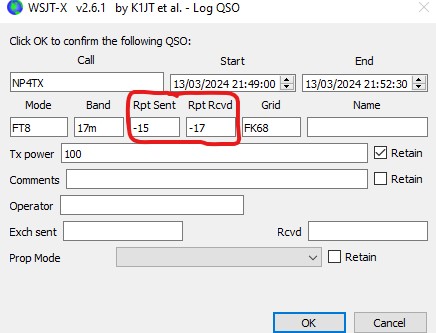
S-Points is the common method of measuring signal strength between operators, however many programs like WSJTX use dB. So how do you convert between dB and S?
S-points go from S1 to S9, and each S-point is defined as a 6 dB change in signal strength. Therefore, each time the voltage is halved (–6 dB) the signal strength decreases by one point. S9 is already a very strong signal, but to describe larger signals, steps of 10 dB are used instead of 6 dB, noted “S9+20” meaning 20 dB above S9.
S-points for frequencies below 30 MHz
| Signal strength | Relative intensity |
| S1 | –48 dB |
| S2 | –42 dB |
| S3 | –36 dB |
| S4 | –30 dB |
| S5 | –24 dB |
| S6 | –18 dB |
| S7 | –12 dB |
| S8 | –6 dB |
| S9 | 0 dB |
| S9+10 | 10 dB |
| S9+20 | 20 dB |
| S9+30 | 30 dB |
| S9+40 | 40 dB |
| S9+50 | 50 dB |
| S9+60 | 60 dB |
S-points for frequencies above 30 MHz:
| Signal strength | Relative intensity |
| S1 | –48 dB |
| S2 | –42 dB |
| S3 | –36 dB |
| S4 | –30 dB |
| S5 | –24 dB |
| S6 | –18 dB |
| S7 | –12 dB |
| S8 | –6 dB |
| S9 | 0 dB |
| S9+10 | 10 dB |
| S9+20 | 20 dB |
| S9+30 | 30 dB |
| S9+40 | 40 dB |
| S9+50 | 50 dB |
| S9+60 | 60 dB |
Hopefully, this helps answer the question how to convert a dB signal strength to a S1 to S9 signal strength.
If you enjoyed this read, there are some others below you may enjoy. Please put your email address in the subscribe area if you want to keep updated with all the updates.
- Radioddity Nodara Mesh Device
 The Radioddity Nodara is an upcoming, highly anticipated off-grid mesh communication device built for the LoRa network. Developed by Radioddity primarily as an official Meshtastic radio, its robust hardware has…
 - Baofeng UV-29 Pro Dual-Band Handheld Radio
 The Baofeng UV-29 Pro is a powerful dual-band handheld radio designed for amateur radio operators, outdoor activities, emergency communications and general VHF/UHF radio use. With up to 10 watts of…
 - Baofeng Celebrates 25 Years of Two-Way Radio Innovation
 In 2026, Baofeng celebrates 25 years as one of the world’s best-known manufacturers of affordable two-way radios. Founded in 2001 as Fujian Baofeng Electronics Co., Ltd., the company has grown…
 - 20m vs 17m
 One day I was checking the bands and noticed the 17m band is open for a short period. I have noticed this over a long period that it often opens…
 - HF on a Hand Held?
 Radioditty sent the new GS-10B Pro to me before it was released as they wanted you to see it first. When sending it, they never told me what to say,…
 - CW Skimmer
 CW Skimmer is a popular amateur radio software program used for decoding Morse code signals on the HF bands. The program is widely used by ham radio operators, DX chasers,…
 - ADIF Master
 ADIF Master is a popular amateur radio logging software tool used for editing and managing ADIF log files. ADIF stands for Amateur Data Interchange Format, which is the worldwide standard…
 - 15 Metre band
 The 15 metre band is one of the most popular HF amateur radio bands for long-distance communication, offering an excellent balance between reliability and worldwide reach. Frequency Range The standard…

