Dipole Antenna for Portable Use – Make your own!

A dipole antenna is a basic radio antenna made of two conductive elements fed at the center. It is typically a half-wavelength long and is widely used as a reference antenna in antenna theory and practice.

Dipole antennas work by converting alternating current into electromagnetic waves. Their radiation pattern is strongest perpendicular to the antenna and weakest along its axis, forming a donut-shaped pattern in three dimensions.

The orientation of a dipole antenna determines its polarization. A horizontal dipole produces horizontally polarized waves, while a vertical dipole produces vertically polarized waves. Matching polarization improves signal strength.

A half-wave dipole has an impedance of about 73 ohms in free space, which closely matches common coaxial cables. Proper impedance matching improves efficiency and reduces signal reflections.

When a dipole is installed close to the ground, near objects, or in an inverted-V shape, its impedance naturally drops from ~73 ohms toward 50 ohms. Many real-world dipoles end up near 50 ohms without extra components.

A folded dipole has about 300 ohms impedance, but using a 4:1 balun converts it to 75 ohms, and further matching can bring it to 50 ohms if needed.

Common types include half-wave, folded, short, and inverted-V dipoles. Dipole antennas are used in FM radio, television, amateur radio, and as components of directional antenna arrays.

My Antenna

Below is the antenna I made and tested. This video will show you how I did it, and why. I share some tips I learned along the way. But I would also value your thoughts.

The app I used to get the measurements from is this one:

https://play.google.com/store/apps/details?id=com.daveyhollenberg.amateurradiotoolkit

However you can get lots of different apps that will do this. Or you can use the simple formula to work it out in metric or imperial.

My portable setup

Below are some videos on my portable setup which you may enjoy.


If you enjoyed this read, below are some you may also enjoy.

  • Dipole Antenna for Portable Use – Make your own!
    A dipole antenna is a basic radio antenna made of two conductive elements fed at the center. It is typically a half-wavelength long and is widely used as a reference antenna in antenna theory and practice. Dipole antennas work by converting alternating current into electromagnetic waves.…
  • Interference
    Interference in Amateur Radio refers to unwanted signals that disrupt radio communication. This interference can reduce signal clarity, make contacts difficult, or completely block communication between amateur radio operators. Radio Frequency Interference (RFI) is one of the most common problems in amateur radio. It often comes…
  • 6m and TV Channel 0
    Prior to 1989, it was illegal to operate between 50 MHz and 52 MHz in Australia. It was a real pain as that was where all the action was when the band opened up. However, after many requests from the WIA to the DoTC back in…
  • Dipole Antennas Vs Long Wire Antennas
    I’ve heard a lot about dipole antennas, and I’ve heard a lot about long wire antennas also. I would say I’ve seen more dipoles than long wire antennas. So why is that? What is the difference between them? Which is better? If one is a clear…
  • Repeater-START
    Repeater-START is a multi-platform app designed for ham radio and radio-operator enthusiasts who need fast access to repeater information. The app provides a detailed repeater map as well as a distance-sorted list, allowing users to easily locate nearby communication points wherever they travel. Because it uses…
  • The 6-Meter Amateur Radio Band
    What Is the 6m Band? The 6-meter band, spanning roughly 50–54 MHz, is a section of the VHF spectrum assigned to amateur radio operators. Its wavelength is six meters, and its position between HF and VHF makes it behave like a mix of both services. Why…
  • Anytone AT-778UV
    Overview The Anytone AT-778UV is a dual-band VHF/UHF mobile transceiver designed for amateur radio operators. It operates on the 136–174 MHz (VHF) and 400–490 MHz (UHF) bands, offering reliable two-way communication for both ham radio and commercial use (depending on firmware version). Power Output This transceiver…
  • 160 Meters Band
    160 meters band is known as the “Gentlemen’s band”. It is right next to the AM commercial band, known as medium wave. The 160-meter band is the radio frequencies between 1.8 and 2 MHz. For many decades it was the lowest radio frequency band allocated for…

Interference

Interference in Amateur Radio refers to unwanted signals that disrupt radio communication. This interference can reduce signal clarity, make contacts difficult, or completely block communication between amateur radio operators.

Radio Frequency Interference (RFI) is one of the most common problems in amateur radio. It often comes from man-made electronic devices such as phone chargers, computers, LED lights, televisions, and power supplies. These devices can produce continuous noise or buzzing sounds across radio bands.

Natural Interference also affects amateur radio operations. Lightning causes static noise, while solar activity can disrupt or enhance signals, especially on HF bands. Atmospheric conditions play a major role in how radio waves travel and how much noise is present.

Adjacent Channel Interference and Harmonics occur when signals spill over into nearby frequencies or when transmitters emit unwanted signals outside their assigned band. This is usually caused by poor filtering, excessive power, or improperly adjusted equipment.

Managing and Reducing Interference is an important responsibility for amateur radio operators. Techniques include proper grounding, using quality cables, installing filters, adding ferrite chokes, and ensuring transmitters produce clean signals.

Rules and Responsibilities in Amateur Radio require operators to avoid causing harmful interference, accept interference from other legal users, and correct any problems their station may cause. Cooperation among amateur radio operators helps identify and resolve interference issues effectively.

Options

Amateur radio interference can be reduced by controlling unwanted radio-frequency (RF) energy and improving how equipment handles it. One of the most effective methods is using ferrite chokes on coaxial cables, power leads, and the cables of affected devices. These chokes block RF from traveling along cables and significantly reduce interference.

Good grounding and bonding are also essential. The radio, power supply, and antenna system should be properly grounded, with metal parts bonded together using short, thick wires. A single, well-designed ground point helps prevent RF from spreading into household wiring and electronics.

The antenna system plays a major role in interference. A properly tuned antenna with low SWR reduces stray RF, and placing the antenna farther from buildings and electronics helps limit interference. Using baluns or common-mode chokes at the antenna feed point can further prevent RF from flowing back along the coax.

Interference can also be reduced by lowering transmit power to only what is necessary and by using filters such as low-pass or band-pass filters. Replacing or relocating noisy household electronics—like cheap power adapters or LED lights—can improve reception. Finally, using shielded cables, keeping wiring short, and changing frequency or band when needed can help minimize interference even further.

What about you?

I would love to hear what you have experienced and done about radio interference. Did you cause it? Did you experience it? What helped?


If you enjoyed this read, here are some others you may enjoy

  • 10 metres 28.490
    On the 10-metre band, 28.490 is the unofficial calling frequency for Australia and New Zealand. This is interesting as the Band plans state it is 28.390 as the recommended intra-VK calling frequency. That said, 28.490 is more recognised as the unofficial calling…
  • 160 Meters Band
    160 meters band is known as the “Gentlemen’s band”. It is right next to the AM commercial band, known as medium wave. The 160-meter band is the radio frequencies between 1.8 and 2 MHz. For many decades it was the lowest radio…
  • 6m and TV Channel 0
    Prior to 1989, it was illegal to operate between 50 MHz and 52 MHz in Australia. It was a real pain as that was where all the action was when the band opened up. However, after many requests from the WIA to…
  • Amateur Radio Nets
    A list of Radio nets we have gathered from web pages around the world, as well as friends etc.…
  • Anytone 778UV Key Assignment
    Key Assignment For some reason, not all the key assignment options are in the manual and after a bit of searching, I found no complete list.  Hopefully this below helps you in selecting your Key Assignments on the main unit P1-P6 keys,…
  • Anytone AT-778UV
    Overview The Anytone AT-778UV is a dual-band VHF/UHF mobile transceiver designed for amateur radio operators. It operates on the 136–174 MHz (VHF) and 400–490 MHz (UHF) bands, offering reliable two-way communication for both ham radio and commercial use (depending on firmware version).…
  • Australian DMR Repeaters
    There are several DMR networks around the world, and more and more start all the time. The Australian DMR network currently covers the entire country and is for Australian residents only. It can often be hard to find which DMR repeaters are…
  • Band Stacking
    Have you ever tried Band Stacking before? This is where you have three options per band every time you go to that band. For example, you may have one set up on SSB, one on CW and another on Data, all on…
  • Baofeng GT-5R Pro
    The first thing I noticed after receiving the radio was the size of the radio. It is small yet not to small that it is hard to use. It fits comfortably in your hand. Not only is it physically small, the price…
  • Baofeng K5 Plus Radio
    I managed to get one of these radios and was rather impressed with it and what it came with. Have a look what my box had in it. Some of the things I liked included: It is a Tri-Band radio which includes…

The 6-Meter Amateur Radio Band

What Is the 6m Band?

The 6-meter band, spanning roughly 50–54 MHz, is a section of the VHF spectrum assigned to amateur radio operators.

Its wavelength is six meters, and its position between HF and VHF makes it behave like a mix of both services.

Why It’s Called the “Magic Band”

6 meters has an almost unpredictable personality.

Sometimes it acts like a local VHF band; other times it opens up suddenly and supports long-distance DX like HF.

Because of these rapid and surprising changes, operators refer to it as the Magic Band.

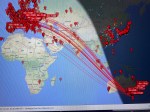
Contacts I had across to Europe

Propagation Characteristics

6 meters supports a wide range of radio propagation mechanisms:

Sporadic-E

Dense patches of ionization in the E-layer

Allows contacts hundreds to thousands of kilometers away

Most common from late spring through summer and again in winter

F-Layer / F2 Propagation

Appears during strong solar activity

Enables global, long-haul communication

Can keep the band open for long stretches

Tropospheric Enhancement

Weather-related bending in the lower atmosphere

Extends VHF-range signals over much longer distances

Meteor Scatter

Radio waves reflect off meteor trails

Excellent during meteor showers

Modern digital modes—especially MSK144—dominate this technique

Auroral Propagation

Signals scatter from auroral activity

Produces a very distinct, rough sound

Common at northern latitudes

Trans-Equatorial Propagation (TEP)

Occurs near the geomagnetic equator

Allows north–south DX paths across continents

Modes of Operation

6 meters accommodates virtually every common amateur mode

Weak-Signal & DX

SSB, CW

Digital

FT8 (primary mode for most openings)

FT4, JT65

MSK144 (meteor scatter)

FM

Simplex and repeater use in certain regions

AM

Niche but still used by some hobbyists

Equipment and Antennas

Radio

Many modern HF transceivers include the 6-meter band. Examples include:

Icom IC-7300

Yaesu FT-991A

Icom IC-705

Dedicated 6-meter rigs and transverters are also popular among weak-signal operators.

Antennas

6-meter antennas are small enough to install easily yet large enough to perform well.

Common options:

Dipoles

Verticals (good for FM)

Yagis (excellent for DX)

Moxons

Loops

End-fed half waves

Even a small Yagi can work impressive DX during an opening.

Seasonal and Solar Patterns

May–August: Prime Sporadic-E season

December–January: Smaller Es season

Active solar years: Best chances for worldwide F2 propagation

Meteor showers: Ideal for MSK144 activity

What Makes 6 Meters Appealing

Sudden, exciting band openings

Possibility of worldwide communication with small antennas

Plenty of room for experimentation

A wide variety of propagation modes

Generally less crowded than HF

The band blends scientific curiosity, operating skill, and pure luck — which is exactly why many operators love it.

Example

I love 6m when it is active. But I also love 6m when it isn’t open as a few of us use it to chat on it.

The Japanese love 6m. They seem to use it all year perhaps because they don’t need the band to be open to use it and talk across their country.

Below is a video where the band was open for a few minutes. Only a few contacts were made and I happen to be one of them.

After my contact, the bad suddenly closed, making this contact all the more special.


Other Reads

If you enjoyed this, here are some others you may enjoy also.

  • Dipole Antenna for Portable Use – Make your own!
    A dipole antenna is a basic radio antenna made of two conductive elements fed at the center. It is typically a half-wavelength long and is widely used as a…
  • Interference
    Interference in Amateur Radio refers to unwanted signals that disrupt radio communication. This interference can reduce signal clarity, make contacts difficult, or completely block communication between amateur radio operators.…
  • 6m and TV Channel 0
    Prior to 1989, it was illegal to operate between 50 MHz and 52 MHz in Australia. It was a real pain as that was where all the action was…
  • Dipole Antennas Vs Long Wire Antennas
    I’ve heard a lot about dipole antennas, and I’ve heard a lot about long wire antennas also. I would say I’ve seen more dipoles than long wire antennas. So…
  • Repeater-START
    Repeater-START is a multi-platform app designed for ham radio and radio-operator enthusiasts who need fast access to repeater information. The app provides a detailed repeater map as well as…
  • The 6-Meter Amateur Radio Band
    What Is the 6m Band? The 6-meter band, spanning roughly 50–54 MHz, is a section of the VHF spectrum assigned to amateur radio operators. Its wavelength is six meters,…
  • Anytone AT-778UV
    Overview The Anytone AT-778UV is a dual-band VHF/UHF mobile transceiver designed for amateur radio operators. It operates on the 136–174 MHz (VHF) and 400–490 MHz (UHF) bands, offering reliable…
  • 160 Meters Band
    160 meters band is known as the “Gentlemen’s band”. It is right next to the AM commercial band, known as medium wave. The 160-meter band is the radio frequencies…
  • What does this Antenna do?
    Have you ever had an antenna and forgotten what it is for? Maybe you have been given one and wasn’t told exactly what it was used for. I got…
  • Olivia Digital Mode MFSK
    Yes, this popular girl name is actually an Amateur Radio term. Christian, DK8EW, put me onto Olivia after we chatted on VARA HF. I had heard about Olivia before,…
  • Yaesu FT-620
    The Yaesu FT-620 (and its updated version, the FT-620B) is a vintage amateur radio transceiver designed specifically for the 6-meter band (50–54 MHz). Produced in the 1970s, it offers support for AM, CW, and SSB…
  • FreeDV
    I came across something different, FreeDV. The name FreeDV insinuates it is free, but is it? What is it? And what does it do? They say it will be…
  • Anytone 778UV Key Assignment
    Key Assignment For some reason, not all the key assignment options are in the manual and after a bit of searching, I found no complete list.  Hopefully this below…
  • Kenwood – did you know this?
    Everyone that has been into radio for a while will know the brand Kenwood.  And most know Kenwood isn’t only into Amateur radio, they are bigger than that, and…

DXHeat.com

DXHeat.com is a great website that can update you the current conditions on each band. The website has filtering of incoming DX Spots which can be displayed instantly using great graphical tools.

From the main landing page dxheat.com you can do a search by call sign or open DX Cluster. You can also scroll down to see more information.

Callsign Search

By typing in a call sign, you will see a lot of information instantly about that person. Some of the graphs are interesting as it shows how often the selected user does DX Spots by date, by band and what Continent they have been heard in.

It then shows what DX spots this user as submitted by time, band, and Continent.

DX Cluster

This is the best part of the website.

In the middle you can see live data. You can apply filters as required on the left side. On the right is the current UTC time and a lot of other interesting things.

On the right is a Propagation box which is helpful.

Also on the right is a Band Activity box which is great and perhaps the best part of the website.

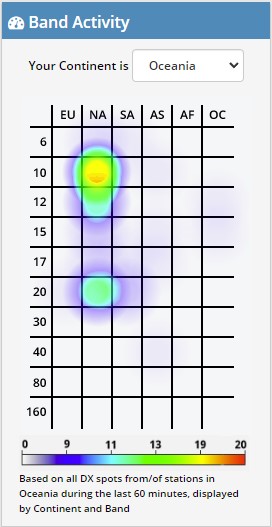
This graph is powerful and shows you instantly where the bands are open.

Select your area via the drop-down box. I have selected Oceania in the example shown. You can see the band is open on 10 metres to NA, which is North America, and slightly open to NA on 20 metres also.

10 minutes before I took this screen dump, 10 metres was in the red to North America, so it changes live. 10 minutes after this screen dump, 20 metres was in the purple meaning conditions were getting harder, however 10 metres became a solid red.

20 minute later after the above screen dump, I took the following one on the right.

Now you can see 10 metres to North America is strong, and 20 metres is not even showing anymore. 15 metres is also on the graph now potentially growing in strength.

Asia is also starting to show signs of colour on 17 metres which it wasn’t before.

While these graphs are powerful, they are limited to the amount of activity on the band. For example, if no one picks up a microphone, then there is still no one to listen to.

It is a great starting point though and displayed very well. I would love to embed this on my QRZ page if anyone knows how.

The main text in the screen, you can hover over the green boxes and filter according to that box. Up towards the top, there is a mode section on the left side with green boxes, you can filter by them also. You can filter via region and band also.

Login

At the top of the screen is a login/sign up option. I would encourage you to create an account. Simply put in your email and password, then confirm it and you will be able to update your profile. You will then have an opportunity to adjust your display DX-Cluster settings as you like.

Other websites

There are other websites that show similar information in a different format that include:

Other interesting reads:

Did you enjoy this read, below are some other interesting topics you may enjoy also:

  • Dipole Antenna for Portable Use – Make your own!
    A dipole antenna is a basic radio antenna made of two conductive elements fed at the center. It is typically a half-wavelength long and is widely used as a reference…
  • Interference
    Interference in Amateur Radio refers to unwanted signals that disrupt radio communication. This interference can reduce signal clarity, make contacts difficult, or completely block communication between amateur radio operators. Radio…
  • 6m and TV Channel 0
    Prior to 1989, it was illegal to operate between 50 MHz and 52 MHz in Australia. It was a real pain as that was where all the action was when…
  • Dipole Antennas Vs Long Wire Antennas
    I’ve heard a lot about dipole antennas, and I’ve heard a lot about long wire antennas also. I would say I’ve seen more dipoles than long wire antennas. So why…
  • Repeater-START
    Repeater-START is a multi-platform app designed for ham radio and radio-operator enthusiasts who need fast access to repeater information. The app provides a detailed repeater map as well as a…
  • The 6-Meter Amateur Radio Band
    What Is the 6m Band? The 6-meter band, spanning roughly 50–54 MHz, is a section of the VHF spectrum assigned to amateur radio operators. Its wavelength is six meters, and…
  • Anytone AT-778UV
    Overview The Anytone AT-778UV is a dual-band VHF/UHF mobile transceiver designed for amateur radio operators. It operates on the 136–174 MHz (VHF) and 400–490 MHz (UHF) bands, offering reliable two-way…
  • 160 Meters Band
    160 meters band is known as the “Gentlemen’s band”. It is right next to the AM commercial band, known as medium wave. The 160-meter band is the radio frequencies between…
  • What does this Antenna do?
    Have you ever had an antenna and forgotten what it is for? Maybe you have been given one and wasn’t told exactly what it was used for. I got given…
  • Olivia Digital Mode MFSK
    Yes, this popular girl name is actually an Amateur Radio term. Christian, DK8EW, put me onto Olivia after we chatted on VARA HF. I had heard about Olivia before, but…