OpenHamClock is an open-source amateur radio dashboard designed as a modern successor to the original HamClock used by radio amateurs worldwide. It provides a real-time visual display of essential ham radio propagation data, world clocks, DX activity, and space weather information in a single, easy-to-read interface. Built with modern web technology, OpenHamClock runs in any web browser and adapts to screens ranging from small Raspberry Pi displays to large 4K shack monitors.
The project is community-driven and open source, allowing amateur radio operators to contribute features, host their own instance, or customise the display. Unlike the original HamClock, which relied on specific servers and hardware constraints, OpenHamClock is designed to be flexible, future-proof, and not dependent on a single data source. This ensures long-term reliability for hams who rely on propagation and solar data for HF operation.
OpenHamClock includes many features familiar to HamClock users, such as a world map with day/night grey line, UTC and local time zones, and real-time solar indices like solar flux, sunspot numbers, and geomagnetic activity. It also displays DX Cluster spots, satellite tracking, and propagation modelling directly on the map, helping operators quickly identify openings on the HF bands.
Because it is web-based, OpenHamClock can be used instantly in a browser or installed locally on devices such as a Raspberry Pi, desktop computer, or via Docker for advanced users. This makes it ideal as a permanent ham shack display or a portable dashboard accessible from anywhere.
OpenHamClock continues the legacy of the original HamClock created by Elwood Downey, WB0OEW, ensuring that amateur radio operators still have access to a powerful propagation monitoring tool, DX spotting map, and space weather dashboard long after the original service ends.
Don’t forget to see my video on this:
If you enjoyed this read, here are some more things you may enjoy:
HF radio and lightning storms are closely connected because lightning creates strong radio frequency interference that affects HF radio communication (3–30 MHz). High Frequency radio is commonly used for amateur radio (ham radio), marine radio, aviation HF communication, emergency communications, and long-distance…
OpenHamClock is an open-source amateur radio dashboard designed as a modern successor to the original HamClock used by radio amateurs worldwide. It provides a real-time visual display of essential ham radio propagation data, world clocks, DX activity, and space weather information in…
An antenna coupler (also called an antenna tuner or matching network) is a device used in radio systems to ensure impedance matching between a transmitter and an antenna. Most transmitters are designed for a specific impedance, commonly 50 ohms, while antennas often…
Amateur radio operators use many different antenna types, each designed for specific bands, space limits, and operating goals. Here’s a clear overview of the most common ones and why hams choose them. Wire Antennas These are some of the simplest and most…
A dipole antenna is a basic radio antenna made of two conductive elements fed at the center. It is typically a half-wavelength long and is widely used as a reference antenna in antenna theory and practice. Dipole antennas work by converting alternating…
Interference in Amateur Radio refers to unwanted signals that disrupt radio communication. This interference can reduce signal clarity, make contacts difficult, or completely block communication between amateur radio operators. Radio Frequency Interference (RFI) is one of the most common problems in amateur…
Prior to 1989, it was illegal to operate between 50 MHz and 52 MHz in Australia. It was a real pain as that was where all the action was when the band opened up. However, after many requests from the WIA to…
I’ve heard a lot about dipole antennas, and I’ve heard a lot about long wire antennas also. I would say I’ve seen more dipoles than long wire antennas. So why is that? What is the difference between them? Which is better? If…
What Is the 6m Band? The 6-meter band, spanning roughly 50–54 MHz, is a section of the VHF spectrum assigned to amateur radio operators. Its wavelength is six meters, and its position between HF and VHF makes it behave like a mix…
160 meters band is known as the “Gentlemen’s band”. It is right next to the AM commercial band, known as medium wave. The 160-meter band is the radio frequencies between 1.8 and 2 MHz. For many decades it was the lowest radio…
Yes, this popular girl name is actually an Amateur Radio term. Christian, DK8EW, put me onto Olivia after we chatted on VARA HF. I had heard about Olivia before, but he encouraged me to give it ago. Soon I made contact with…
I bought this wireless keyboard/mouse which was very cheap. It does come with a USB dongle. It has a fantastic range since it is 2.4GHz RF. The back also has good grip which apparently isn’t common on all models. You can select what colour you want the plastic to be also.
Setup
Setup couldn’t be easier. Make sure it has batteries installed, some come with a rechargeable, mine required triple A batteries. Make sure the switch on the top side of the keyboard it to the left position for it to turn on – it should light up when you do this. Then in the battery compartment will be the USB dongle. Just plug in the USB dongle before powering up (if it is into an Android box), then it will connect and work fine straight away. If your model came with the battery, there may be a cord to charge the unit also.
Touch Pad
The top part of the keyboard in the touch pad area controls your mouse position. Using two fingers will scroll up and down the scroll bars. Unfortunately two finger zooming does not work. Right click can be done by a simultaneous two finger tap. You can turn the touch pad on or off by pressing Fn + F8.
Changing the Touch Pad Tracking Speed
All you have to do is press the blue Fn (function) button down the bottom left corner, then press the space bar.
Shortcuts
The keyboard comes with the following shortcuts at the top of the keyboard.
Far left Shortcuts
Over the far left side are media buttons, including volume up and down, pause and play, next track
Middle shortcuts
Either side of the touch pad are shortcuts, then are the following from top to bottom in order
Left Side of Touch Pad
Right Side of Touch Pad
1. Open Music Player App
1. Open Google Search
2. Open Email App
2. Go home button
3. Mute button
3. Internet Browser
4. Mouse left button ( this is also on the far left of the letters below on the top)
4. Mouse right button (this is also on the far left of the letters below on the bottom)
Far right Shortcuts
Over the right side at the top are directional buttons with an OK button in the middle.
Sleep Mode
The Keyboard will auto sleep and wake-up to save the battery. When the keyboard is idle for 3 minutes, it will go into auto sleep mode, and all LED indicators will turn off.
Keyboard Glowing Colours
Some keyboards glow at night. Unfortunately mine foes not, but if yours does, you just press blue the Fn key down the bottom left and the F2 key to change the colours. Press Fn-F2 again to change to the next colour and so on. This will give you the three standard colours. However, if your feeling nerdy, you can press and hold down the Fn key, then using your thumb on the touch pad, move it left and right to get all the other colours. There are 7 different colours in total.
If you want to be a geek of all the nerds, you can do the RGB spectrum, but pressing and holding F2 and then scrolling your thumb across left to right on the touch pad, then let go. It will scroll through all the colours automatically. You can still use the touch pad as normal while it automatically changes colours. I guess not having this saves some power also, however it does turn off every 30 or so seconds. There is a switch up the top right on the side of the keyboard that will turn it off also.
Fuction Keys
Apart from what I have already mentioned, you can do the following functions using the blue function key (Fn) found down the bottom left corner.
Fn + Fn = Enter into pair mode
Fn + F7 = take a screen shot
Fn + F8 = turn on or off the touch pad
Fn + F9 = F11 key
Fn + F10 = F12 key
Fn + Back = Delete
Fn + Page Up = Home
Other Keyboards
Here is a review on several other keyboards of similar size. This is not my video, but thought it gave a good quick overview of several models available.
Conclusion
The size of the keyboard is just right, not to small so you can’t find it or use it easily, but not to big so it takes over the desk or armchair. It works well with my Android TV device, but understand it does work on other devices such as windows, Raspberry Pi etc.
If I was going to buy it again, I may get the one with the inbuilt battery installed that can be re-charged, however once the batter goes, you almost have to replace it. My model could be loaded up with rechargeable batteries you can buy from anywhere.
Before I was using this Keyboard, I used a USB mouse, and while in some ways that is easier than a touch pad, to have a full keyboard and the touch pad all cordless with a good range is fantastic.
Other things to read
Enjoyed the read, why not subscribe to this site. Here are some other interesting reads:
An unusual name, but a catchy name no less, just like Peanut that was written by the same person, David PA7LIM. If you like Peanut, then you will like this project also. This project, like Peanut, includes some amazing coding and thinking.…
I found it hard to find useful information on how to run the OpenGD-77 hotpot mode with Windows 10. At the time of writing this, there is a lot about this topic using a pistar and even android or ISO, but not much with Windows 10. This is my experence with BlueDV and Open GD-77 using a Windows 10 PC.…
This page is just a help to friends I have spoke to who are interested in upgrading the Radioditty GD-77 to the OpenGD77 software. This is not my work, however I really do appreciate Roger and his team have done to put this together. I claim no responsibility if it breaks your radio, however I have not hear this happen now in some time. I am not an expert at all with OpenGD77, I have just put this together to help people who have asked me how to do it.…
A good friend of mine, Mike VK5ZC, put the information below together and asked me to put it on my web site. He has spent a lot of time putting it together with pictures and videos, so I encourage you to have a good read.…
A good friend of mine, Mike VK5ZC, put the information below together and asked me to put it on my web site. He has spent a lot of time putting it together with pictures and videos, so I encourage you to have a good read.…
I recently started using ProScan after years of using FreeScan. I have always enjoyed using FreeScan as it is easy to setup, I can download outputs from the software, and the main reason “it works”. However ProScan seems to be more graphical and has different features also.…
I recently started using ProScan after years of using FreeScan. I have always enjoyed using FreeScan as it is easy to setup, I can download outputs from the software, and the main reason “it works”. However ProScan seems to be more graphical and has different features also.…
I bought this wireless keyboard/mouse which was very cheap. It does not come with batteries, but come with a USB dongle. It has a fantastic range since it is 2.4GHz RF. The back also has good grip which apparently isn’t common on all models. You can select what colour you want the plastic to be also.…


 HF radio and lightning storms are closely connected because lightning creates strong radio frequency interference that affects HF radio communication (3–30 MHz). High Frequency radio is commonly used for amateur radio (ham radio), marine radio, aviation HF communication, emergency communications, and long-distance…
 OpenHamClock is an open-source amateur radio dashboard designed as a modern successor to the original HamClock used by radio amateurs worldwide. It provides a real-time visual display of essential ham radio propagation data, world clocks, DX activity, and space weather information in…
 An antenna coupler (also called an antenna tuner or matching network) is a device used in radio systems to ensure impedance matching between a transmitter and an antenna. Most transmitters are designed for a specific impedance, commonly 50 ohms, while antennas often…
 Amateur radio operators use many different antenna types, each designed for specific bands, space limits, and operating goals. Here’s a clear overview of the most common ones and why hams choose them. Wire Antennas These are some of the simplest and most…
 A dipole antenna is a basic radio antenna made of two conductive elements fed at the center. It is typically a half-wavelength long and is widely used as a reference antenna in antenna theory and practice. Dipole antennas work by converting alternating…
 Interference in Amateur Radio refers to unwanted signals that disrupt radio communication. This interference can reduce signal clarity, make contacts difficult, or completely block communication between amateur radio operators. Radio Frequency Interference (RFI) is one of the most common problems in amateur…
 Prior to 1989, it was illegal to operate between 50 MHz and 52 MHz in Australia. It was a real pain as that was where all the action was when the band opened up. However, after many requests from the WIA to…
 I’ve heard a lot about dipole antennas, and I’ve heard a lot about long wire antennas also. I would say I’ve seen more dipoles than long wire antennas. So why is that? What is the difference between them? Which is better? If…
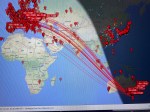 What Is the 6m Band? The 6-meter band, spanning roughly 50–54 MHz, is a section of the VHF spectrum assigned to amateur radio operators. Its wavelength is six meters, and its position between HF and VHF makes it behave like a mix…
 Yes, this popular girl name is actually an Amateur Radio term. Christian, DK8EW, put me onto Olivia after we chatted on VARA HF. I had heard about Olivia before, but he encouraged me to give it ago. Soon I made contact with…




















 VK3TBS