
What Is the 6m Band?
The 6-meter band, spanning roughly 50–54 MHz, is a section of the VHF spectrum assigned to amateur radio operators.
Its wavelength is six meters, and its position between HF and VHF makes it behave like a mix of both services.
Why It’s Called the “Magic Band”
6 meters has an almost unpredictable personality.
Sometimes it acts like a local VHF band; other times it opens up suddenly and supports long-distance DX like HF.
Because of these rapid and surprising changes, operators refer to it as the Magic Band.

Propagation Characteristics
6 meters supports a wide range of radio propagation mechanisms:
Sporadic-E
Dense patches of ionization in the E-layer
Allows contacts hundreds to thousands of kilometers away
Most common from late spring through summer and again in winter
F-Layer / F2 Propagation
Appears during strong solar activity
Enables global, long-haul communication
Can keep the band open for long stretches
Tropospheric Enhancement
Weather-related bending in the lower atmosphere
Extends VHF-range signals over much longer distances
Meteor Scatter
Radio waves reflect off meteor trails
Excellent during meteor showers
Modern digital modes—especially MSK144—dominate this technique
Auroral Propagation
Signals scatter from auroral activity
Produces a very distinct, rough sound
Common at northern latitudes
Trans-Equatorial Propagation (TEP)
Occurs near the geomagnetic equator
Allows north–south DX paths across continents
Modes of Operation
6 meters accommodates virtually every common amateur mode
Weak-Signal & DX
SSB, CW
Digital
FT8 (primary mode for most openings)
FT4, JT65
MSK144 (meteor scatter)
FM
Simplex and repeater use in certain regions
AM
Niche but still used by some hobbyists
Equipment and Antennas
Radio
Many modern HF transceivers include the 6-meter band. Examples include:
Icom IC-7300
Yaesu FT-991A
Icom IC-705
Dedicated 6-meter rigs and transverters are also popular among weak-signal operators.
Antennas
6-meter antennas are small enough to install easily yet large enough to perform well.
Common options:
Dipoles
Verticals (good for FM)
Yagis (excellent for DX)
Moxons
Loops
End-fed half waves
Even a small Yagi can work impressive DX during an opening.
Seasonal and Solar Patterns
May–August: Prime Sporadic-E season
December–January: Smaller Es season
Active solar years: Best chances for worldwide F2 propagation
Meteor showers: Ideal for MSK144 activity
What Makes 6 Meters Appealing
Sudden, exciting band openings
Possibility of worldwide communication with small antennas
Plenty of room for experimentation
A wide variety of propagation modes
Generally less crowded than HF
The band blends scientific curiosity, operating skill, and pure luck — which is exactly why many operators love it.
Example
I love 6m when it is active. But I also love 6m when it isn’t open as a few of us use it to chat on it.
The Japanese love 6m. They seem to use it all year perhaps because they don’t need the band to be open to use it and talk across their country.
Below is a video where the band was open for a few minutes. Only a few contacts were made and I happen to be one of them.
After my contact, the bad suddenly closed, making this contact all the more special.
Other Reads
If you enjoyed this, here are some others you may enjoy also.
- Amateur TV
 Amateur Radio Television (ATV), often called “ham TV,” is a niche part of amateur television where licensed radio operators transmit live video and audio over radio frequencies instead of…
 - Baofeng UV-5R Mini
 The Baofeng UV-5R Mini handheld radio is a popular and affordable dual-band amateur radio transceiver widely used by beginners and experienced ham radio operators. Designed as a compact version…
 - Lightning Storm & HF Radio
 HF radio and lightning storms are closely connected because lightning creates strong radio frequency interference that affects HF radio communication (3–30 MHz). High Frequency radio is commonly used for…
 - OpenHamClock
 OpenHamClock is an open-source amateur radio dashboard designed as a modern successor to the original HamClock used by radio amateurs worldwide. It provides a real-time visual display of essential…
 - Radtel P8 PoC radio
 The Radtel P8 PoC radio is a Push-to-Talk over Cellular (PoC) device that looks like a traditional walkie-talkie but communicates using 4G/LTE mobile networks instead of UHF/VHF radio frequencies.…
 - What is an Antenna Coupler
 An antenna coupler (also called an antenna tuner or matching network) is a device used in radio systems to ensure impedance matching between a transmitter and an antenna. Most…
 - Antennas
 Amateur radio operators use many different antenna types, each designed for specific bands, space limits, and operating goals. Here’s a clear overview of the most common ones and why…
 - Dipole Antenna for Portable Use – Make your own!
 A dipole antenna is a basic radio antenna made of two conductive elements fed at the center. It is typically a half-wavelength long and is widely used as a…
 - Interference
 Interference in Amateur Radio refers to unwanted signals that disrupt radio communication. This interference can reduce signal clarity, make contacts difficult, or completely block communication between amateur radio operators.…
 - 6m and TV Channel 0
 Prior to 1989, it was illegal to operate between 50 MHz and 52 MHz in Australia. It was a real pain as that was where all the action was…
 - Dipole Antennas Vs Long Wire Antennas
 I’ve heard a lot about dipole antennas, and I’ve heard a lot about long wire antennas also. I would say I’ve seen more dipoles than long wire antennas. So…
 - Repeater-START
 Repeater-START is a multi-platform app designed for ham radio and radio-operator enthusiasts who need fast access to repeater information. The app provides a detailed repeater map as well as…
 - The 6-Meter Amateur Radio Band
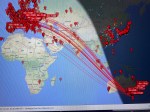 What Is the 6m Band? The 6-meter band, spanning roughly 50–54 MHz, is a section of the VHF spectrum assigned to amateur radio operators. Its wavelength is six meters,…
 - Anytone AT-778UV
 Overview The Anytone AT-778UV is a dual-band VHF/UHF mobile transceiver designed for amateur radio operators. It operates on the 136–174 MHz (VHF) and 400–490 MHz (UHF) bands, offering reliable…
 VK3TBS