
The S-meter is an instrument on most radio receivers that measures the strength of the signal being received. It uses a unit: the S-point. HF radios usually have a needle scale, whereas other bands often have LEDs displaying the S-Points.
S-Points is the common method of measuring signal strength between operators, however many programs like WSJTX use dB. So how do you convert between dB and S?
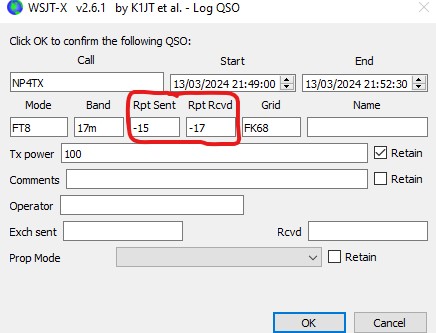
S-points go from S1 to S9, and each S-point is defined as a 6 dB change in signal strength. Therefore, each time the voltage is halved (–6 dB) the signal strength decreases by one point. S9 is already a very strong signal, but to describe larger signals, steps of 10 dB are used instead of 6 dB, noted “S9+20” meaning 20 dB above S9.
S-points for frequencies below 30 MHz
| Signal strength | Relative intensity |
| S1 | –48 dB |
| S2 | –42 dB |
| S3 | –36 dB |
| S4 | –30 dB |
| S5 | –24 dB |
| S6 | –18 dB |
| S7 | –12 dB |
| S8 | –6 dB |
| S9 | 0 dB |
| S9+10 | 10 dB |
| S9+20 | 20 dB |
| S9+30 | 30 dB |
| S9+40 | 40 dB |
| S9+50 | 50 dB |
| S9+60 | 60 dB |
S-points for frequencies above 30 MHz:
| Signal strength | Relative intensity |
| S1 | –48 dB |
| S2 | –42 dB |
| S3 | –36 dB |
| S4 | –30 dB |
| S5 | –24 dB |
| S6 | –18 dB |
| S7 | –12 dB |
| S8 | –6 dB |
| S9 | 0 dB |
| S9+10 | 10 dB |
| S9+20 | 20 dB |
| S9+30 | 30 dB |
| S9+40 | 40 dB |
| S9+50 | 50 dB |
| S9+60 | 60 dB |
Hopefully, this helps answer the question how to convert a dB signal strength to a S1 to S9 signal strength.
If you enjoyed this read, there are some others below you may enjoy. Please put your email address in the subscribe area if you want to keep updated with all the updates.
- Amateur TV
 Amateur Radio Television (ATV), often called “ham TV,” is a niche part of amateur television where licensed radio operators transmit live video and audio over radio frequencies instead of traditional…
 - Baofeng UV-5R Mini
 The Baofeng UV-5R Mini handheld radio is a popular and affordable dual-band amateur radio transceiver widely used by beginners and experienced ham radio operators. Designed as a compact version of…
 - Lightning Storm & HF Radio
 HF radio and lightning storms are closely connected because lightning creates strong radio frequency interference that affects HF radio communication (3–30 MHz). High Frequency radio is commonly used for amateur…
 - OpenHamClock
 OpenHamClock is an open-source amateur radio dashboard designed as a modern successor to the original HamClock used by radio amateurs worldwide. It provides a real-time visual display of essential ham…
 - Radtel P8 PoC radio
 The Radtel P8 PoC radio is a Push-to-Talk over Cellular (PoC) device that looks like a traditional walkie-talkie but communicates using 4G/LTE mobile networks instead of UHF/VHF radio frequencies. This…
 - What is an Antenna Coupler
 An antenna coupler (also called an antenna tuner or matching network) is a device used in radio systems to ensure impedance matching between a transmitter and an antenna. Most transmitters…
 - Antennas
 Amateur radio operators use many different antenna types, each designed for specific bands, space limits, and operating goals. Here’s a clear overview of the most common ones and why hams…
 - Dipole Antenna for Portable Use – Make your own!
 A dipole antenna is a basic radio antenna made of two conductive elements fed at the center. It is typically a half-wavelength long and is widely used as a reference…
 VK3TBS